✴ The Firma Architecture · ComponentsAR_01
Realm
A Realm is the living personal edge domain through which a person or household participates in the greater network.
Realm
A Realm is the living personal edge domain through which a person or household participates in the Settlemint stack and the greater network.
That is the component definition. The conceptual introduction lives in The Architecture of Place; this page describes the component itself.
The place of Realm in the wider architecture is fixed by three lines:
Realms are the living edge nodes of the people.
Settlemints are the embodied places they make operable.
Network states are the political communities they may compose.
The fullest current definition:
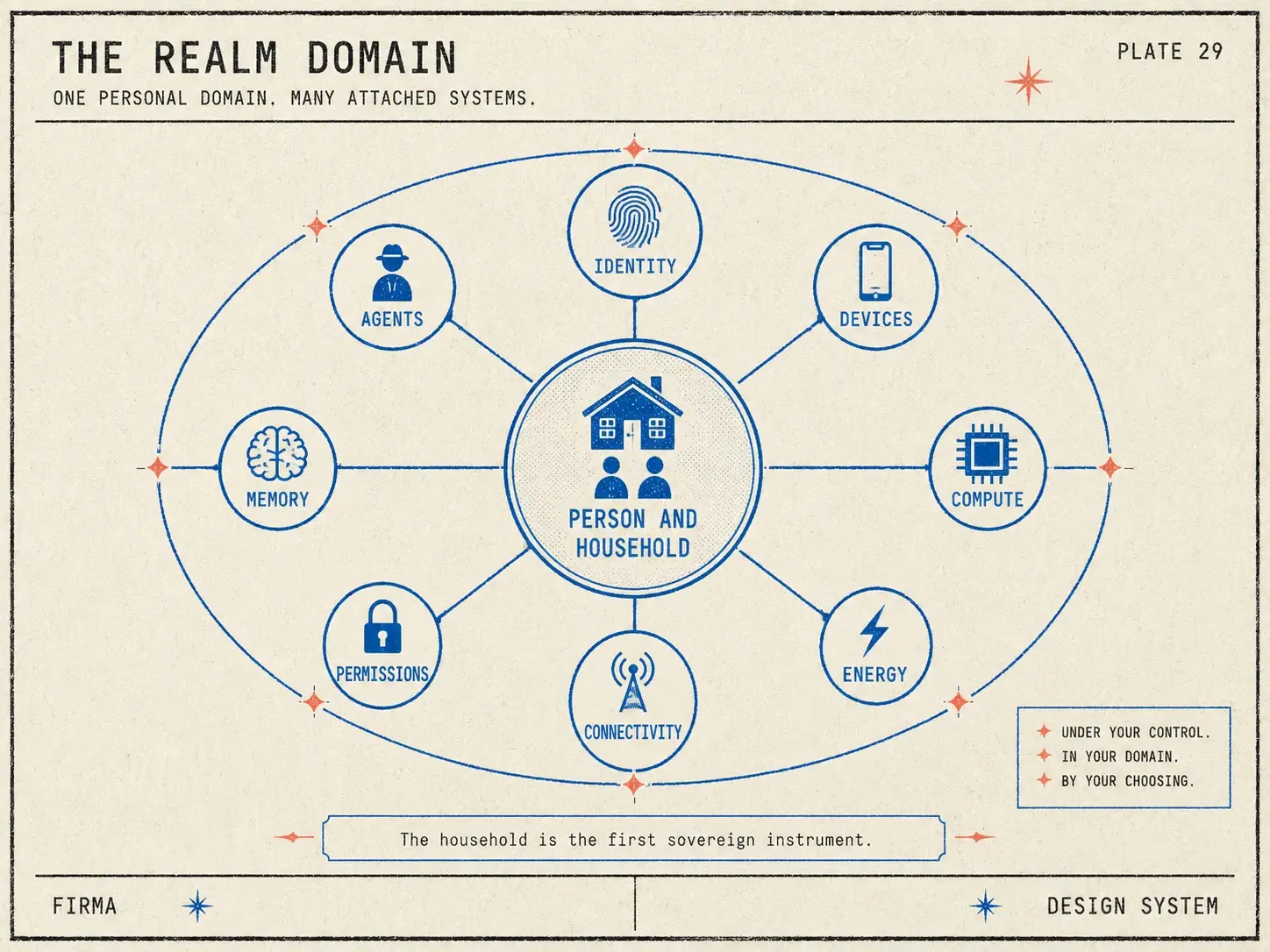
A Realm is the living personal edge domain through which a person or household participates in the Settlemint stack and the greater network. It is made real through the devices, agents, identity, compute, energy, connectivity, resources, intelligence, contribution history, and ownership under their stewardship. A Realm can connect with other Realms, contribute useful excess to the commons, carry personal AI and context, extend the physical reach of the greater whole, and create the conditions from which emergent shared capabilities and breakthroughs become possible.
Short form:
Your Realm is your dominion within the network.
Simplest form:
Your Realm is your part of the whole.
The word dominion is used carefully. It does not mean isolated supremacy over others. It means the sphere of responsibility, capability, participation, and stewardship that is genuinely yours.
The problem Realm solves
A person may participate in the greater system through devices, connectivity, compute, energy, identity, agents, AI inference, contribution, ownership, reputation, mobility, and physical presence. Without Realm, these risk becoming a pile of separate products, accounts, apps, wallets, nodes, devices, and data trails.
Realm answers a different question:
What is the persistent personal domain that unifies a person's or household's participation in the greater whole?
What a Realm is not
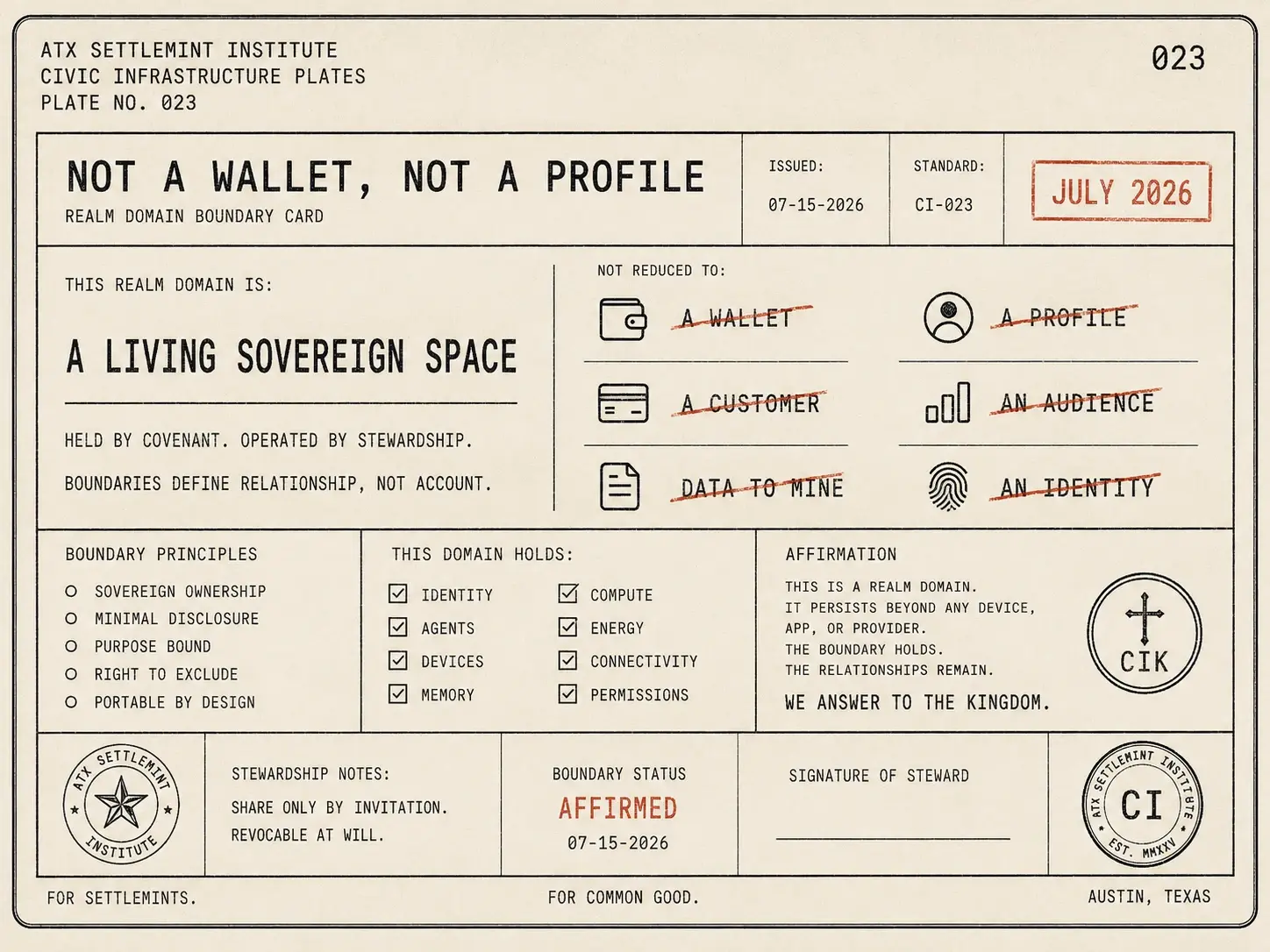
A Realm is not merely an account, a wallet, a profile, a login, an identity record, a reputation score, an AI assistant, a social graph, a home router, an edge box, or a product bundle. Those may all exist inside or through the Realm.
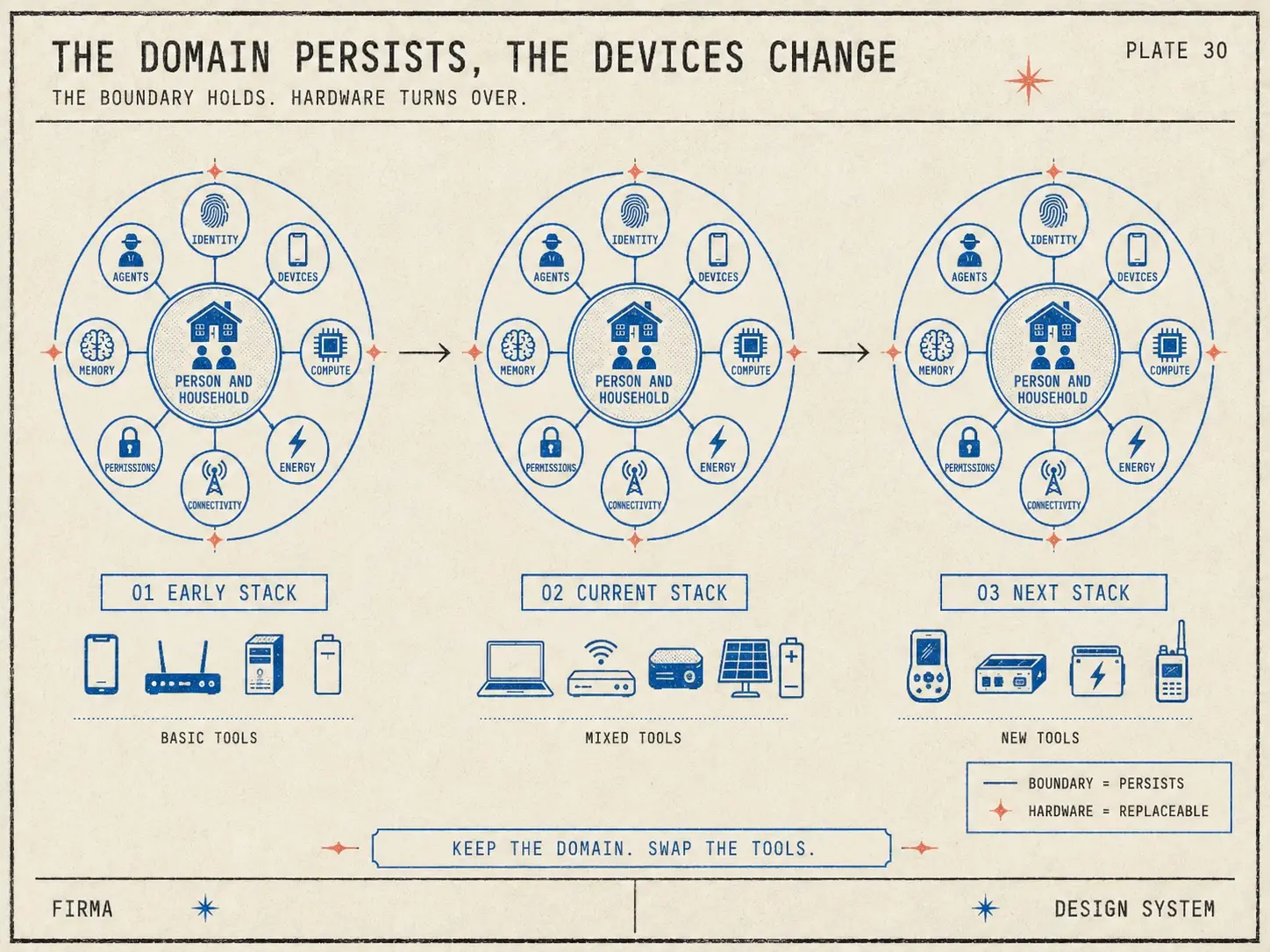
A phone can be replaced. A vehicle can change. A home node can be upgraded. A satellite connection can be swapped. The Realm persists because it is the continuing personal domain of identity, devices, agents, permissions, memory, contribution, ownership, relationships, intelligence, and physical presence.
One Realm may be expressed through many devices. The devices can change. The Realm persists.
The Realm preserves the person or household as a stewarded domain rather than reducing them to a user record inside a platform.
The domain and the products
The Realm is the domain. The products make it real.
Realm the component is an architectural category. The following are possible product expressions of that category, not substitutes for it. Product names remain provisional.
Realm Node — proposed. The persistent home or place-based edge node. It may eventually provide some combination of local compute, connectivity, AI inference, mesh participation, network routing, storage, agent operation, contribution measurement, or other household edge functions.
Realm Mobile — proposed. The personal mobile expression of a Realm. It moves with the person and may include phone, portable compute, mobile AI, connectivity, identity continuity, permissions, location-aware services, and contribution to the greater mesh.
Realm Link — proposed. The connectivity expression of a Realm. Its function is not merely internet access: it helps connect the personal Realm into wider communications infrastructure and, where architecture permits, into the greater mesh.
Possible future expressions — vehicle, tag, energy, compute, and other devices — remain concept only. Their names are not canonized.
In the current organizational architecture, Realm appears as a platform within Firma Edge, an operating company of Firma Labs (Realm → Firma Edge → Firma Labs). That platform is a product expression of the Realm domain; the domain itself is the canonical category.
What Realm connects the person to
A Realm connects the person or household outward without dissolving them into the systems they touch.
- To the Settlemint stack and the greater network. The Realm is the personal edge through which participation happens.
- To the settlement. A Realm may contribute compute, connectivity, energy, identity, memory, or economic activity to a Settlemint. But the distinction remains: The Realm belongs to the person or household. The Settlemint belongs to the shared life of the place.
- To the shared substrate. Firmamint may give the Realm a way to persist across devices, remember contribution, coordinate agents, prove participation, access shared compute, exchange value, and interoperate with other Realms. The Realm remains the person's domain; the substrate helps that domain participate in the larger whole. Proposed — how Realm interacts with Firmamint at the protocol level remains open.
- To organizational intelligence, at arm's length. Realm belongs to the individual. THEOS, the agentic operating system, is designed to interact with Realm. THEOS does not own Realm.
Realm began as the personal form of the Omnimesh idea: the older network idea was roughly that nodes connect and extend the network. Realm changes the unit.
Every person or household can possess a living edge domain made real by nodes that move, compute, connect, contribute, earn, and carry intelligence with them.
Realm is therefore not merely mesh infrastructure. It is personalized mesh participation.
Personal AI belongs inside Realm
Proposed. A person's AI should not have to exist only as a remote profile inside a centralized provider's cloud. Where practical, Realm should enable personal intelligence to remain close to the person or household through local or edge inference, trusted personal devices, private context, personal memory, permissions controlled by the Realm, agent operation, and selective access to shared compute when needed.
Your AI should be rooted in your Realm, even when it reaches beyond it for greater compute or shared intelligence.
This can create a safer architecture for personal AI because the individual Realm can become the primary trust boundary for highly personal context. The exact technical security model remains to be defined; no privacy or security guarantees are claimed until architecture proves them.
Realm at the edge
A Realm is a contributor, not merely a consumer. It may contribute compute, bandwidth, storage, energy, sensing, mobility, local presence, labor, capital, trust, reputation, or other productive resources. Proposed.
The individual gives useful excess to the commons. The commons makes every Realm less fragile and more capable.
That is different from pure self-sufficiency and different from centralized extraction.
Contribution must have memory. A Realm's contribution should not disappear into the commons without record. Proposed — the specific recording mechanisms remain provisional until separately defined, but the principle stands:
Contribution should create durable memory, accountability, and fair participation.
And the working thesis on ownership:
A person's participation in the greater whole should be legible through the contribution of their Realm.
A Realm is personal, but not isolationist. Its strength comes partly from connecting with others:
My Realm protects my domain.
Our Realms protect the commons.
The commons makes every Realm stronger.
From many cooperating Realms, shared capabilities may emerge — sovereign communications, resilient routing, local compute capacity, distributed sensing, energy coordination, emergency fallback, greater geographic reach, and shared protection. Sovereign communications as a shared capability is concept: architectural direction, not a deployed technical claim.
The network belongs nowhere because parts of it live everywhere its people do.
Realms also extend the boundaries of the greater network. Concept.
Every active Realm can extend the physical reach of the network.
A Realm at home extends it there. A mobile Realm moves with the person. A Realm in a vehicle extends reach through movement. A Realm carrying compute or communications can bring capability to places where the greater system had no presence before.

Realms create the conditions for emergence
Concept. This is a core Realm principle:
Realms do not merely participate in emergence. Realms create the conditions from which emergence becomes possible.
One Realm contributes one set of capabilities; another contributes different capabilities. As more Realms connect, share useful excess, carry intelligence, provide compute, extend communications, contribute energy, and create physical presence, the result is not merely additive. New capabilities can appear that no single Realm could produce alone. The architecture should leave room for outcomes that were not centrally designed in advance.
Realms are catalysts for breakthrough.
The formula:
Realm → connection → contribution → interaction → emergence → breakthrough.
The individual Realm gives part of its excess to the whole. The whole gives every Realm capabilities no individual could independently maintain. That reciprocity is the engine.
What remains open
These are design questions, not holes in the concept:
- exact Realm hardware architecture,
- exact local AI model and inference architecture,
- security and privacy guarantees,
- how Realm identity works,
- whether a Realm belongs to the person, the household, or both by default,
- how shared family Realms work,
- how permissions move between devices,
- how Realm-to-Realm trust works,
- how mesh routing works,
- how contribution is rewarded,
- whether agents directly compensate Realm owners,
- how mobile Realms extend jurisdiction versus only network reach,
- and how Realm interacts with Firmamint at the protocol level.
Per the governing rule of this volume: The function is canonical. The implementation is provisional.
Related: Firmamint · The Architecture of Place
✴ Last updated · Tue Jul 21 2026 00:00:00 GMT+0000 (Coordinated Universal Time)