✴ Part IV — In PracticeCH_10
ATX: A Settlemint in Formation
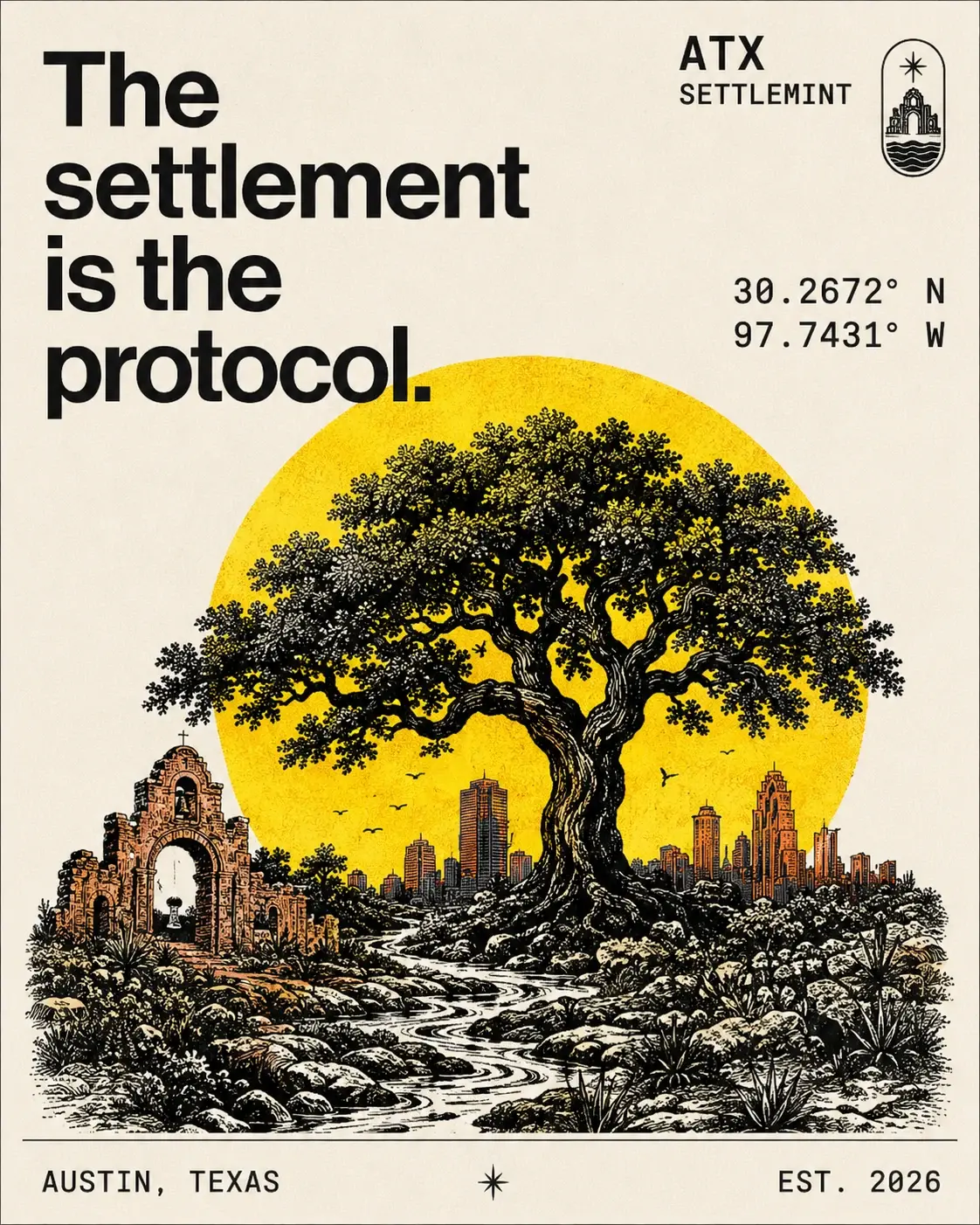
ATX is a genesis Settlemint in formation: a real place where the framework must prove itself through lived human function.
ATX is a Settlemint in formation: a real place where the framework must prove itself through lived human function.
ATX is not presented as a finished model, sovereign city, mature District, or completed Settlemint stack. It is the first serious attempt to apply the ideas in this guide to real land, real people, real constraints, and real responsibility.
The purpose is not to make ATX look complete. The purpose is to turn essential functions into reliable institutions, record what works, expose what fails, and produce knowledge that other communities can use.
The concise answer
ATX is a genesis Settlemint in formation in Austin, Texas.
It brings together:
- people,
- land,
- worship,
- community,
- stewardship,
- infrastructure,
- productive work,
- training,
- hospitality,
- and mission.
Its value will not be proven by terminology or branding. It will be proven by whether people can increasingly live, build, worship, govern, produce, care, coordinate, and endure there.
Why ATX exists
ATX exists to become a living demonstration of what a Settlemint can become when human, spiritual, ecological, economic, institutional, and technical systems are developed in one coordinated place.
It is not merely:
- a property restoration project,
- a retreat center,
- a church campus,
- a technology deployment,
- a farm,
- a company site,
- or a political simulation.
It may contain aspects of all of these. The larger category is a functioning human settlement organized around a shared purpose.
What already exists
ATX did not begin with software or a token. It began with people and place.
Existing assets include:
- real land,
- existing buildings and infrastructure,
- relationships,
- shared Christian mission,
- spiritual leadership,
- builders and operators,
- access to capital,
- institutional partnerships,
- long-term commitment,
- and willingness to test the framework publicly.
These are meaningful inputs. They are not yet proof of a mature Settlemint.
Infrastructure can be purchased. Trust, shared purpose, and institutional memory must be cultivated.
The governing purpose
The vision for CIK ATX Settlemint is:
To cultivate a living demonstration of the Kingdom of God where the presence of Jesus shapes the way people live, land is restored, resources are stewarded, community is formed, and sons and daughters are sent into the earth carrying the life and government of the Lamb.
Its mission is to restore people, place, and purpose through a Christ-centered community rooted in worship, apostolic family, regenerative stewardship, resilient infrastructure, practical training, and mission.
This covenantal identity is specific to ATX and the Nation of Heaven vision. It is not a universal requirement for every settlement to qualify as a Settlemint.
What ATX is trying to become
ATX is intended to become a place where people can:
- live and belong,
- worship and receive formation,
- restore and steward land,
- coordinate real work,
- host leaders and communities,
- learn practical skills,
- govern defined common matters,
- produce goods and services,
- care for people in difficulty,
- build resilient infrastructure,
- prepare for deployment,
- and document repeatable knowledge.
Technology should support these functions. It should not become the center of the place.
The first systems
ATX should build one functioning system at a time rather than claiming the entire Settlemint stack already exists.
Community rhythms
The community needs recurring patterns of worship, meals, work, rest, decision-making, hospitality, and formation.
Property stewardship
The land and buildings require restoration, maintenance, prioritization, budgeting, ownership clarity, and accountable operating responsibility.
Worship and formation
Prayer, worship, sacramental life, discipleship, and spiritual formation should remain central rather than becoming decorative branding around a development project.
Hospitality
The site should develop a reliable capacity to host leaders, teams, retreats, training, and aligned communities without depending on constant improvisation.
Regenerative land systems
Agriculture, soil restoration, water stewardship, landscaping, food production, and ecological care should develop according to the actual capabilities and climate of the site.
Training and deployment
CIK Equip and related programs can turn the property into a training ground where people are formed spiritually and practically for real service and deployment.
Governance
ATX needs clear decision rights, stewardship roles, accountability, conflict resolution, financial controls, and a process for correcting failed decisions.
Economic coordination
The community should develop real productive activity, transparent resource flows, work systems, treasury practices, and repeatable economic loops.
Infrastructure resilience
Communications, energy, water, compute, housing, safety, transportation, and logistics should become more reliable and less dependent on single points of failure.
Institutional memory
ATX should remember who contributed, what was decided, what was spent, what was built, what failed, and what obligations remain.
Governance in formation
ATX should not simulate statehood or use sophisticated governance language before basic operating authority is clear.
The first governance questions are practical:
- Who is responsible for which domain?
- Who can approve spending?
- Who can commit the community?
- Who maintains the property?
- How are work priorities selected?
- How are decisions recorded?
- How are disagreements resolved?
- How is poor leadership corrected?
- Which decisions belong to the property owner, ministry leadership, operators, residents, or partners?
Governance begins when decision rights, obligations, and accountability become clear enough to practice repeatedly.
ATX currently has leadership and relationships. Mature governance remains to be proved.
Economic activity
A durable Settlemint cannot depend indefinitely on unstructured generosity or one benefactor's liquidity.
ATX should develop productive functions that serve its mission and contribute to operating sustainability.
Potential areas include:
- hospitality and retreats,
- training programs,
- regenerative agriculture,
- restoration and construction capabilities,
- fabrication and workshops,
- deployment support,
- aligned events,
- energy or compute infrastructure,
- and shared services for partner communities.
Revenue is not the purpose of ATX. Economic durability is necessary if the place is to continue serving its purpose.
Subsidy can begin a system. Only repeated productive function can prove that it endures.
Technology at ATX
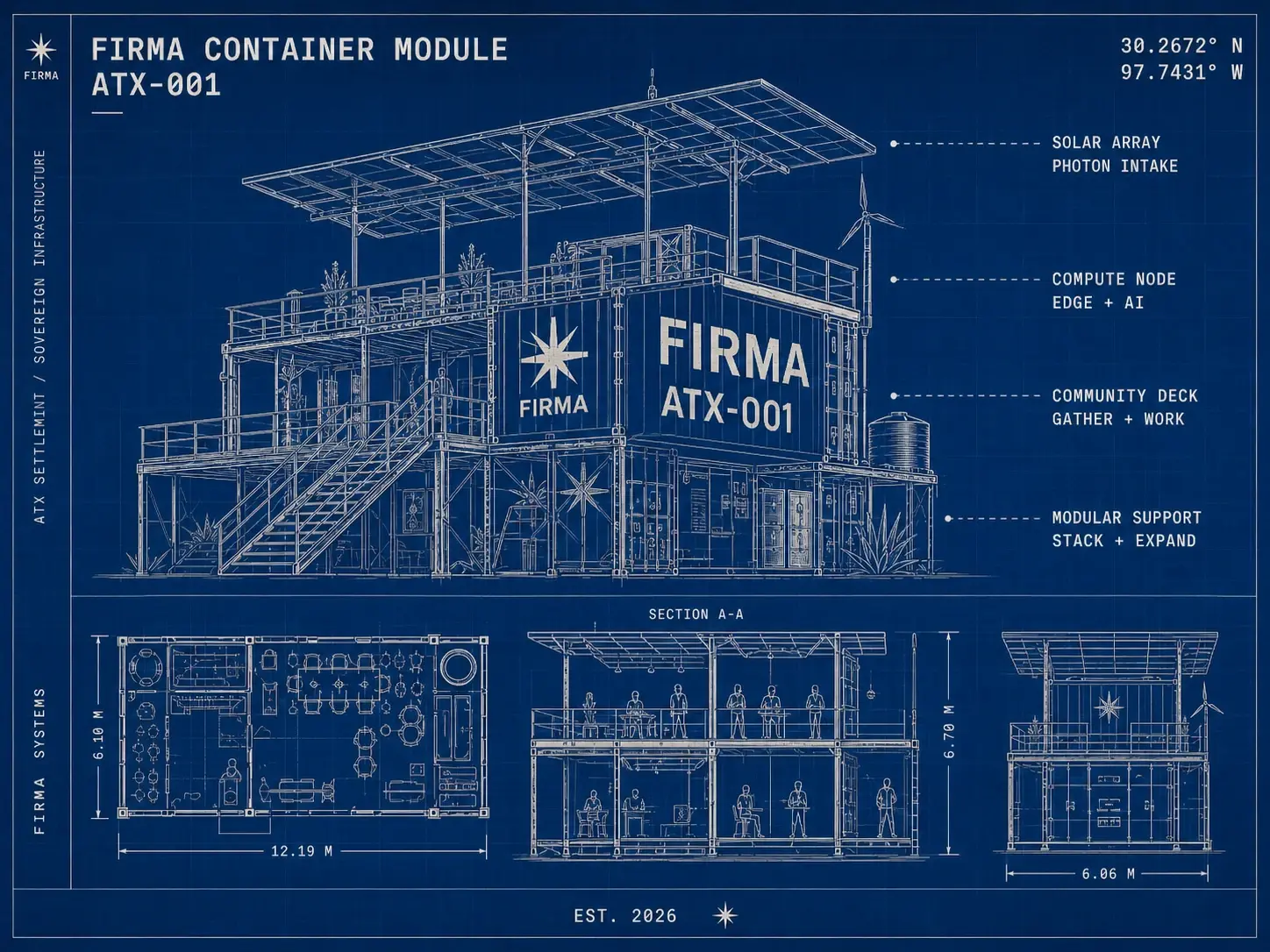
Potential technical components include:
- Realm,
- Firmamint,
- identity and permissions,
- task coordination,
- proposals and decision records,
- reputation and contribution history,
- transparent treasury operations,
- USDC-based payments where appropriate,
- resilient communications,
- local compute,
- and infrastructure monitoring.
These remain provisional implementations.
The human function is canonical. The technical implementation is provisional.
ATX should use the simplest reliable tool that solves the present problem. It should not deploy technology merely to make the site appear futuristic.
What ATX must prove
ATX should be evaluated through the same proof discipline applied throughout this guide.
| Domain | Current evidence | What remains to be proved |
|---|---|---|
| People | Existing relationships, leaders, team members, and aligned partners | Durable membership, roles, residency patterns, and shared obligations |
| Place | Real land, buildings, and physical infrastructure | Reliable habitation, restoration, maintenance, and sustained use |
| Purpose | Strong Christian mission and Settlemint vision | Translation of vision into recurring practice and clear priorities |
| Governance | Leadership and informal decision-making | Legible authority, accountability, dispute resolution, and continuity |
| Economy | Capital, work, restoration activity, and possible revenue functions | Repeatable productive loops, transparent treasury practices, and operating sustainability |
| Infrastructure | Existing property systems and active restoration work | Reliable water, energy, communications, housing, compute, logistics, and maintenance |
| Memory | Emerging records, plans, and coordination systems | Durable contribution, decision, asset, expense, and obligation records |
| Continuity | Commitment and activity | Function through time, leadership changes, conflict, and financial constraint |
ATX is not yet a District
A Settlemint and a District are different claims.
ATX may become a mature Settlemint before it possesses meaningful city-level political capacity. It currently operates under the laws and jurisdiction of Texas and the United States.
It does not presently possess:
- independent criminal jurisdiction,
- border authority,
- treaty capacity,
- independent foreign relations,
- sovereign taxation,
- or internationally recognized statehood.
District language should therefore remain aspirational until actual political capacity and lawful authority emerge.
ATX is a reference implementation, not a universal blueprint
ATX should not become the template every future Settlemint must copy.
Its origin, theology, climate, land, relationships, funding, and institutional partnerships are specific.
Its larger contribution should be a tested body of knowledge:
- what functions mattered first,
- what dependencies were hidden,
- which systems failed,
- which practices became reliable,
- how much maintenance was required,
- what governance proved legitimate,
- what economics became sustainable,
- and what could be repeated elsewhere.
A reference implementation shows one credible way the framework can work. It does not eliminate other ways.
The evidence ledger for ATX
ATX should maintain a simple evidence ledger for every major claim.
For each system, record:
- the claim,
- current maturity,
- concrete evidence,
- owner or steward,
- dependencies,
- known failure modes,
- next proof required,
- and last review date.
Use the maturity sequence:
Claim → Signal → Evidence → Repetition → Reliability → Institution
This will allow ATX to grow without confusing aspiration with accomplishment.
What success looks like
ATX is succeeding when:
- people are becoming healthier and more capable,
- worship remains central,
- the land is becoming more fruitful,
- buildings and infrastructure are becoming more reliable,
- responsibilities are becoming clearer,
- governance is becoming more trustworthy,
- productive work is increasing,
- resources are being stewarded transparently,
- leaders and teams are being formed,
- hospitality becomes repeatable,
- knowledge is being documented,
- and other communities can learn from both success and failure.
Its greatest contribution may not be the property itself.
Its greatest contribution may be proving how other Settlemints can begin.

Current status
ATX is a genesis Settlemint in formation.
It has real land, people, resources, relationships, and responsibility.
It does not yet have every mature system described in the Settlemint framework.
That distinction is not weakness. It is disciplined truthfulness.
Claim is not proof. Deployment, endurance, and fruit provide the evidence.
✴ Last updated · Sun Jul 19 2026 00:00:00 GMT+0000 (Coordinated Universal Time)