✴ Part II — SettlementCH_06
From Community to Network State
Political communities mature by accumulating proofs, not merely by passing through labels. The original progression, a broader set of thresholds, and four distinct forms of maturity.
Political communities mature by accumulating proofs, not merely by passing through labels.
The original network-state progression remains useful:
Startup Society → Network Union → Network Archipelago → Network State
But it describes one pathway. Real communities may begin from different conditions, develop several capacities at once, skip labels, regress, or become strong in one domain while remaining weak in another.
A ladder shows one possible order. A map shows what is actually true.
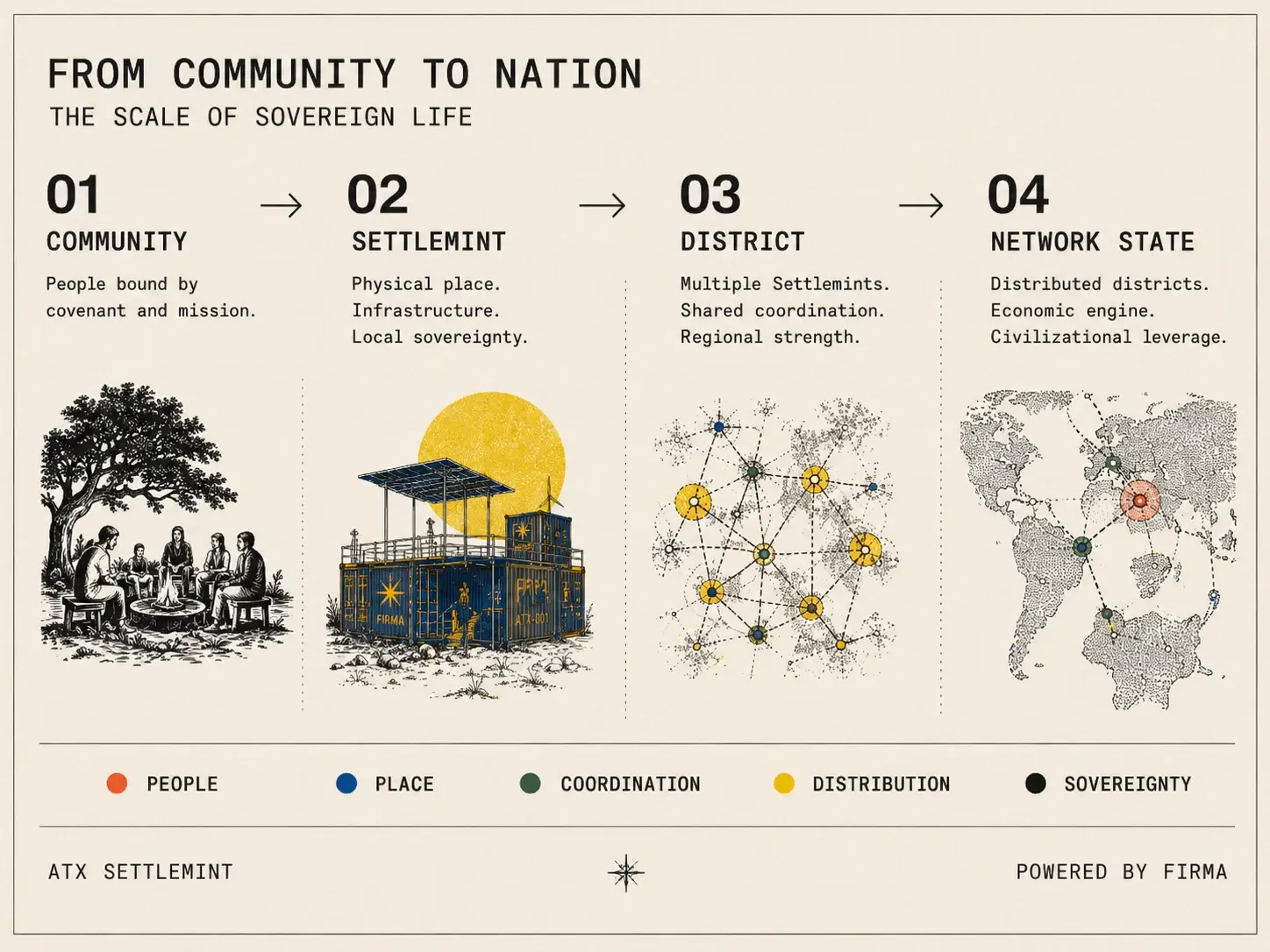
Why progression models help
A progression gives founders and communities a shared language for:
- where they currently stand,
- which functions are missing,
- what the next proof may be,
- and what stronger political claims would require.
That clarity is useful.
The danger is treating the model as inevitable. A project may acquire land before becoming a people. A church may possess covenant, continuity, leadership, and place before building digital coordination. A distributed economic network may be highly capable without possessing political identity.
The order in which capabilities appear is not always the order in which they mature.
The original network-state pathway
Startup society
A founder and community gather around a moral innovation or binding principle.
Plainly:
We believe something together.
Network union
The community proves that it can coordinate across distance, pool resources, and execute collective action.
Plainly:
We can act together.
Network archipelago
The community acquires or coordinates distributed physical territory.
Plainly:
We can inhabit places together.
Network state
The distributed polity reaches sufficient scale and gains some degree of diplomatic recognition or political standing from existing states.
Plainly:
Other governments begin to acknowledge us politically.
This model correctly emphasizes that a network state requires more than online attention. It must demonstrate alignment, collective action, economy, embodiment, measurable scale, and external standing.
A broader set of thresholds
The following categories identify important changes in function. They are not mandatory steps in one universal sequence.
Audience → Community → People → Startup Society → Network Union → Network Polity → Physical Settlement Network → Network State → Sovereign State
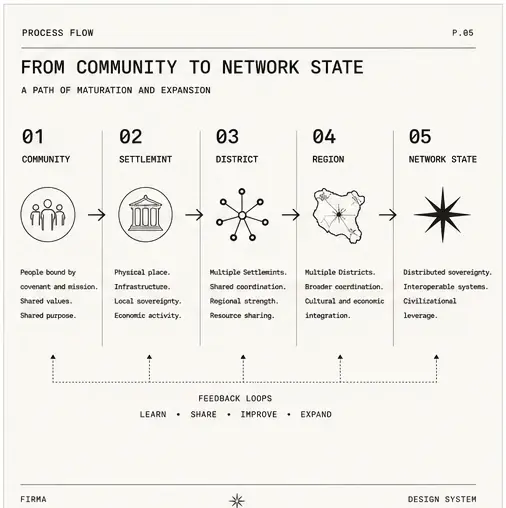
Audience
An audience pays attention.
People may follow, watch, subscribe, donate, or repeat language. The relationship is mainly between the audience and a central voice, brand, or platform.
The test is:
Would these people remain connected if the content stopped?
Community
A community forms recurring relationships.
Members interact with one another, not only with the founder. Shared practices, gatherings, work, mutual aid, language, and common interests begin to persist.
The test is:
Do meaningful relationships and shared activity continue between members?
People
A people understands itself as a "we."
Members develop shared memory, identity, duty, covenant, culture, history, and future orientation.
The test is:
Do members believe they belong to one another in a durable and consequential way?
Not every community becomes a people. Not every people seeks statehood.
Startup society
A startup society deliberately organizes around a binding principle and the intent to build a different social order.
Identity becomes an intentional institutional project. The community begins asking how it should live, who belongs, what it should build, and which institutions are required.
Network union
A network union is a distributed community with demonstrated collective action.
It can repeatedly convert alignment into concrete outcomes through shared work, treasury activity, mutual aid, campaigns, standards, or infrastructure.
Network polity
A network polity is a digitally coordinated political community with meaningful membership, governance, collective action, and shared institutions.
This category is useful because it describes something clearly political without prematurely calling it a state.
Physical settlement network
A physical settlement network exists when the polity has durable embodied life across one or more real places.
This is stronger than owning property. It may include Settlemints, residences, institutions, workplaces, farms, worship sites, infrastructure, or other recurring territorial presence.
The test is:
Does the political community sustain meaningful human life in place?
Network state
A network state is a network-born polity with substantial collective capacity, physical embodiment, and meaningful external political standing.
The original definition ultimately requires diplomatic recognition. Broader contemporary usage often applies the term earlier. This guide will make the intended threshold explicit.
Sovereign state
A sovereign state possesses ultimate governing authority over a population and territory and functions independently in international relations.
This is a substantially higher threshold than an autonomous community, special zone, city project, or network-state aspiration.
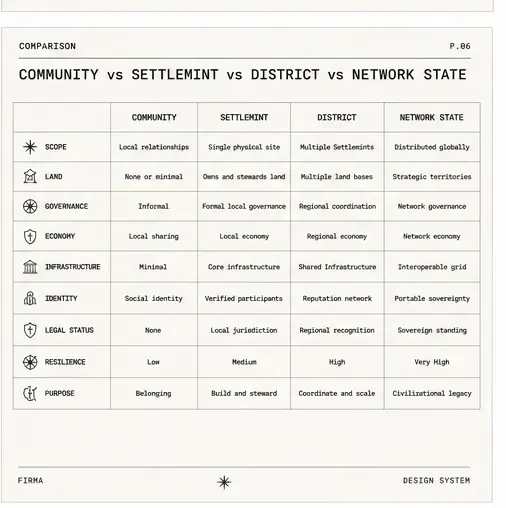
Four distinct forms of maturity
The greatest weakness of one ladder is that it combines different kinds of development.
Social maturity
How deeply have individuals become a people?
Possible movement:
Audience → Community → People
Political maturity
How capable is the people of legitimate collective governance and external political standing?
Possible movement:
Startup Society → Network Union → Network Polity → Network State → Sovereign State
Settlement maturity
How capable are its places of sustaining human life and shared function?
Possible movement:
Site → Occupied Place → Settlement → Settlemint → Mature Settlemint
A District should not be treated automatically as the next settlement tier. It is primarily a political category that may emerge from one or more mature settlements.
Infrastructure maturity
How capable is the community of operating the systems beneath its life?
Relevant domains may include:
- communications,
- compute,
- energy,
- water,
- housing,
- food,
- payments,
- identity,
- logistics,
- healthcare,
- transport,
- and data.
A polity may be socially mature and politically coherent while remaining highly dependent on systems controlled by others.
Use a maturity map, not one score
A single tier or number creates false precision.
A better representation maps the project across dimensions such as:
- peoplehood,
- membership,
- collective action,
- governance,
- economy,
- settlement,
- infrastructure,
- continuity,
- external relations,
- authority,
- and recognition.
Each domain can use the proof ladder:
Claim → Signal → Evidence → Repetition → Reliability → Institution
A project may therefore report that:
- community is at reliability,
- governance is at evidence,
- settlement is at signal,
- and economic coordination is at repetition.
That is more accurate than calling the whole project "Stage Three."
Maturity can regress
Development is not permanently unlocked.
A community may lose members, trust, land, leadership, infrastructure, legitimacy, capital, or recognition. A reliable function may become intermittent. A settlement may become uninhabitable. A governance process may cease to be accepted.
Maturity is maintained through repeated function, not awarded forever by one milestone.
Different origin paths
Cloud-first
Online community → collective action → land → recognition
This is the original network-state pathway.
Place-first
Land or town → residents → shared institutions → network coordination → wider polity
Covenant-first
Covenant → people → shared life → institutions → network expansion
Institution-first
Church, university, company, order, or mission → durable community → settlement → political development
Crisis-first
Shared emergency or displacement → mutual aid → community → institutions → political identity
Infrastructure-first
Communications, compute, energy, or economic network → recurring participants → peoplehood and governance
No pathway guarantees statehood. Each must be judged by what it actually proves.
Firma's possible pathway
Firma may not follow a purely cloud-first model.
Its current ingredients may include:
- covenant,
- people,
- land,
- physical proximity,
- capital,
- worship,
- shared work,
- institutional relationships,
- and emerging network infrastructure.
The strongest provisional description remains:
Covenant first. People and place together. Network everything.
This should remain a testable origin pathway, not a slogan that substitutes for execution.
Where ATX currently sits
ATX should not be assigned one misleading overall tier.
A more honest preliminary profile is:
- People and relationships: meaningful existing evidence.
- Land and physical place: real evidence.
- Shared purpose and covenant: meaningful evidence, with membership boundaries still developing.
- Settlement function: formation and early pilots.
- Governance: mostly proposed or ad hoc.
- Economic loops: early and incomplete.
- Infrastructure autonomy: mixed, with several systems under restoration or externally dependent.
- Continuity: not yet proved over enough time.
- District political capacity: aspirational.
- Network-state standing: aspirational.
Therefore:
ATX is a genesis Settlemint in formation and a proving ground for the larger architecture.
Working transition thresholds
Audience → Community
Members form recurring relationships beyond content consumption.
Community → People
Durable shared identity, memory, obligation, and future orientation emerge.
People → Startup Society
The people deliberately begin designing and building a social order.
Startup Society → Network Union
The society repeatedly coordinates collective action across distance.
Network Union → Network Polity
Governance, membership, political organization, and shared institutions become durable.
Network Polity → Physical Settlement Network
The polity establishes recurring embodied life across real places.
Physical Settlement Network → Network State
The polity acquires enough external political standing and recognition to justify the term.
Network State → Sovereign State
It attains ultimate state authority and independent international standing.
These are working thresholds, not universal laws.
The category should follow the proof
Do not begin with the desired title and search for evidence afterward.
Use the reverse process:
- Identify the functions being performed.
- Record the evidence.
- Test repetition, reliability, and legitimacy.
- Determine which category the evidence supports.
The proof should earn the name.

The lines to remember
A ladder tells you one possible order. A map tells you what is actually true.
And:
Political communities do not mature by collecting titles. They mature by turning critical functions into reliable institutions.
✴ Last updated · Sun Jul 19 2026 00:00:00 GMT+0000 (Coordinated Universal Time)