✴ Part III — ArchitectureCH_09
Where Firma Fits
The ideas in this guide are larger than Firma. Universal concepts, Firma architecture, and the Nation of Heaven — three levels that must remain separate.
The ideas in this guide are larger than Firma.
Nations, states, settlements, political communities, governance, sovereignty, and infrastructure do not belong to one organization.
Firma did not invent these realities.
Firma is one proposed architecture for helping people and communities build greater sovereign capability.
The concise answer
Firma exists to build on-chain and on-the-ground infrastructure for people and communities operating at the edges.
Its role is not to become the political center of every community using its tools. Its role is to make critical human functions more capable, interoperable, resilient, and locally operable.
The clean distinction is:
- Universal concepts explain human and political realities.
- Firma architecture proposes infrastructure and systems that may support those realities.
- The Nation of Heaven is one explicitly Christian and covenantal political project that may use Firma architecture.
These three levels must remain separate.
Universal concepts
The following concepts exist independently of Firma:
- person and household,
- community and nation,
- settlement,
- polity,
- government,
- economy,
- infrastructure,
- statehood,
- sovereignty,
- jurisdiction,
- recognition,
- and network state.
A reader should be able to understand and use these concepts without adopting the Firma ecosystem, its products, or its theology.
This publication should therefore explain the human function before introducing a Firma-specific implementation.
Firma architecture
Firma architecture includes proposed categories, infrastructure, products, and coordination systems such as:
- Realm,
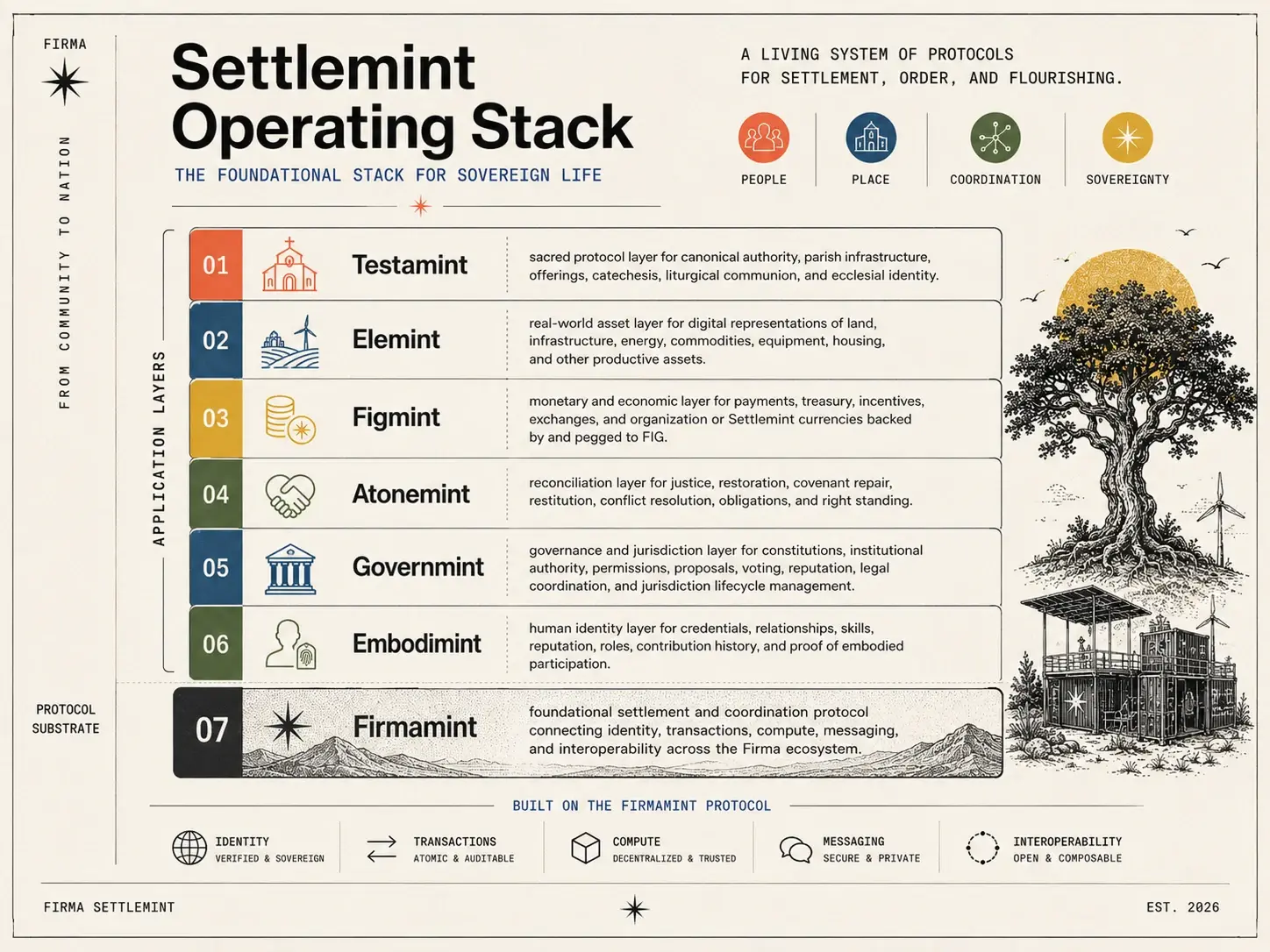
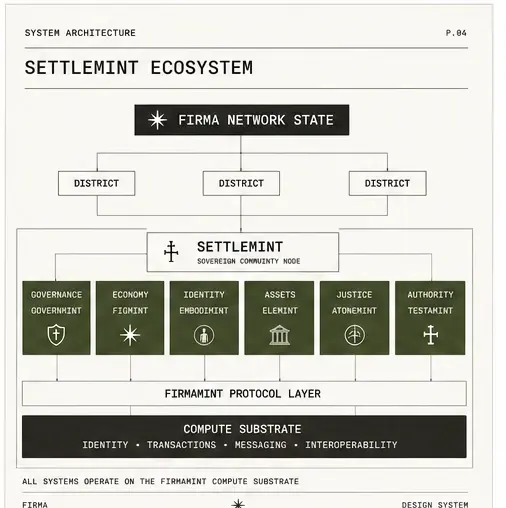
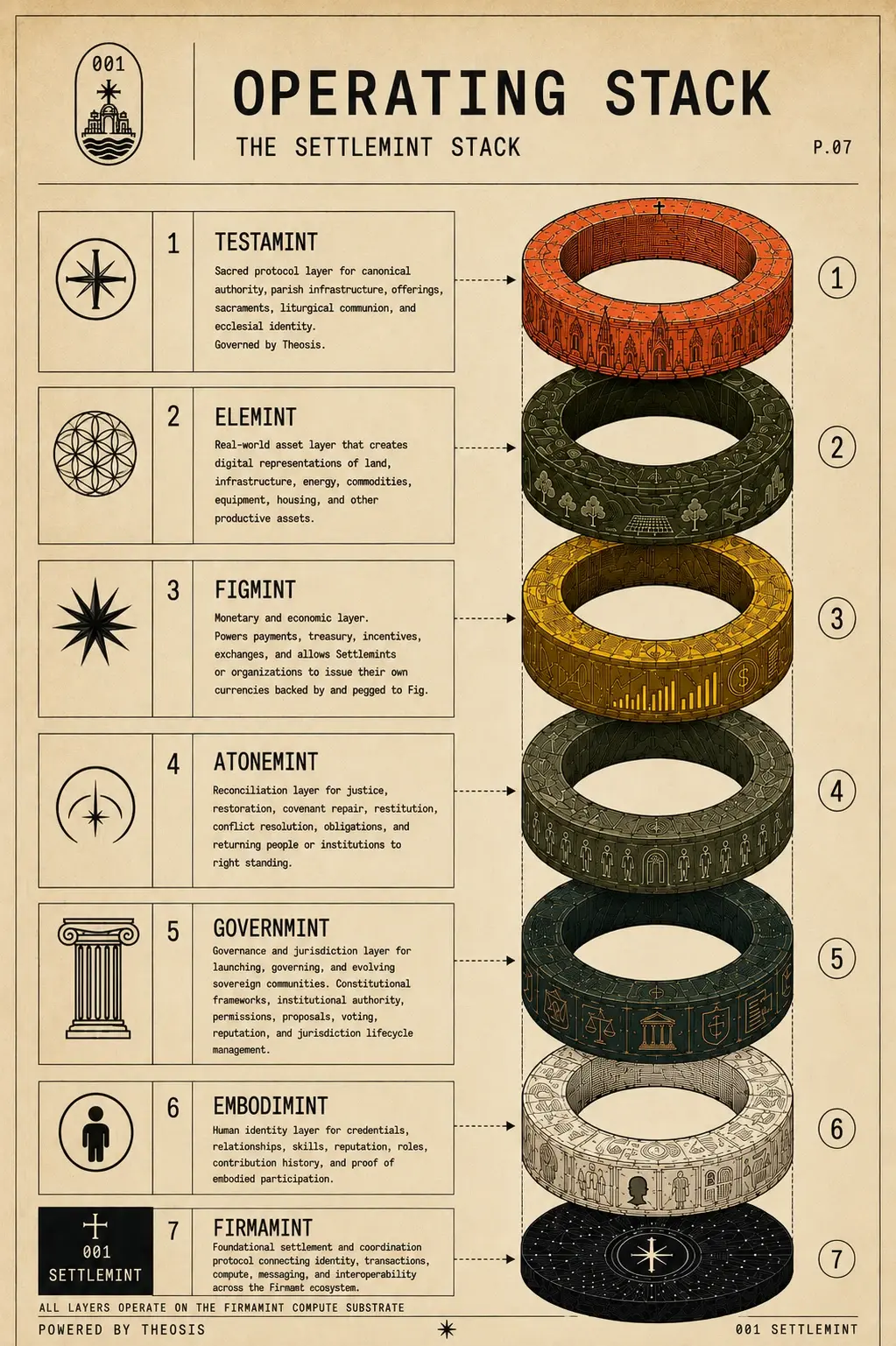
- Settlemint,
- Firmamint,
- modular settlement systems,
- energy infrastructure,
- compute infrastructure,
- communications,
- identity and permissions,
- economic coordination,
- housing,
- and other edge capabilities.
These should be judged by whether they solve real human problems.
A Firma term does not become credible merely because it fits the larger vision. It must earn its place by describing a distinct function and surviving implementation.
The Nation of Heaven
The Nation of Heaven is the explicitly Christian and covenantal political expression within the larger architecture.
It may include:
- Districts of Heaven,
- covenantal membership,
- worship and sacramental life,
- Orthodox Christian formation,
- Testamint,
- spiritual inheritance,
- shared memory,
- and a larger network-state project.
This distinction is essential:
A Settlemint does not have to be Christian or belong to the Nation of Heaven.
The Nation of Heaven may use Settlemint architecture. Settlemint remains a broader settlement category.
Firma's purpose
Firma exists to build sovereign on-chain and on-the-ground infrastructure for the edges.
It does not exist to:
- own every settlement,
- govern every polity,
- make every community politically identical,
- require every network state to join one nation,
- or reduce civilization to one technical platform.
Its purpose is to increase the practical capability of people and communities while preserving legitimate local stewardship and political distinction.
Firma Foundation
The Firma Foundation is the governance layer of the Firma order: one governed order expressed through three operating divisions. The Foundation establishes covenant, constitutional principles, and strategic alignment without directly managing operations; the divisions execute within its guardrails.
It is intended to serve as the long-term steward of the mission and public purpose.
Its responsibilities may include:
- protecting foundational principles,
- stewarding research and public goods,
- maintaining standards,
- preserving long-term alignment,
- protecting the distinction between infrastructure and political control,
- and preventing short-term commercial incentives from quietly replacing the stated purpose.
Plainly:
The Foundation asks whether the ecosystem is building toward the right ends.
The exact powers and governance of the Foundation must be verified against actual governing documents before public claims become final.
Firma Labs
Firma Labs is the engineering and implementation organization.
Its role is to:
- design,
- prototype,
- build,
- deploy,
- test,
- maintain,
- and improve systems.
Plainly:
Labs asks whether the architecture can actually be built and operated.
Labs is one of three operating divisions.
Firma Capital
Firma Capital is the stewardship, investment, and treasury division. It manages financial resources, real assets, investment vehicles, and capital deployment.
Firma Theosis
Firma Theosis is the formation, ministry, and mission division. It forms people and cultivates community.
One governed order
Capital stewards. Labs builds. Theosis forms. The Foundation governs.
No division can accomplish the mission alone. The functions remain distinct even where they cooperate closely.
Firmamint
Firmamint is not a company, government, city, settlement, nation, or network state.
Firmamint is the proposed shared substrate through which distinct people, Realms, Settlemints, Districts, and political communities may coordinate, remember, exchange, compute, prove, and interoperate.
Firmamint is orthogonal to the civil architecture. It may operate across several layers rather than sitting above them as another political tier.
Firmamint runs through the architecture; it does not sit above it as sovereign ruler.
This preserves an important boundary:
Infrastructure may enable sovereignty. Infrastructure should not quietly become the sovereign.
The exact Firmamint protocol, chain, governance, economic model, and deployment status belong in The Firma Architecture, not in this conceptual volume.
Realm
Realm is the personal or household edge domain.
It is the layer through which a person may carry and steward:
- identity,
- devices,
- agents,
- private context,
- local inference,
- compute,
- energy,
- connectivity,
- permissions,
- contribution history,
- memory,
- ownership,
- and participation.
The Realm is the domain. The products make it real.
Realm Node, Realm Mobile, and Realm Link are possible product expressions. They are not the definition of Realm itself.
Settlemint
A Settlemint is a functioning human settlement whose essential systems are integrated enough for people to live, build, govern, exchange, produce, coordinate, and belong with increasing operational autonomy.
It is not automatically:
- part of Firma,
- Christian,
- a District of Heaven,
- a sovereign jurisdiction,
- or a network state.
Settlemint is a general settlement architecture, not a religious-membership requirement.
Districts of Heaven
Districts of Heaven are envisioned as constituent city-polities within the Nation of Heaven network state.
They are political and covenantal categories, not universal settlement categories.
A District may contain one or many Settlemints. A Settlemint may exist outside any District.
The precise sovereignty, legal authority, representation, and jurisdiction of future Districts remain unproven and must be described with discipline.
Nation of Heaven
The Nation of Heaven is the explicitly covenantal network-state project.
Its common life is intended to be shaped by Orthodox Christianity, covenantal belonging, worship, formation, and shared political purpose.
It may be supported by:
- Districts of Heaven,
- Settlemints,
- Realms,
- and Firmamint infrastructure.
But:
Using Firmamint or Settlemint infrastructure does not automatically make a community part of the Nation of Heaven.
Political and covenantal membership must be distinct from technical participation.
Testamint
Testamint concerns faith, covenant, witness, formation, inheritance, and continuity across generations.
For the Nation of Heaven, it may become a system through which a people remember:
- who they are,
- what they believe,
- what they have received,
- what they must preserve,
- and what they are responsible to pass on.
Testamint is specific to covenantal formation. Settlemint is the broader settlement category.
Its exact institutional or technical form remains provisional.
Three architectures
Firma must keep three architectures distinct.
Civil architecture
This explains how people and political communities relate:
Person / Household → Realm → Settlemint → District → Nation → Constellation
This is a conceptual map, not a rigid containment hierarchy.
Infrastructure architecture
This explains how capability moves:
- compute,
- energy,
- communications,
- identity,
- payments,
- storage,
- logistics,
- records,
- and interoperability.
Firmamint belongs primarily in this architecture.
Application architecture
This contains products and interfaces people may actually use, such as:
- Realm products,
- Haven,
- Photon,
- compute products,
- Governmint,
- Figmint,
- Testamint,
- and future applications.
These implementations may change as technology and deployment experience evolve.
A product can change. The human function remains.
Function before product
The publication should treat human functions as canonical before product names.
- Governance is required. Governmint is one possible implementation.
- Housing is required. Haven is one possible implementation.
- Economic coordination is required. Figmint is one possible implementation.
- Faith formation may be required for the Nation of Heaven. Testamint's exact implementation is not fixed.
- Settlement memory is required. A specific ledger or token is not automatically required.
The function is canonical. The implementation is provisional.
This rule prevents the conceptual architecture from becoming disguised product marketing.
What success looks like
Success is not every community joining Firma.
It is not every Settlemint joining the Nation of Heaven.
It is not every network state using Firmamint.
It is not market share becoming the measure of civilization.
Success means more people and communities gain:
- real agency,
- useful infrastructure,
- resilient local capability,
- trustworthy institutions,
- greater operational autonomy,
- durable memory,
- and the ability to cooperate without unnecessary centralization.
Firma does not seek to replace civilization. It seeks to build infrastructure that helps people build more capable civilization together.
Current status discipline
The public website must preserve the difference between intention and evidence.
- Foundation and division responsibilities follow the published Firma organizational architecture; final confirmation against governing documents remains required.
- Firma Labs capabilities must be classified as proposed, prototype, pilot, deployed, repeated, or institutional.
- Firmamint remains an emerging substrate architecture.
- Realm products remain proposed or in development unless deployment evidence says otherwise.
- Settlemint is a working settlement category.
- Districts of Heaven and the Nation of Heaven remain emerging political architecture.
- Testamint remains an emerging covenantal concept.
- ATX is a Settlemint in formation, not proof that the entire architecture is operational.
✴ Last updated · Wed Jul 22 2026 00:00:00 GMT+0000 (Coordinated Universal Time)