✴ The Frontier Standard · SpecificationsST_04
Governance Minimums
The minimum governance functions a Settlemint must be able to perform before it can claim that governance exists.
This specification standardizes the minimum governance functions a Settlemint must be able to perform before it can honestly claim that governance exists. It states required functions, never structures. It names no councils, quorums, voting systems, or procedures — those are each community's to design.
Status: Working specification v1 — the required functions are published canon; no structures, thresholds, or procedures are defined, by design. A vote alone is not enough, and no arrangement is prescribed.
The operational treatment of these functions is published in the handbook at Governance and Dispute Resolution.
1. What this specification standardizes
Governance is not proved by a constitution, a vote, or a governance application. This specification standardizes the smaller, testable claim beneath all of those: whether the community can actually perform the functions governance requires, repeatedly, in a way its members accept as legitimate.
Governance software is not automatically a government.
2. The minimum function set
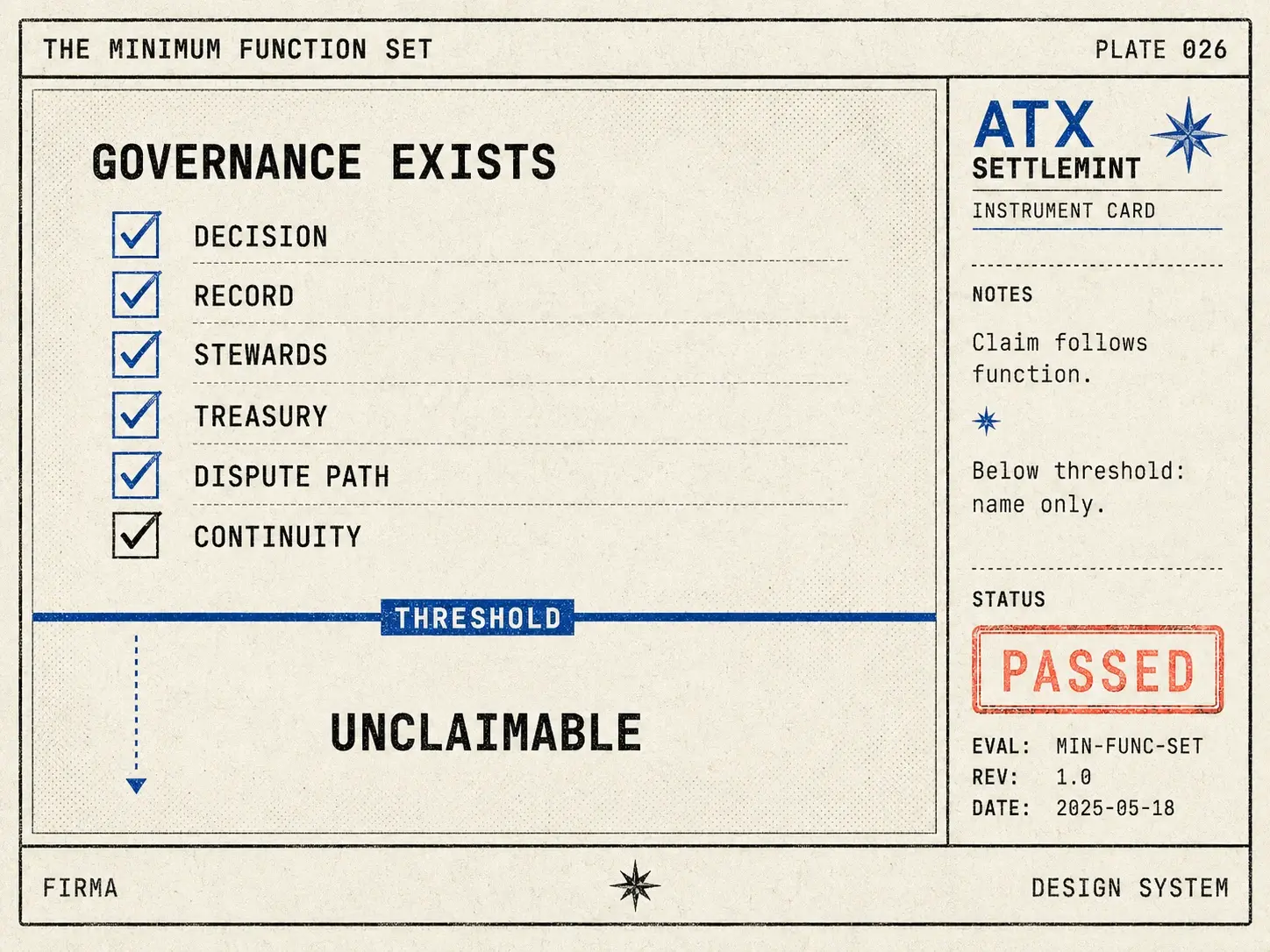
A Settlemint claiming governance must be able to:
- make decisions,
- execute them,
- allocate authority,
- resolve conflict,
- correct mistakes,
- and maintain legitimacy.
A vote alone is not enough. The published proof discipline applies: the functions must be demonstrated in practice, not asserted by structure. Their maturity is reported through the Proof-of-Function instrument.
3. The threshold
The line between having leadership and having governance is the point at which these functions become repeatable:
Governance begins when decision rights, obligations, and accountability become clear enough to practice repeatedly.
Below this line a community has leadership and relationships. It does not yet have governance, however sophisticated its language.
4. The standard checklist
Before a Settlemint claims governance, it should be able to answer these practical questions — the published first governance questions:
- Who is responsible for which domain?
- Who can approve spending?
- Who can commit the community?
- How are work priorities selected?
- How are decisions recorded?
- How are disagreements resolved?
- How is poor leadership corrected?
- Which decisions belong to which parties — owners, leadership, operators, residents, or partners?
These are questions, not a template. A conformant Settlemint has answers it actually practices; it does not have a required set of institutions.
5. The legitimacy requirement
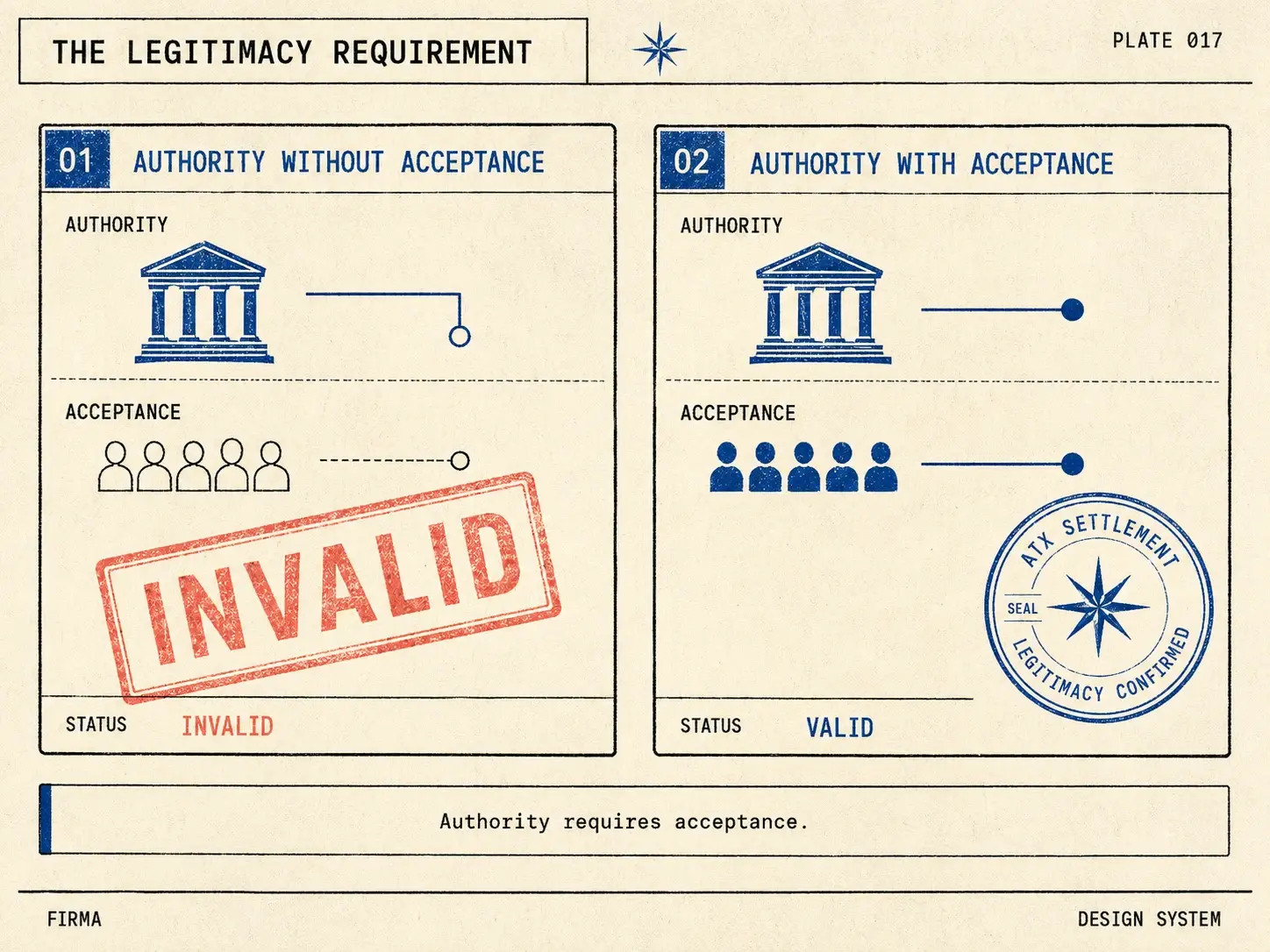
Maintaining legitimacy is a function, not a formality. A system is not legitimate merely because its rules are recorded or a founder approved them.
Legitimacy is the belief that an authority has the right to rule or decide.
Legitimacy may rest on consent, covenant, law, tradition, representation, performance, office, ownership, or recognized spiritual authority. These sources can conflict. A conformant Settlemint names those conflicts rather than hiding them.
6. Conformance
A governance arrangement conforms to this specification when it:
- Performs all six minimum functions — decisions can be made, executed, authority allocated, conflict resolved, mistakes corrected, legitimacy maintained.
- Has answers to the standard checklist that are practiced repeatedly, not improvised.
- Records its decisions so authority and accountability remain legible over time.
- Can correct poor leadership without depending on the founder remaining in the room.
- Names honestly the sources of its legitimacy and any conflicts among them.
- Does not simulate statehood or use sophisticated governance language before basic operating authority is clear.
7. What this specification does not define
This specification defines no structures. Membership categories and rights, entry, discipline, removal, appeal and exit, representation, citizenship, and which decisions belong to which level of the civil architecture all remain open — they are each community's to answer, and several are named open questions in the canon rather than settled doctrine. This specification requires that the functions exist and are practiced; it does not prescribe the institutions that carry them.
✴ Last updated · Sat Jul 25 2026 00:00:00 GMT+0000 (Coordinated Universal Time)