✴ The Frontier Standard · SpecificationsST_05
External Recognition and Relationships
How to record external standing as a spectrum, never as one vague claim.
This specification standardizes how a community records external recognition — the acknowledgment it has received from outside actors — as a spectrum of standing rather than a single claim. Its purpose is to prevent the most common inflation in the field: treating any acknowledgment as recognition of statehood.
Status: Working specification v1 — the recognition doctrine is published canon; which forms of recognition should count toward network-state standing remains an open question, not a defined threshold.
The full doctrine is published at What Is a Network State? and What Is Sovereignty?; the operational treatment is in the handbook at External Relationships.
1. The definition
Recognition is when an outside actor acknowledges that an entity possesses a particular status.
Recognition may come from individuals, companies, municipalities, courts, regional governments, sovereign states, or international organizations. These forms of recognition are not equivalent.
2. The non-equivalence rule
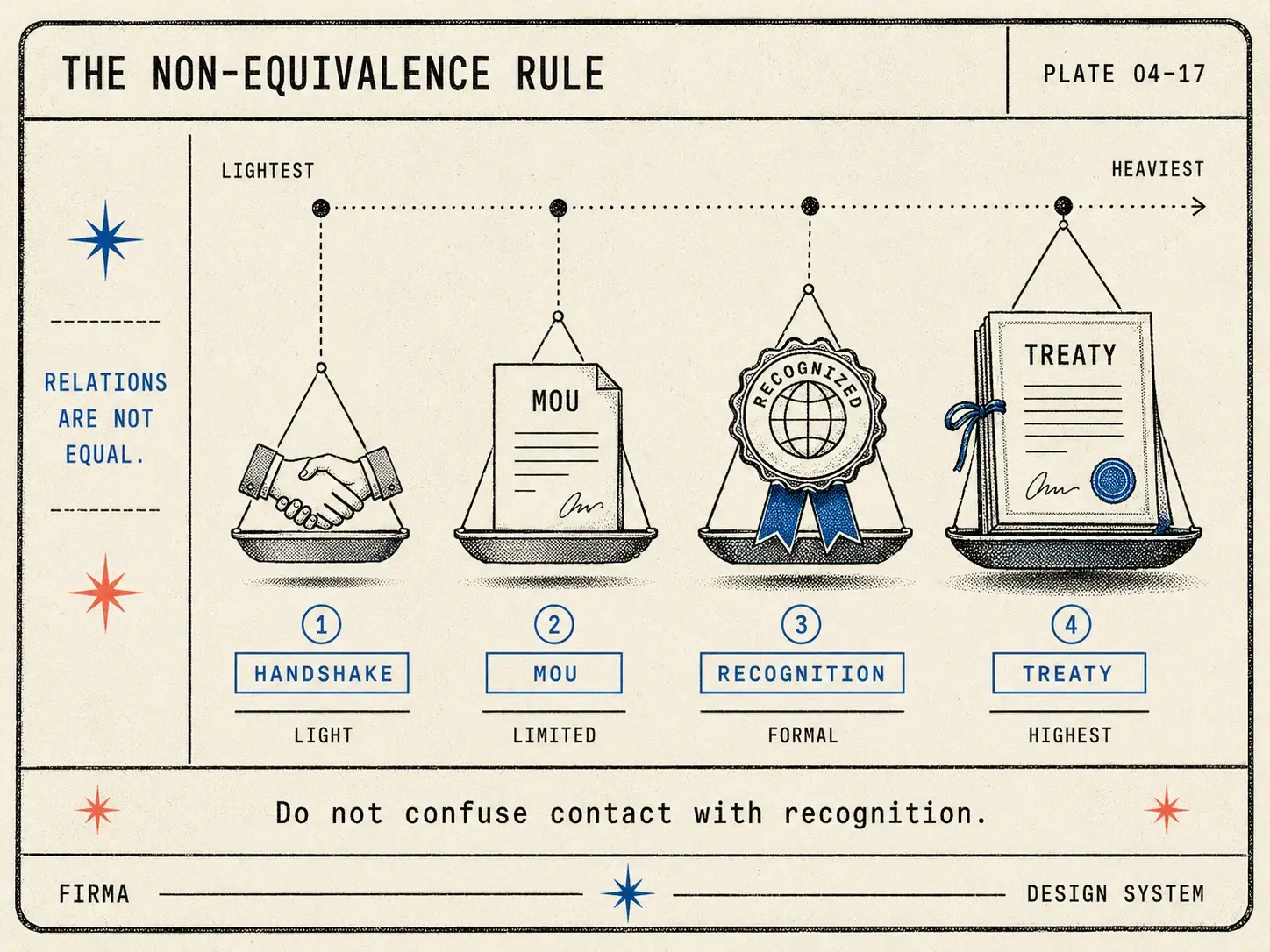
The central discipline of this specification: different acknowledgments carry different weight, and none may be reported as more than it is.
A mayor acknowledging a community is not the same as a sovereign state recognizing another state. A partnership is not recognition of statehood. A protocol listing is not political recognition.
An introduction to a mayor, an MOU with a ministry, municipal cooperation, recognition by a sovereign government, formal diplomatic relations, and membership in an international organization do not carry equal weight. Recognition is a spectrum of external standing, not one vague claim.
3. The proof discipline
Recognition claims are subject to the same proof discipline as every other claim in the guide.
Diplomatic language does not prove diplomatic recognition.
A meeting with government officials does not prove diplomatic recognition.
Language, meetings, and aspiration are not standing. Only the actual acknowledgment, from the actual actor, at the actual level, is.
4. Recording rules
A community conforming to this specification records each acknowledgment as two facts and no more: the specific actor and the specific status that actor acknowledged. It does not aggregate distinct acknowledgments into a single headline claim, and it does not describe an acknowledgment at a higher level than the actor granted.
Recognition is also reported alongside capacity, never as a substitute for it:
Recognition does not create capacity, and capacity does not automatically create recognition.
A community may be widely acknowledged and unable to perform, or highly capable and unacknowledged. The two are recorded separately.

5. Conformance
A recognition record conforms when it:
- Names each acknowledgment by its specific actor and specific status.
- Never reports an acknowledgment as more than the actor granted — no MOU as statehood, no partnership as political recognition, no protocol listing as sovereign standing.
- Treats recognition as a spectrum of external standing, reported per-actor, never as one aggregate claim.
- Keeps recognition and capacity as separate records.
- Applies the proof discipline — language and meetings are not recorded as recognition.
6. What this specification does not define
Which forms of external recognition should count toward network-state standing is deliberately left open — the published reading order marks it as an open question, not settled doctrine. This specification standardizes how recognition is recorded and reported honestly; it does not rank the forms or set a threshold at which accumulated recognition becomes political standing.
✴ Last updated · Sat Jul 25 2026 00:00:00 GMT+0000 (Coordinated Universal Time)