✴ The Frontier Standard · SpecificationsST_03
Maturity Classifications
Maturity is a profile, not one score.
This specification standardizes how the maturity of a community, polity, or settlement is classified and reported. It replaces any single-tier or single-score labeling with a multidimensional maturity map.
Status: Working specification v1 — the classification system is published canon; no quantitative thresholds, timelines, or certification are defined, by design.
The full doctrine behind this classification system is published at From Community to Network State and Claim Is Not Proof.
1. The classification principle
Maturity is a profile, not one score. A single tier or number creates false precision.
Civilizational capacity is multidimensional.
A project may have strong identity, weak governance, real land, no internal economy, advanced technology, poor dispute resolution, substantial capital, and weak continuity. Calling the project simply "mature" or "immature" hides this unevenness.
A ladder shows one possible order. A map shows what is actually true.
The greatest weakness of one ladder is that it combines different kinds of development. This specification therefore classifies maturity along four separate axes, with each domain reported against the proof ladder.
Political communities mature by accumulating proofs, not merely by passing through labels.
2. The four maturity axes
A classification under this specification evaluates each of the four axes independently. They influence one another but do not advance automatically together.
2.1 Social maturity
How deeply have individuals become a people?
Possible movement:
Audience → Community → People
2.2 Political maturity
How capable is the people of legitimate collective governance and external political standing?
Possible movement:
Startup Society → Network Union → Network Polity → Network State → Sovereign State
2.3 Settlement maturity
How capable are its places of sustaining human life and shared function?
Possible movement:
Site → Occupied Place → Settlement → Settlemint → Mature Settlemint
2.4 Infrastructure maturity
How capable is the community of operating the systems beneath its life?
Relevant domains may include:
- communications,
- compute,
- energy,
- water,
- housing,
- food,
- payments,
- identity,
- logistics,
- healthcare,
- transport,
- and data.
A polity may be socially mature and politically coherent while remaining highly dependent on systems controlled by others.

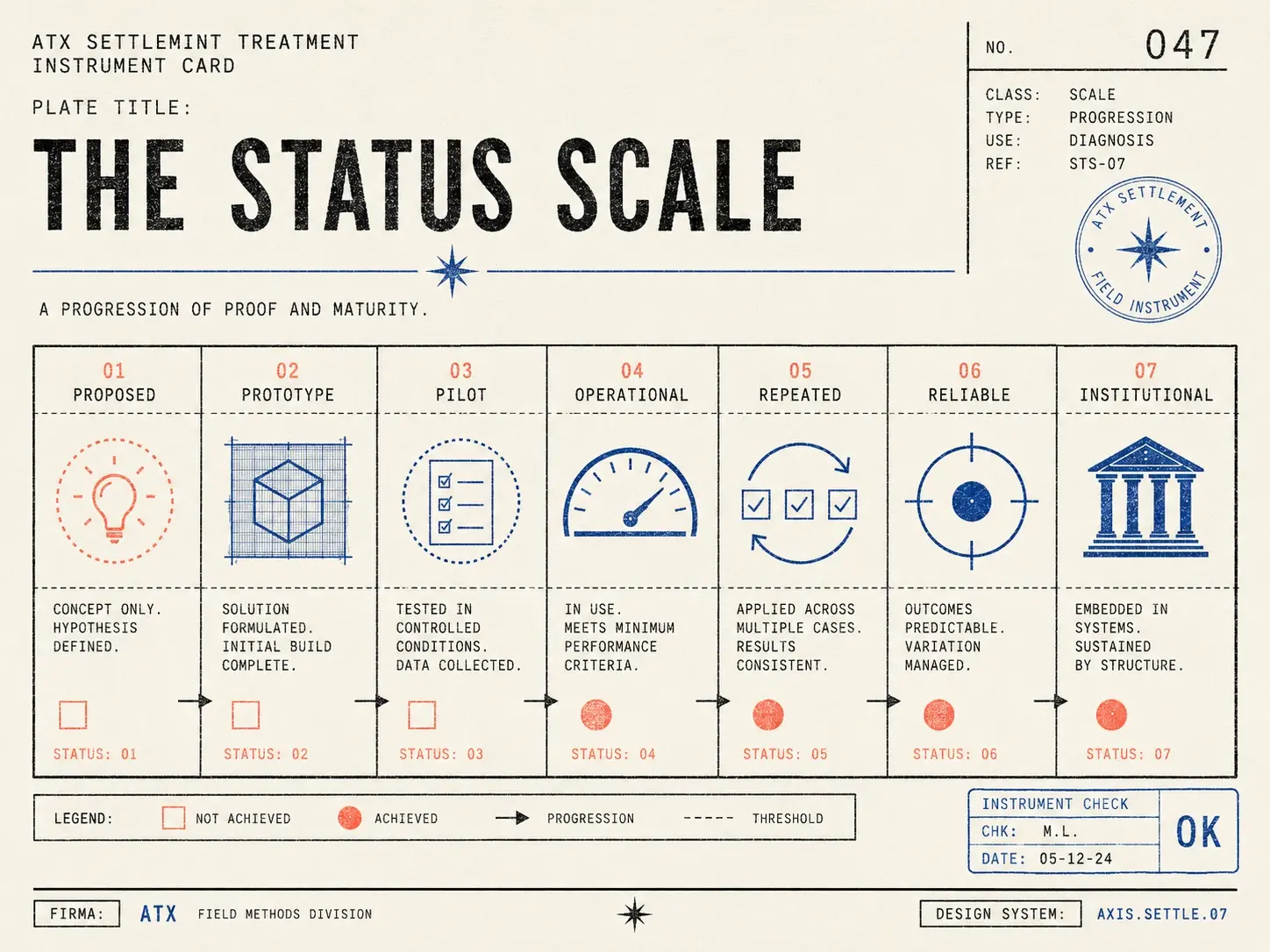
3. The per-domain status scale
Each domain is classified against the proof ladder, which supplies the standard rung vocabulary. The ladder is specified in full at Proof-of-Function Requirements.
Claim → Signal → Evidence → Repetition → Reliability → Institution
Beyond the four axes, a maturity map may cover dimensions such as: peoplehood, membership, collective action, governance, economy, settlement, infrastructure, continuity, external relations, authority, and recognition.
The compliant reporting form is exemplified by a project reporting that:
- community is at reliability,
- governance is at evidence,
- settlement is at signal,
- and economic coordination is at repetition.
That is more accurate than calling the whole project "Stage Three."
4. Classification rules
4.1 Separate axes. Do not force settlement maturity and political maturity onto one ladder. The greatest weakness of one ladder is that it combines different kinds of development. Each axis is classified independently.
4.2 District is a political category. A District should not be treated automatically as the next settlement tier. It is primarily a political category that may emerge from one or more mature settlements.
4.3 Classifications can regress. Development is not permanently unlocked. A community may lose members, trust, land, leadership, infrastructure, legitimacy, capital, or recognition. A reliable function may become intermittent. A settlement may become uninhabitable. A governance process may cease to be accepted. Classifications must be re-evaluated when function lapses.
Maturity is maintained through repeated function, not awarded forever by one milestone.
4.4 The category should follow the proof. Do not begin with the desired title and search for evidence afterward. Use the reverse process:
- Identify the functions being performed.
- Record the evidence.
- Test repetition, reliability, and legitimacy.
- Determine which category the evidence supports.
The proof should earn the name.
5. Working transition thresholds
A new category should be used only when its defining function becomes credible. The published transitions are:
- Audience → Community — Members form recurring relationships beyond content consumption.
- Community → People — Durable shared identity, memory, obligation, and future orientation emerge.
- People → Startup Society — The people deliberately begin designing and building a social order.
- Startup Society → Network Union — The society repeatedly coordinates collective action across distance.
- Network Union → Network Polity — Governance, membership, political organization, and shared institutions become durable.
- Network Polity → Physical Settlement Network — The polity establishes recurring embodied life across real places.
- Physical Settlement Network → Network State — The polity acquires enough external political standing and recognition to justify the term.
- Network State → Sovereign State — It attains ultimate state authority and independent international standing.
These are working thresholds, not universal laws.
6. Conformance
A classification under this specification is conformant when it:
- Reports per-axis and per-domain, evaluating each of the four axes independently.
- Uses the proof-ladder rung vocabulary — Claim, Signal, Evidence, Repetition, Reliability, Institution — as the status scale for each domain.
- Never assigns one aggregate stage, tier, or score to the whole project.
- Treats District as a political category, not an automatic settlement tier.
- Re-evaluates classifications when function regresses, rather than treating a milestone as permanently unlocked.
- Assigns category names by the reverse process of Rule 4.4: the proof earns the name.
- Names the intended threshold explicitly whenever using the term network state, since the original definition ultimately requires diplomatic recognition and broader contemporary usage often applies the term earlier.
7. What this specification does not define
This specification defines no quantitative thresholds, no timelines, and no certification. The exact minimum threshold for the term People, the exact boundary between Network Union and Network Polity, the exact recognition threshold for Network State, whether Sovereign State belongs inside a network-state maturity map, and how to visualize multidimensional maturity remain open. The working thresholds of Section 5 identify important changes in function; they are not mandatory steps in one universal sequence. Do not force false precision.
Classification interacts with two companion specifications: authority and dependence are profiled under Sovereignty and Autonomy Vectors, and evidence standards are defined under Proof-of-Function Requirements.
✴ Last updated · Wed Jul 22 2026 00:00:00 GMT+0000 (Coordinated Universal Time)