✴ The Frontier Standard · SpecificationsST_02
Proof-of-Function Requirements
A claim names what you intend to be. Proof demonstrates what you can repeatedly do.
This specification standardizes how a function's status is reported, evaluated, and tracked, so that aspiration is never confused with operation.
A claim names what you intend to be. Proof demonstrates what you can repeatedly do.
Status: Working specification v1 — the proof discipline is published canon; no quantitative thresholds are defined, by design. Do not force false precision before deployments create real data.
The full doctrine behind this specification is published at Claim Is Not Proof. The companion instrument for authority and dependence is Sovereignty and Autonomy Vectors.
The central rule:
Do not confuse the symbol with the function.
The question is always:
What does this actually demonstrate?
1. The proof ladder
The proof ladder is the standard status scale — the standard vocabulary for reporting any function's status.
Claim → Signal → Evidence → Repetition → Reliability → Institution
Each rung carries its published gloss:
- Claim — We say we can do it.
- Signal — Something suggests we may be able to do it.
- Evidence — We did it once or produced a concrete result.
- Repetition — We can do it again.
- Reliability — People can reasonably depend on us doing it.
- Institution — The capability survives individual moments and becomes embedded in durable roles, processes, infrastructure, norms, and systems.
The underlying terms are defined as follows:
- Claim — A statement about what something is, intends to become, or believes itself to be. A claim may be sincere and important. It is not yet proof.
- Signal — An observable indication that a capability, identity, or institution may be emerging. A signal deserves attention, but it may still be temporary or misleading.
- Evidence — A concrete fact that supports a claim.
- Proof — Repeated evidence strong enough to justify the claim being made. Proof is contextual.
Civilization becomes credible when critical functions move from claim to institution.
2. The proof matrix
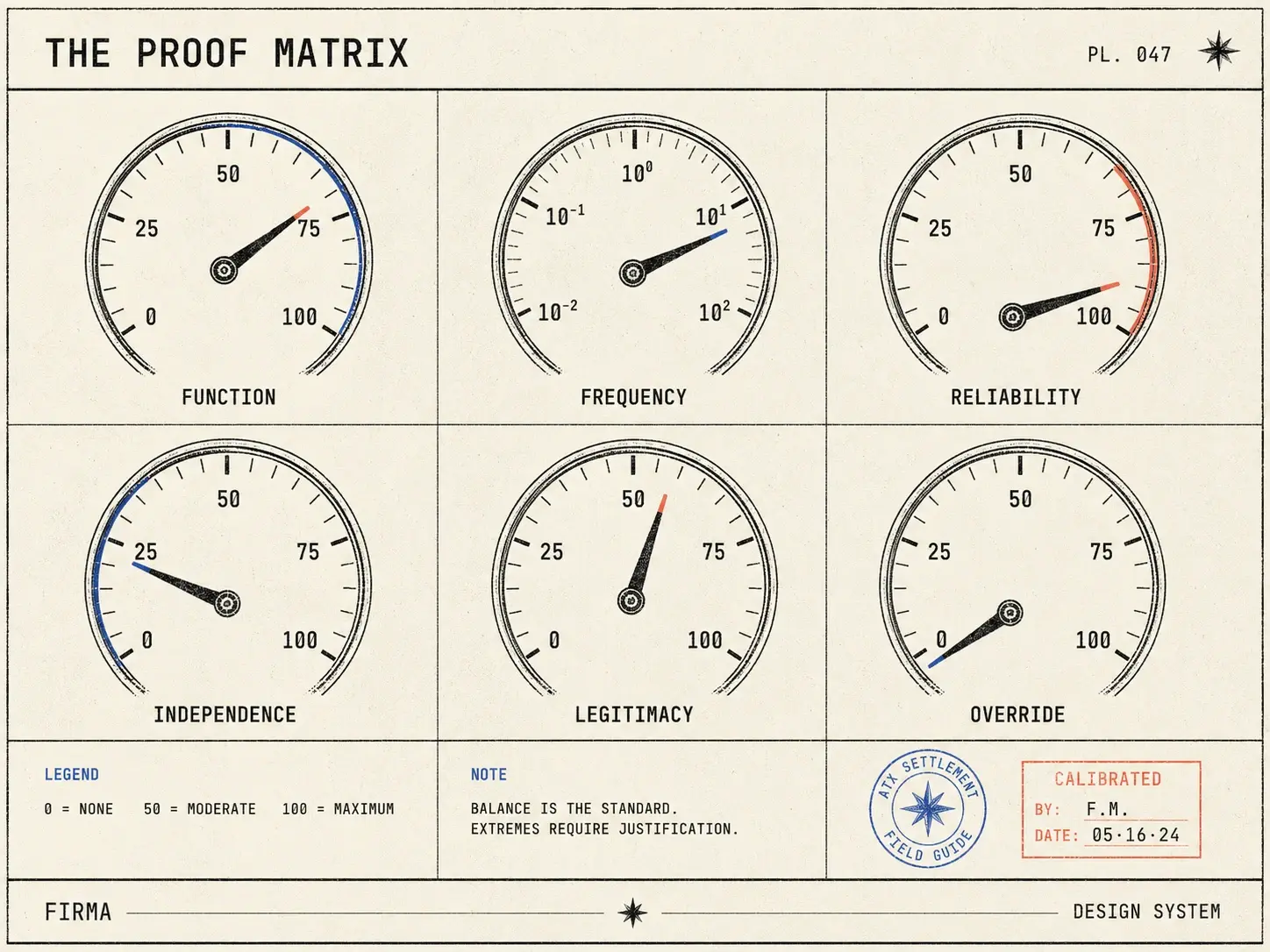
The proof matrix is the standard evaluation. Every major function can be evaluated through six questions.
- Function — What can it actually do?
- Frequency — Has it happened once or repeatedly?
- Reliability — Can people depend on it?
- Independence — What systems, people, capital, permissions, or subsidies must remain available for it to continue?
- Legitimacy — Why do the affected people accept the arrangement?
- Override — Who can ultimately stop, revoke, reverse, or overrule it?
This matrix can evaluate a governance process, treasury, energy system, economy, Realm, Settlemint, network polity, or claim of sovereignty.
3. The evidence-ledger record
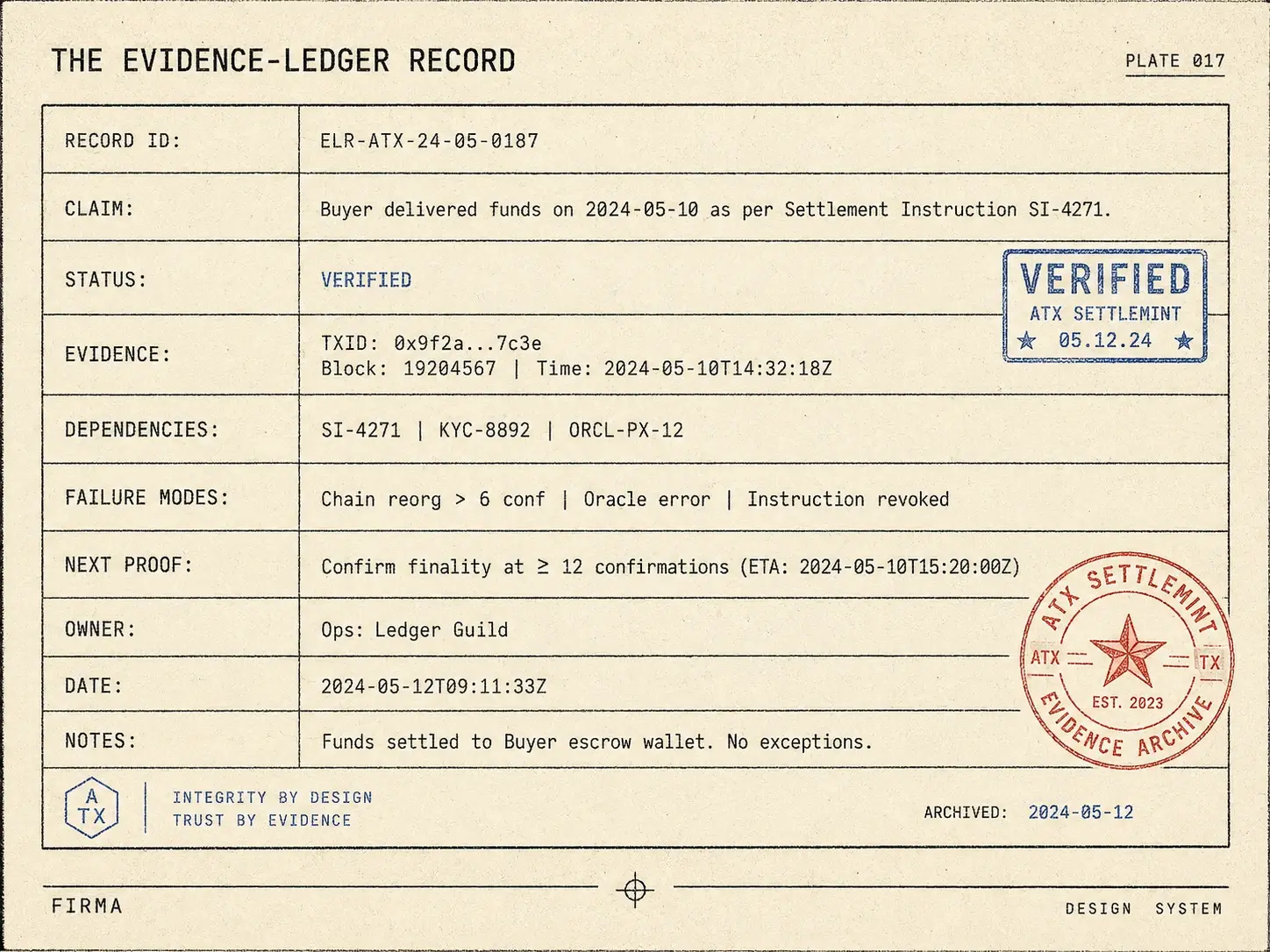
The evidence ledger is the standard tracking format. Each major claim should eventually be tracked through an evidence ledger. For every claim, record six fields:
- Claim — What are we saying?
- Status — Proposed, prototype, pilot, operational, repeated, reliable, or institutional.
- Evidence — What concretely supports the status?
- Dependencies — What outside systems or individuals are required?
- Failure modes — What remains fragile or unproven?
- Next proof — What event or repeated function would advance the claim?
4. What must be proved
Maturity is a profile, not one score. A record reports per-function, and the better question is:
Which functions have moved from claim to institution, and which remain aspiration?
4.1 What a Settlemint must prove
A Settlemint is not proved by land, buildings, a master plan, or a community name. The central question is:
Can this place sustain meaningful human life and collective function over time?
A credible Settlemint should increasingly demonstrate:
- People — real people regularly inhabit or use the place.
- Purpose — the place exists for more than property appreciation.
- Membership — people understand how they belong and participate.
- Habitation — people can stay or establish durable presence.
- Work and production — useful activity occurs.
- Resource flows — money, energy, water, food, materials, compute, or other resources are managed.
- Coordination — shared work can be organized and completed.
- Governance — real decisions can be made, enforced, reviewed, and corrected.
- Care — the community can respond to human need and failure.
- Continuity — the place persists beyond an event, founder visit, or funding cycle.
Not every Settlemint must provide every function internally. Dependence should, however, be visible rather than hidden.
A Settlemint is proved by function in place.
4.2 What a network state must prove
A credible network state should increasingly demonstrate:
- A people — a durable body that meaningfully thinks in terms of "we."
- A binding principle — something stronger than convenience or speculation.
- Membership — meaningful boundaries of belonging and participation.
- Collective action — repeated ability to decide and execute together.
- Governance — legitimate authority, accountability, dispute resolution, and correction.
- Economy — production, exchange, treasury activity, resource allocation, and public goods.
- Embodiment — meaningful physical presence and real-world consequences.
- Continuity — persistence beyond a moment, market cycle, founder, or platform.
- External relations — substantive interaction with governments, institutions, markets, neighbors, and other polities.
- Increasing political standing — autonomy, jurisdiction, recognition, or other state-like capacity across meaningful domains.
No single metric proves the whole category.
5. Rules
5.1 Evidence strength must match claim strength.
The strength of the evidence must match the strength of the claim.
One successful vote proves that a vote occurred. It does not prove durable governance. One month of occupancy proves temporary habitation. It does not prove a durable settlement.
5.2 Proof is domain-specific. Avoid saying:
We are sovereign.
when the actual evidence is:
We generate 80 percent of our electricity locally.
The second statement is smaller, but more credible because it is precise and testable.
Specific proof is stronger than grand language.
5.3 Failure is evidence and must be recorded. If participation collapses, infrastructure requires constant founder intervention, an economy works only while heavily subsidized, or the community cannot survive disagreement, those are material facts. Failure does not automatically invalidate the project. Concealing failure prevents learning.
A system that can see its failures can improve. A system that turns every failure into narrative cannot learn.
5.4 The founder-dependence test.
What stops working when the founder leaves the room?
The problem is not dependence during formation. The problem is claiming that an institution exists when the capability still resides almost entirely in one person. A function becomes institutional as knowledge is shared, roles become clear, authority becomes legible, processes repeat, resources remain available, and correction no longer requires constant founder intervention.
5.5 The continuity test. Ask:
- Does it work after launch attention fades?
- Does it work during conflict?
- Does it work when money becomes tighter?
- Does it work when leadership changes?
- Does it work when infrastructure fails?
- Does it work when people disagree?
Continuity is repeated function under changing conditions.
6. Conformance
A use of this specification is conformant when it:
- Reports every function's status in the vocabulary of the proof ladder, using the accurate rung.
- Reports per-function, never as one score for the whole project. Civilizational capacity is multidimensional.
- Records failure as evidence in the ledger's Failure modes field rather than converting it into narrative.
- Claims no symbol as a function. The anti-aesthetic test: the following may be meaningful, but none proves the larger category by itself.
A following does not prove a nation.
A Discord does not prove a polity.
A token does not prove an economy.
A DAO vote does not prove governance.
Land ownership does not prove a settlement.
A flag does not prove legitimacy.
A constitution does not prove enforceable law.
A passport does not prove recognized citizenship.
Diplomatic language does not prove diplomatic recognition.
Infrastructure does not prove sovereignty.
A blockchain does not prove a state.
Symbols can eventually express something real. The function must come first or grow alongside them.
Do not ask what it calls itself. Ask what it can repeatedly do.
7. What this specification does not define
This specification defines no quantitative thresholds. The following remain open:
- Exact thresholds for each maturity stage.
- Which metrics should be quantitative versus qualitative.
- Whether different Settlemint types require different proof profiles.
- The exact minimum threshold for calling something a network state.
- How external recognition should be weighted.
- Whether Firma should publish its own evidence ledger publicly.
Do not force false precision before deployments create real data.
✴ Last updated · Wed Jul 22 2026 00:00:00 GMT+0000 (Coordinated Universal Time)