✴ The Frontier Standard · SpecificationsST_01
Sovereignty and Autonomy Vectors
The purpose is to show the real shape of authority and dependence.
This specification standardizes the Authority and Autonomy Profile as the standard instrument for describing a community's real shape of authority and dependence. The old working term Sovereignty Vector is understandable but potentially misleading because most domains involve capacity, control, or autonomy rather than sovereignty.
Status: Working specification v1 — the instrument is published canon under its working name; no quantitative scoring thresholds are defined, by design. Do not force false precision before deployments create real data.
The full doctrine behind this instrument is published at What Is Sovereignty?.
1. The instrument
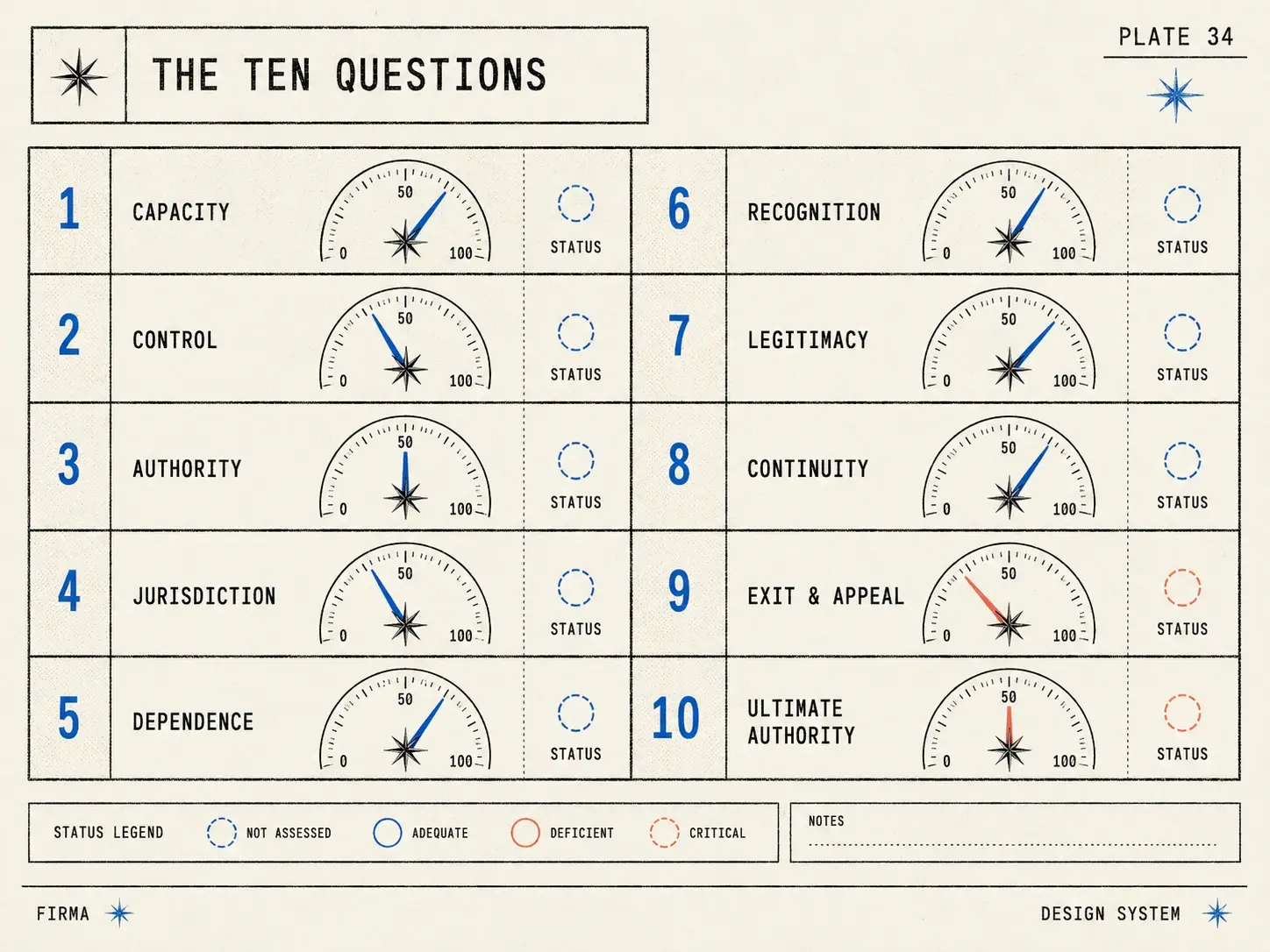
For each domain, ask:
- Capacity — Can the entity perform the function?
- Control — Does it control the relevant systems or assets?
- Authority — Does it have a recognized right to decide?
- Jurisdiction — Where and over whom does that right apply?
- Dependence — Who can interrupt, revoke, or override it?
- Recognition — Who acknowledges the status or authority?
- Legitimacy — Do affected people accept the authority as rightful?
- Continuity — Can the function survive leadership changes or shocks?
- Exit and appeal — Can people leave, appeal, or challenge decisions?
- Ultimate authority — Who has the final word?
This produces a profile rather than a slogan.
2. The language ladder
Use the strongest accurate term, not the strongest-sounding term.
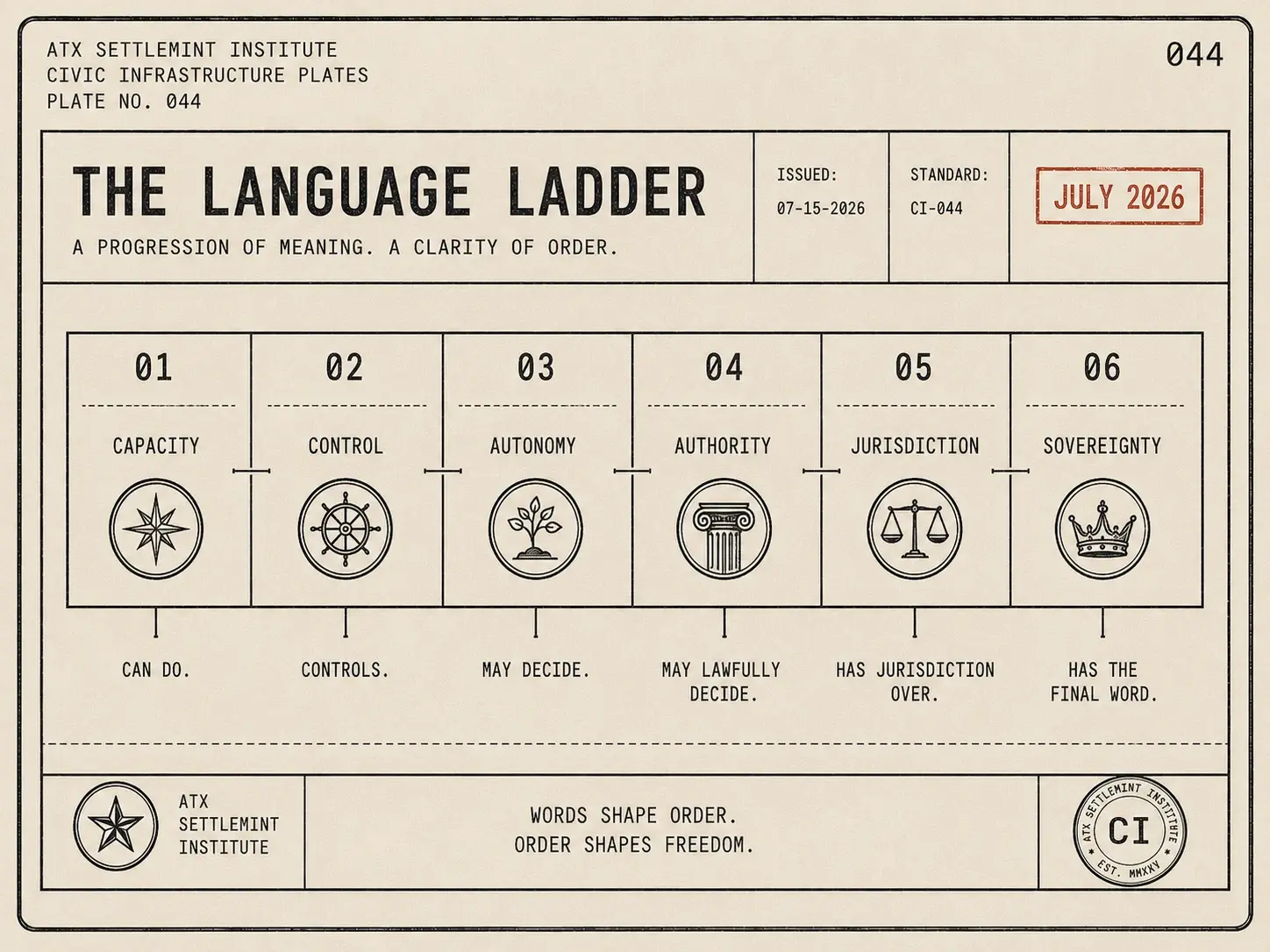
Capacity → Control → Autonomy → Authority → Jurisdiction → Sovereignty
Each term on the ladder carries its published definition:
- Capacity — Capacity is the practical ability to perform a function.
- Control — Control is the practical ability to direct, operate, or exclude others from a resource or system.
- Autonomy — Autonomy is the ability to govern or operate within a limited domain while remaining subject to a higher authority.
- Authority — Authority is the recognized right to make decisions, issue rules, or direct action.
- Jurisdiction — Jurisdiction is lawful authority over a particular person, place, subject, or dispute.
- Sovereignty — Sovereignty is ultimate authority: the authority that is not legally subordinate to another authority in the relevant political order.
The ladder is not always a linear progression. An entity may have legal authority without operational capacity, or practical control without legitimate authority. The ladder exists to prevent inflation.
Can do. Controls. May decide. May lawfully decide. Has the final word.
These are different claims.
3. Domains to evaluate
A profile may cover any of the following standard domains:
membership, identity, governance, treasury, payments, property, land use, housing, work, education, worship, healthcare, energy, water, food, compute, communications, data, reputation, dispute resolution, civil law, criminal law, taxation, public safety, immigration, foreign relations, and defense.
No early Settlemint or network polity should be expected to possess every domain. The purpose is to show the real shape of authority and dependence.
4. Reporting rules
4.1 Per-domain reporting. A profile is reported per-domain, never as one score. This produces a profile rather than a slogan.
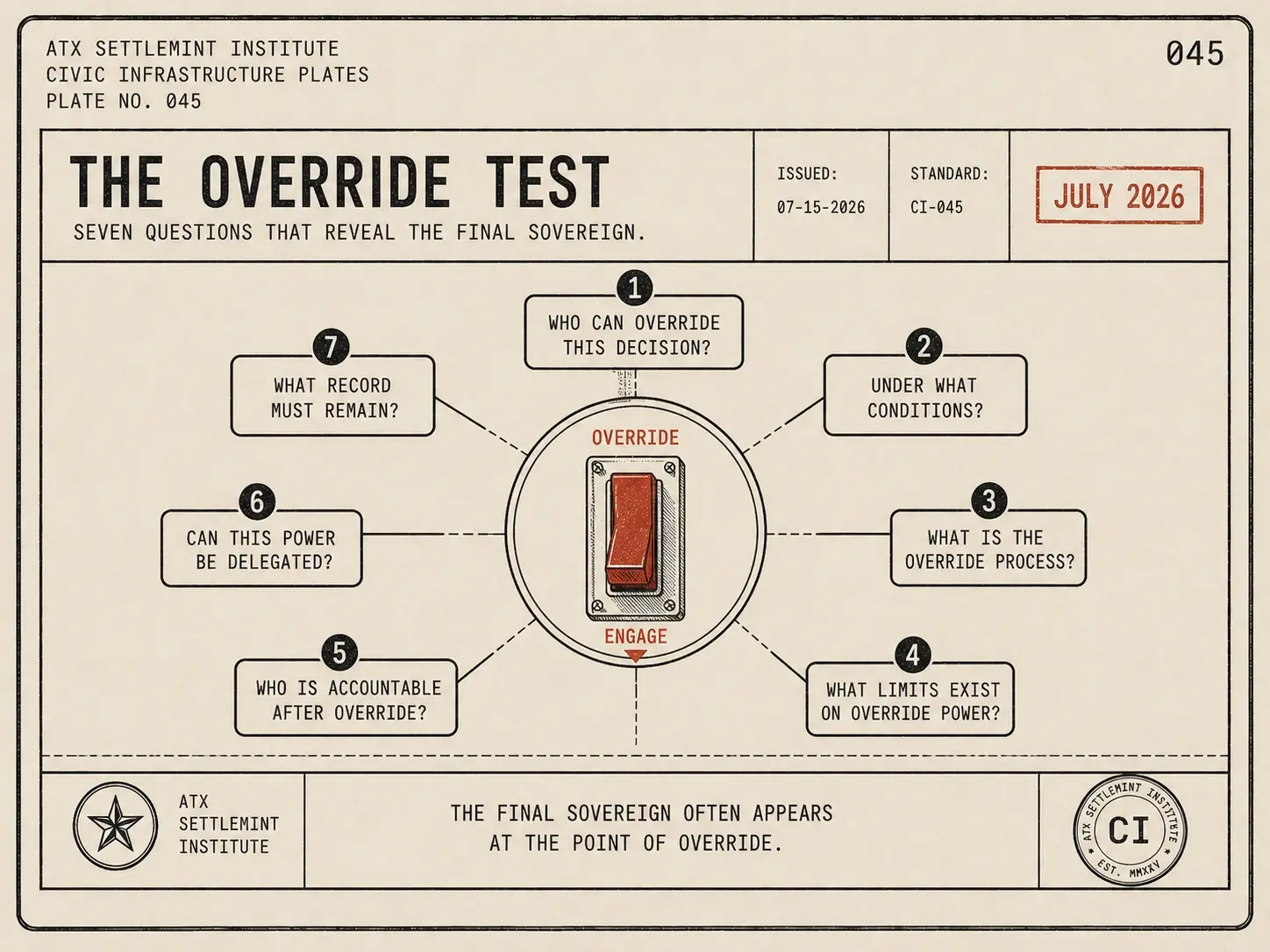
4.2 The override test (mandatory). Sovereignty is not only about what an entity can do. It is also about who can stop it. Every profile must ask:
- Who can override the decision?
- Who can revoke the authority?
- Who controls the courts?
- Who can freeze the treasury?
- Who controls coercive enforcement?
- Who can deny access to infrastructure?
- Who has the final appeal?
The final sovereign often appears at the point of override.
4.3 Compliant reporting style. The accurate-statement pattern is exemplified by:
This Settlemint has meaningful operational autonomy in energy, compute, communications, and treasury, while remaining legally subordinate to the surrounding sovereign state.
Calling such a community simply sovereign would hide more than it explains.
5. Conformance
A use of this specification is conformant when it:
- Evaluates each covered domain through the ten questions of the instrument, not through a single score.
- Names the relationship precisely, using the strongest accurate term from the ladder, not the strongest-sounding term.
- Never claims sovereign where the accurate term is lower on the ladder. Do not use this word merely because it sounds stronger than autonomy or control.
- Applies the override test and reports who has the final word in each domain.
- Reports in the pattern of Chapter 03's accurate statement: the domains where autonomy or authority actually exists, alongside the higher authority to which the entity remains subordinate.
6. What this specification does not define
This specification defines no quantitative scoring, no domain weights, and no certification. Whether the framework should use qualitative levels or numeric scoring, how legitimacy should be measured, and how legal authority and practical control should be weighted remain open. How sovereignty vectors should be measured is open. Do not force false precision before deployments create real data.
✴ Last updated · Wed Jul 22 2026 00:00:00 GMT+0000 (Coordinated Universal Time)