✴ The Settlemint Handbook · ModulesHB_07
External Relationships
A Settlemint must interact meaningfully with neighboring communities, governments, institutions, markets, suppliers, partners, and other polities — naming each relationship precisely, treating recognition as a spectrum, and never confusing recognition with capacity.
External relations is one of the ten functions a Settlemint must eventually prove. A settlement that cannot interact with the world around it is not autonomous; it is isolated, and isolation is not the goal.
The settlement can interact meaningfully with: neighboring communities, governments, institutions, markets, suppliers, partners, and other polities.
That is the published register. This module makes it operational: the posture a Settlemint takes toward existing sovereignty, how to speak about recognition without inflating it, how to examine each dependency, and how to name every external relationship precisely.
The posture: under existing sovereignty, cooperating deeply
A Settlemint does not need to be a sovereign state, diplomatically recognized, legally independent, or politically separatist.
It may exist under the sovereignty of an existing country and cooperate deeply with local government.
This is not a compromise position. The category is settlement maturity, not political emergence — see What Is Sovereignty? and What Is a Network State? for the full distinction. The better question is not:
Does it claim sovereignty?
It is:
Does it function as a meaningful human settlement, and in which domains is it becoming more capable, resilient, autonomous, or self-governing?
A Settlemint's external posture should therefore be cooperative and precise, not adversarial and vague. Cooperation with the surrounding jurisdiction is compatible with increasing operational autonomy, because:
Operational autonomy is not legal sovereignty.

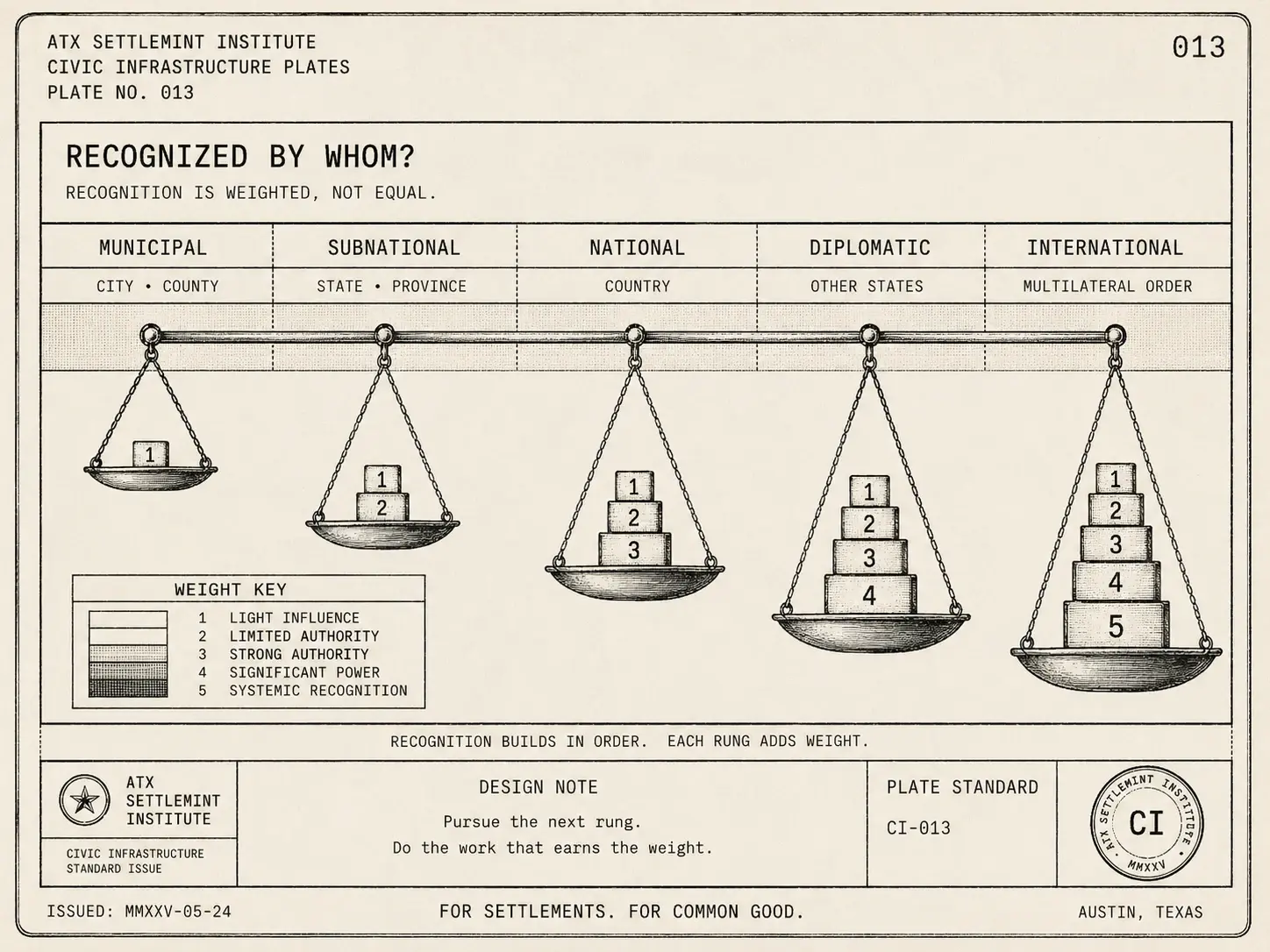
Recognition is a spectrum, and its forms are not equivalent
External relationships inevitably produce moments of acknowledgment: a meeting, a partnership, a cooperation agreement. The discipline is to name each one for exactly what it is.
Recognition is when an outside actor acknowledges that an entity possesses a particular status.
Recognition may come from:
- individuals,
- companies,
- municipalities,
- courts,
- regional governments,
- sovereign states,
- or international organizations.
These forms of recognition are not equivalent. As the published doctrine puts it: a mayor acknowledging a community is not the same as a sovereign state recognizing another state. A partnership is not recognition of statehood. A protocol listing is not political recognition.
Recognition does not create capacity, and capacity does not automatically create recognition.
The network-state chapter applies the same discipline to political standing: an introduction to a mayor, an MOU with a ministry, municipal cooperation, recognition by a sovereign government, formal diplomatic relations, and membership in an international organization do not carry equal weight. Recognition is treated throughout this guide as a spectrum of external standing rather than one vague claim.
Operationally: when a Settlemint records an external acknowledgment, it records the specific actor and the specific status acknowledged. The Authority and Autonomy Profile asks this directly in its recognition question — who acknowledges the status or authority? — domain by domain, actor by actor.
Dependencies are relationships; examine them
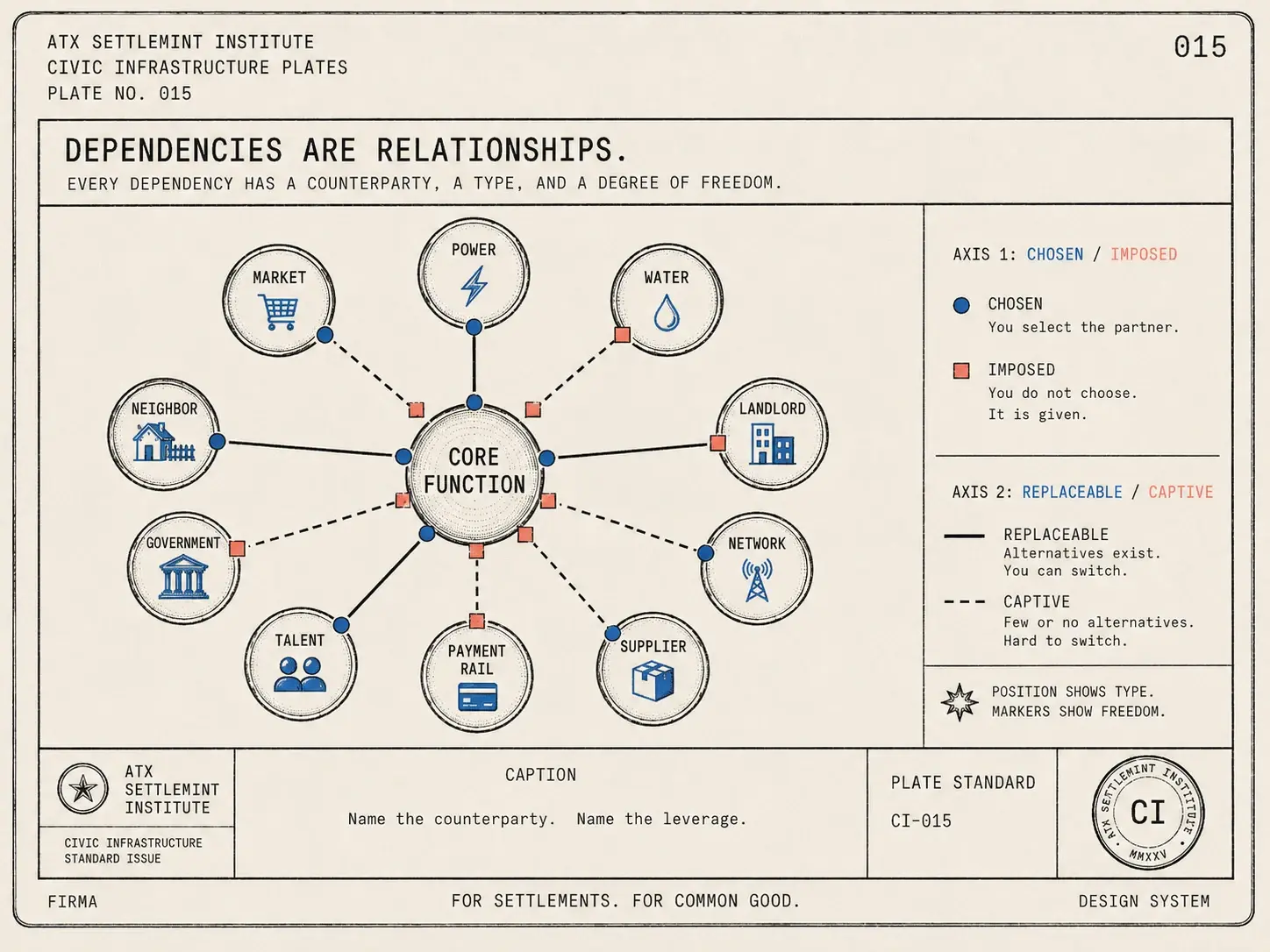
Every external relationship creates or reveals a dependency. That is not failure. Published doctrine is explicit that sovereignty is not isolation: every polity depends on trade, expertise, infrastructure, relationships, and neighboring systems.
The relevant questions are whether those dependencies are:
- chosen or imposed,
- reciprocal or one-sided,
- replaceable or captive,
- transparent or hidden,
- resilient or fragile,
- and governed by legitimate terms.
Sovereignty is not the absence of relationship. It is the ability to enter relationship without surrendering the capacity to govern what is properly yours.
Apply this list to each external relationship the settlement holds, in every category of the register — governments, institutions, markets, suppliers, partners, neighbors, and other polities. Dependence should be visible rather than hidden. The profile's dependence and override questions make the same demand: who can interrupt, revoke, or override it? and, among the published override questions, who can deny access to infrastructure?
Name each relationship precisely
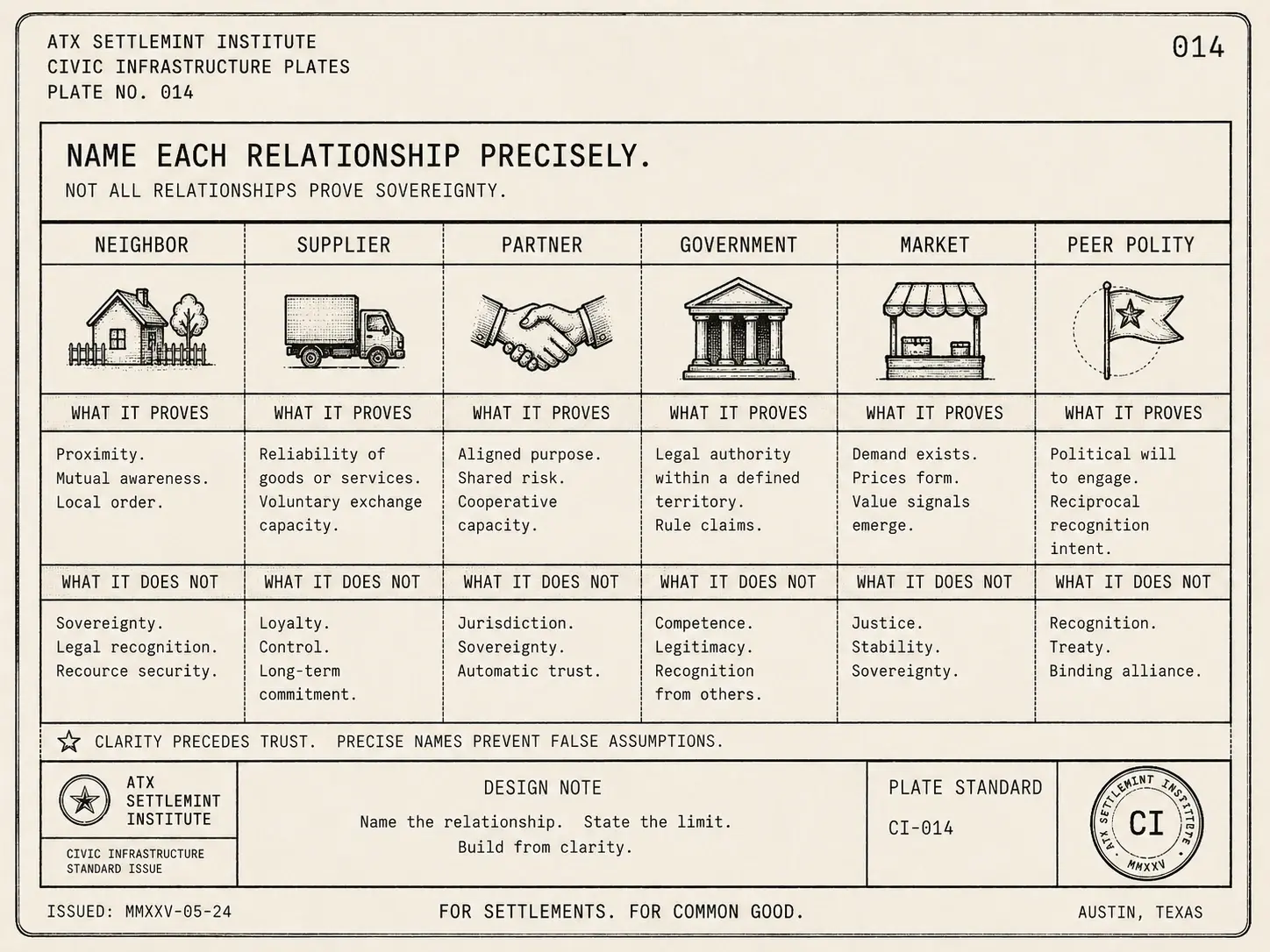
The published register lists the actors. A Settlemint's external relations become manageable when every relationship is filed under what it actually is. This module files them under five working headings:
- Jurisdictional — governments at every level: municipal, regional, national. These relationships carry lawful authority. The settlement remains subject to the law of the surrounding jurisdiction, and its lawful spheres of self-rule — municipal powers, private property, contracts, arbitration, religious institutional rights — are forms of jurisdictional autonomy inside another sovereign order, revocable by a higher authority.
- Commercial — markets, suppliers, and partners. These relationships are contractual and economic. They create real control and real dependence, and each should be examined with the dependency questions above.
- Institutional — institutions the settlement works with, including educational, financial, civic, and religious bodies. An institutional relationship may confer standing, resources, or lawful rights without conferring any political status.
- Neighborly — neighboring communities. These relationships rest on proximity and ongoing conduct rather than contract, and they are part of what external relations must prove: neighbors are among the actors who must be able to interact meaningfully with the settlement.
- Political — other polities: network polities, other settlements, and political communities. Interaction with a polity is not recognition of its claims, and its acknowledgment of the settlement is not recognition of statehood.
Precision here is the whole discipline. A supplier is not a partner-state. Each relationship should be described with the strongest accurate term, not the strongest-sounding term.
What external relations must prove
From the published network-state proof register:
External relations — substantive interaction with governments, institutions, markets, neighbors, and other polities.
The corresponding external proof for a network-born polity is external standing: governments, institutions, neighboring communities, and other political actors increasingly treat the community as a real entity with which they can interact.
External relations is also one of the dimensions of the published maturity map, alongside peoplehood, governance, economy, settlement, infrastructure, continuity, authority, and recognition. Like every dimension, it moves along the proof ladder:
Claim → Signal → Evidence → Repetition → Reliability → Institution
A single meeting is a signal. A functioning supplier relationship is evidence. A cooperation that survives leadership changes on both sides is approaching institution. Track it in the evidence ledger like any other function — see Maturity Stages and Proof Tests.
Do not simulate diplomacy
The same governance-language discipline that governs internal authority governs external language — see Governance and Dispute Resolution. The published discipline applies to every Settlemint: ATX should not simulate statehood or use sophisticated governance language before basic operating authority is clear. The published warnings are direct:
Diplomatic language does not prove diplomatic recognition.
A meeting with government officials does not prove diplomatic recognition.
ATX, the reference case, currently operates under the laws and jurisdiction of Texas and the United States, and District language there remains aspirational until actual political capacity and lawful authority emerge. That is the model for every Settlemint's external voice: describe the relationships you actually hold, in the categories they actually occupy, at the proof stage they have actually reached.
Specific proof is stronger than grand language.
✴ Last updated · Wed Jul 22 2026 00:00:00 GMT+0000 (Coordinated Universal Time)