✴ The Settlemint Handbook · ModulesHB_01
The Settlemint Stack: Functions Before Modules
A Settlemint stack is the coordinated set of human, physical, institutional, economic, and digital systems required to make a settlement function and become more capable over time.
The Settlemint is the functioning human settlement. A Settlemint stack is the set of systems that helps make that settlement operable.
The category comes before the product architecture. The settlement is real whether or not every module has been named.
The plain definition
A Settlemint stack is the coordinated set of human, physical, institutional, economic, and digital systems required to make a settlement function and become more capable over time.
The word stack should not imply software alone. A real settlement stack includes people, land, governance, housing, infrastructure, economy, care, memory, identity, communications, and relationships with the outside world.
Digital systems may help coordinate these functions. They do not replace the functions themselves.
Function first, module second
The handbook always explains the human function before naming a Firma product or module.
A settlement needs a way to make decisions, establish authority, resolve disputes, and correct leadership.
Only after that should the guide discuss whether a working concept such as Governmint helps provide part of that function. Likewise:
A settlement needs ways to allocate capital, coordinate exchange, account for contribution, manage infrastructure, remember obligations, house people, generate energy, and provide compute.
Only then should emerging names such as Figmint, Elemint, Photon, Havens, or Realm be introduced.
The function is canonical before the brand name is canonical.
The minimum functional stack
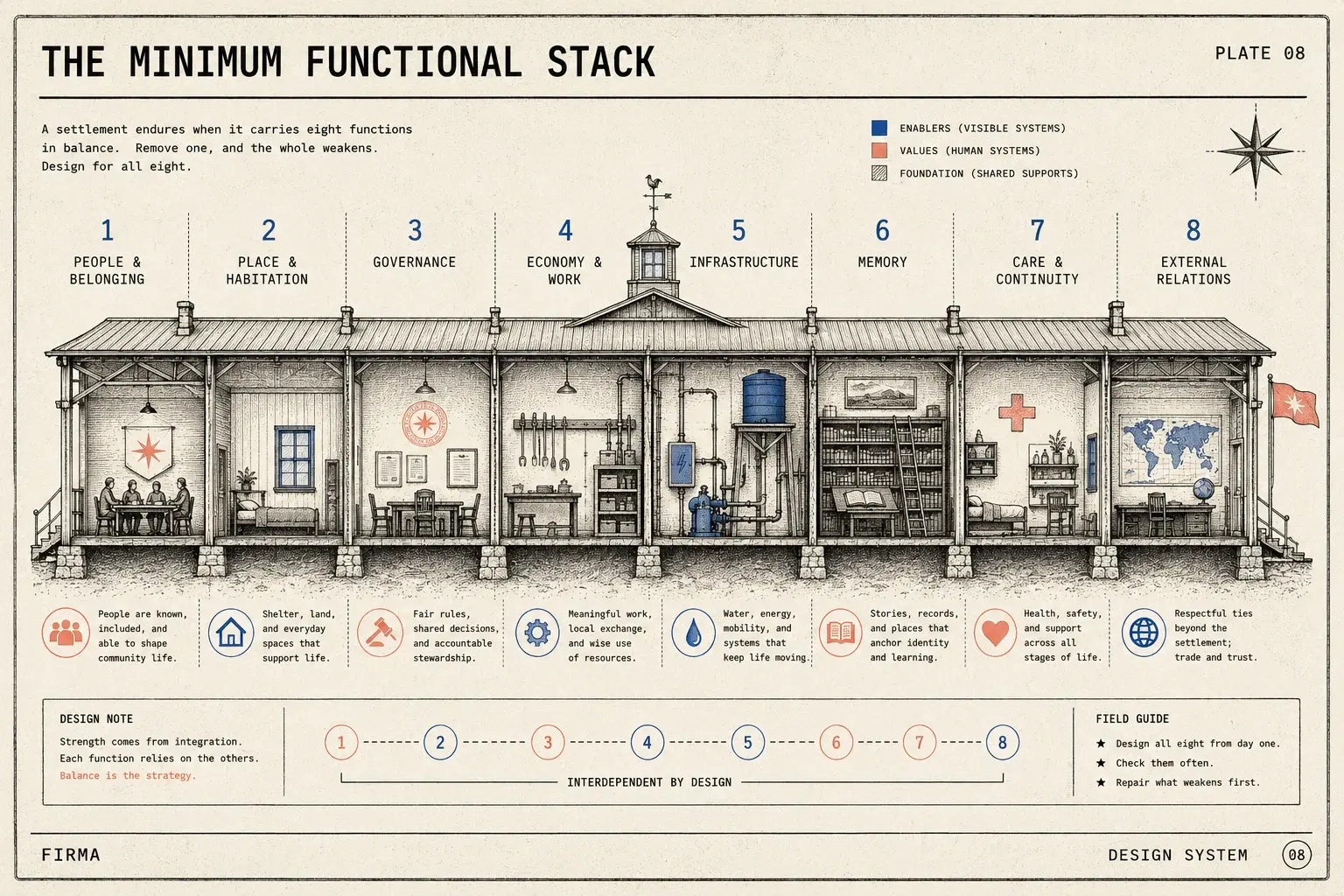
A Settlemint must coordinate at least eight domains.
1. People and belonging
A real body of people must know who belongs, how they participate, what is expected, what they may rely on, and how membership changes. This includes identity, covenant, culture, membership, households, and social continuity.
2. Place and habitation
People need a real place capable of supporting life: land, housing, utilities, access, maintenance, land use, and the relationship between public, common, and private space.
3. Governance and authority
The settlement must be able to make decisions, execute them, allocate authority, resolve conflict, correct mistakes, and maintain legitimacy. A vote alone is not enough.
4. Economy and work
The settlement needs real productive and economic activity: work, exchange, capital, treasury, contribution, compensation, public goods, ownership, and relationships with outside markets. A token alone is not an economy.
5. Infrastructure and resources
The settlement must coordinate the systems necessary for its context: water, energy, communications, compute, food, waste, transport, logistics, tools, healthcare, education, security, and local production.
6. Memory and accountability
The settlement must remember decisions, ownership, contribution, obligations, permissions, disputes, agreements, and institutional history. Memory may be oral, written, legal, digital, on-chain, or some combination.
7. Care and continuity
A settlement must respond when people, systems, or relationships fail: care for children, the sick, and the elderly; emergency response; maintenance; succession; restoration; and continuity beyond one founder or funding cycle.
8. External relations
The settlement must interact with governments, neighbors, suppliers, partners, markets, churches, institutions, and other polities. No settlement exists in a vacuum.
A stack is not a checklist of products
A settlement does not become a Settlemint because it purchased one item from each category. A home node does not prove communications resilience. Solar panels do not prove energy reliability. A governance app does not prove governance. A treasury wallet does not prove an economy. Housing units do not prove community.
The stack becomes real when systems work together in practice.
Integration is demonstrated when one function can reliably depend on another.
For example: identity grants the right permissions; permissions allow access to infrastructure; contribution is remembered; contribution may affect compensation or participation; governance can change the rules; records preserve the decision; and the system continues after the meeting ends. That is closer to a functioning stack.
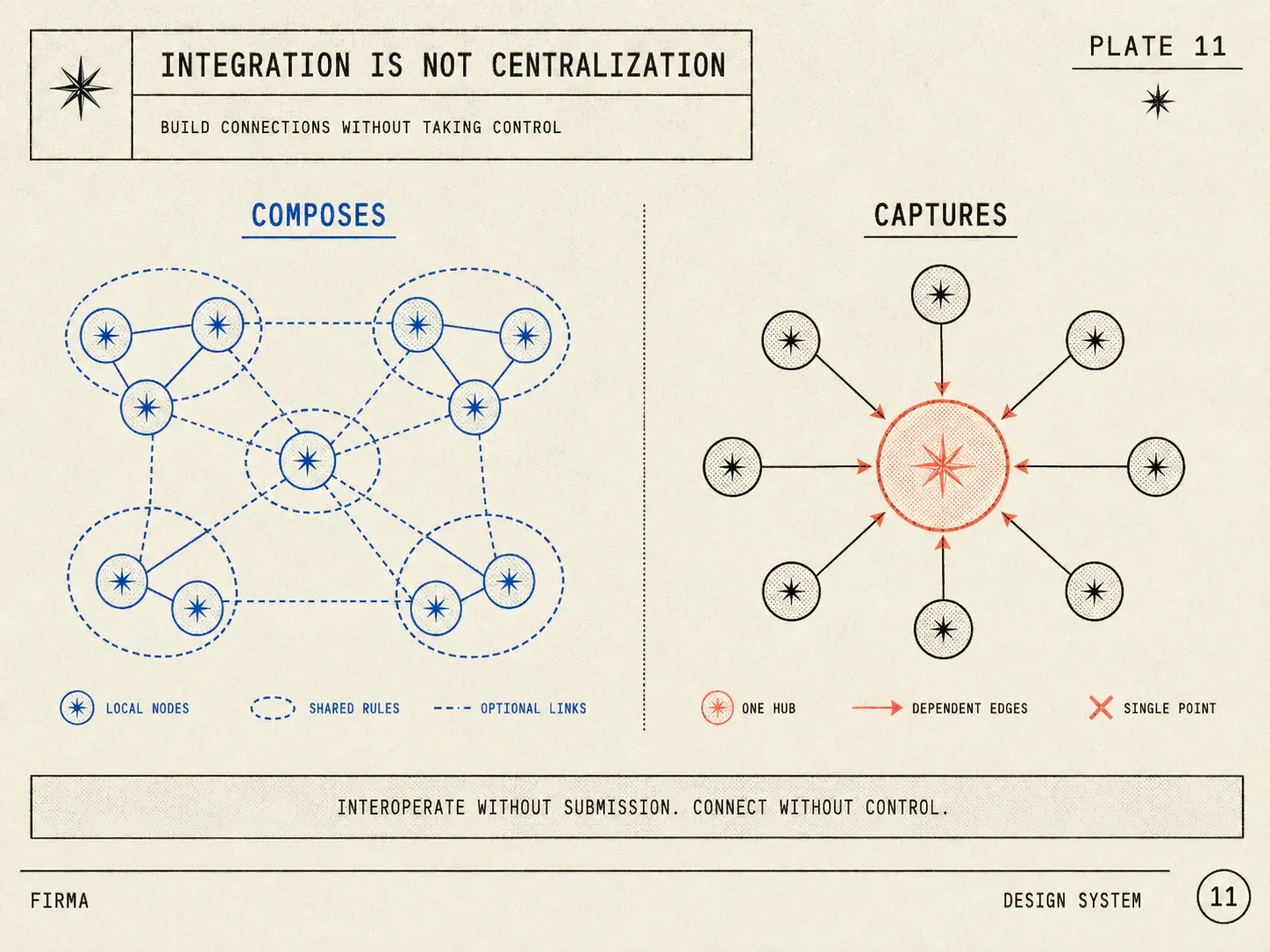
Integration does not mean centralization
A Settlemint stack may include many providers, legal entities, technologies, and local institutions. They do not all need to be owned or controlled by Firma. The real question is:
Can the settlement understand, coordinate, replace, and survive the dependencies among its critical systems?
A strong stack may be federated, modular, and interoperable. A weak stack may appear unified while depending on one opaque provider that can disable everything.
One interface is not the same thing as one center of control.
Firmamint's role
Firmamint is the shared substrate beneath the architecture. It may eventually help the stack coordinate identity and permissions, preserve records, remember contribution, route economic activity, coordinate agents, access compute, prove system activity, and interoperate with other Settlemints, Districts, or network states.
But Firmamint is not the entire Settlemint stack. Water systems, housing, legitimate governance, care, worship, work, and physical infrastructure do not become real because they have a chain representation.
Firmamint may coordinate the stack. It does not substitute for the settlement.
Its component page lives in The Firma Architecture.
Realm's role
Realm is the personal edge domain through which a person or household participates in the larger system.
Realm may connect the person to identity, permissions, personal AI, local inference, compute, energy, connectivity, contribution, ownership, and the shared mesh. Realm is not merely another settlement module — it is the personal edge through which the person participates in multiple parts of the stack.
The Realm crosses functional layers because the person does.
Its component page lives in The Firma Architecture.
The named stack
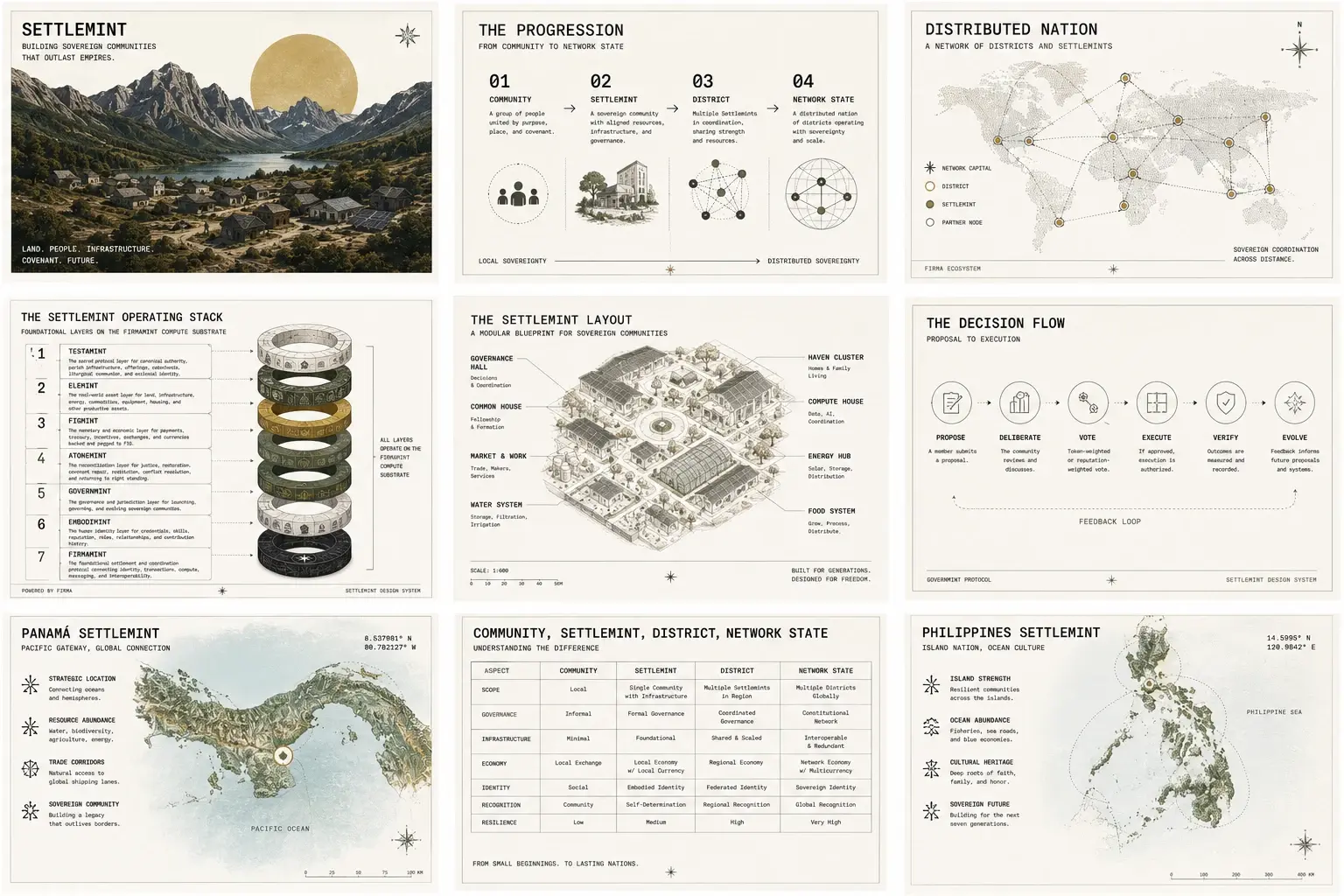
The current organizational architecture names a specific implementation of the stack — seven protocols, each mapping to functions this module describes:
- Firmamint — the coordination and settlement substrate the others run on
- Governmint — governance and jurisdiction
- Embodimint — human identity, credentials, and embodied participation
- Elemint — real-world assets: land, infrastructure, energy, equipment, housing
- Figmint — the monetary and economic layer
- Atonemint — reconciliation: justice, restoration, covenant repair, right standing
- Testamint — the sacred protocol layer, governed ecclesially
These names point at real functions. Per the canon's own discipline, each remains subject to the five-question module test below, and each carries a maturity label in The Firma Architecture rather than being treated as settled by naming alone.
The function is canonical. The implementation is provisional.
The five-question module test
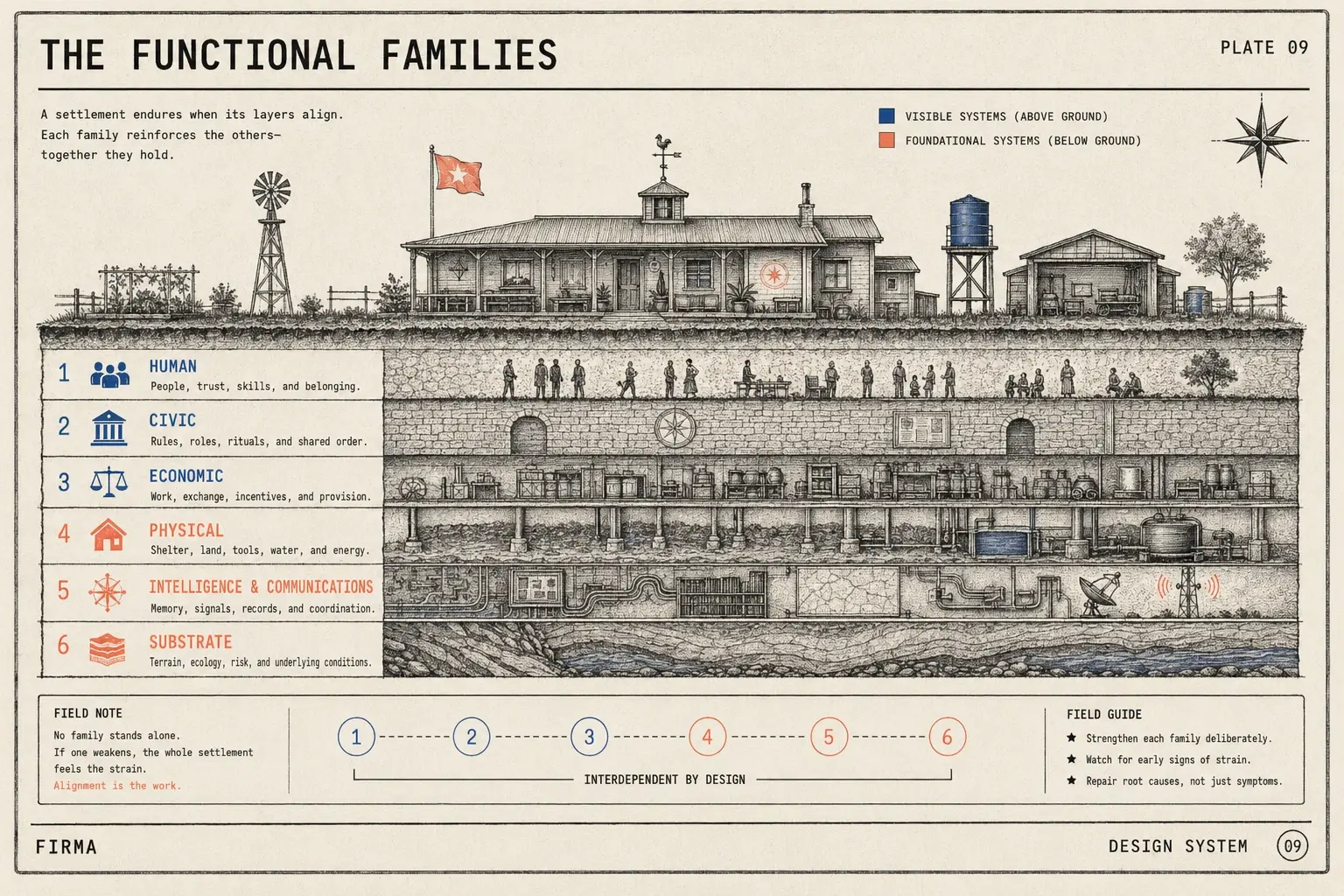
Before any working module name becomes canonical, it must answer five questions:
- What human or settlement problem does it solve?
- What is inside its boundary, and what is outside?
- How is it different from adjacent modules?
- What is its current proof status?
- Is the name necessary to explain the Settlemint model?
If these cannot be answered clearly, the term belongs in the working ledger rather than the canonical guide.
The functional families
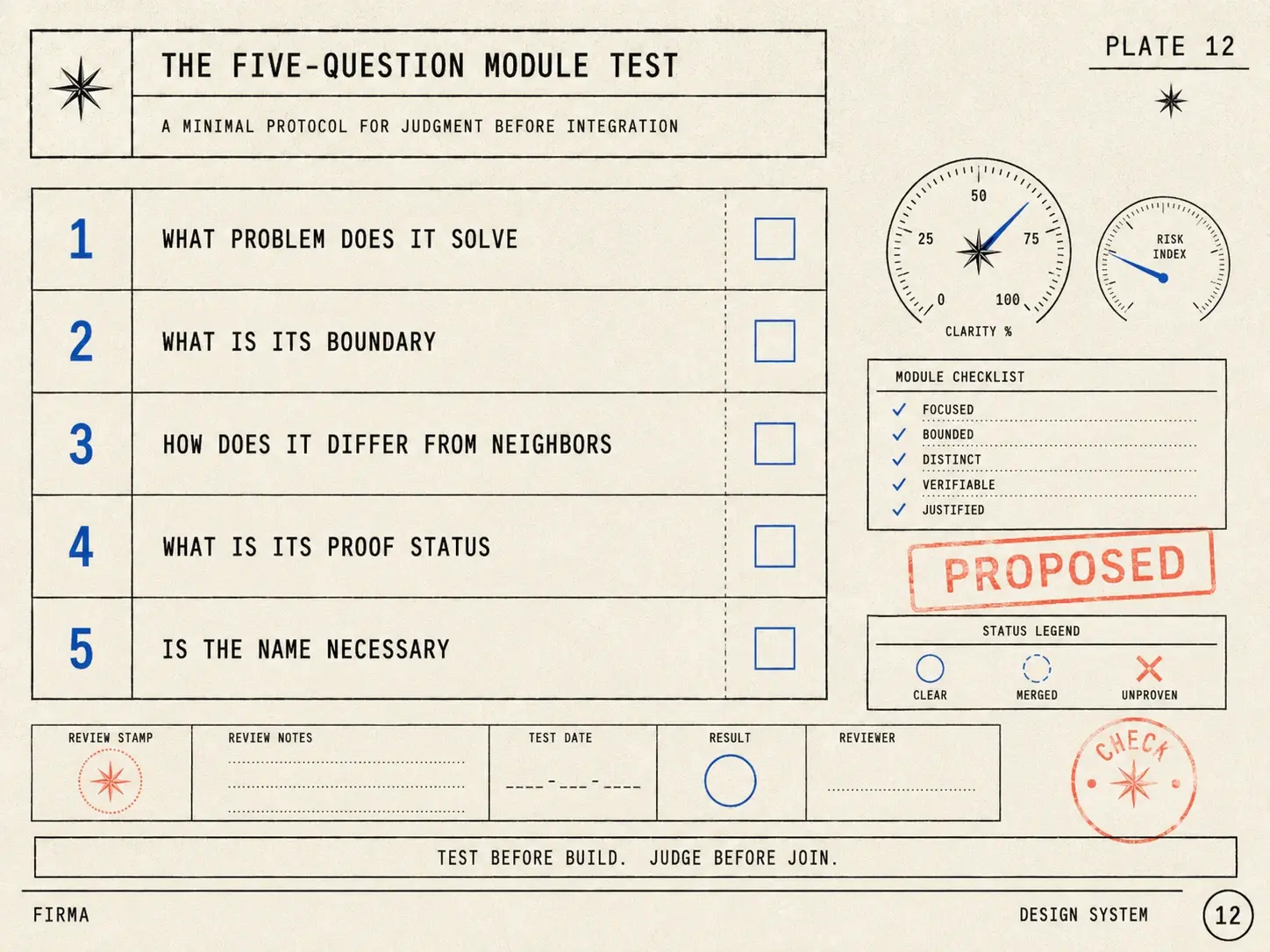
Until the module taxonomy is proven, the handbook uses functional families rather than a dense set of product names.
- Human layer — people, households, belonging, covenant, identity, care, culture.
- Civic layer — governance, authority, membership, dispute resolution, representation, external relations.
- Economic layer — work, capital, exchange, treasury, contribution, ownership, public goods.
- Physical layer — land, housing, energy, water, food, transport, logistics, healthcare, production.
- Intelligence and communications layer — connectivity, compute, AI, agents, data, sensing, memory.
- Substrate layer — Firmamint, interoperability, shared records, proofs, permissions, routing, settlement coordination.
This is not a rigid technical stack. It is an information architecture for explaining the whole.
The stack varies by context
A remote frontier Settlemint may prioritize energy, communications, water, compute, logistics, and housing. A church-centered urban Settlemint may prioritize worship, membership, care, education, housing, treasury, and local economic coordination. A humanitarian deployment may prioritize shelter, healthcare, water, communications, logistics, and identity.
The functions are recurring. The implementation is contextual.
Minimum viable stack versus mature stack
A minimum viable Settlemint does not need every function at high maturity. It needs enough integrated function to support a persistent community in place: real people, real place, shared purpose, habitation, a workable decision process, meaningful shared work or economic activity, critical infrastructure, institutional memory, and demonstrated continuity.
A mature stack may add redundancy, local production, stronger autonomy, durable institutions, sophisticated economic coordination, interoperable Realms, advanced care systems, and deeper political capacity.
Maturity is increasing reliability, integration, legitimacy, and resilience — not merely adding more modules.
The maturity discipline has its own module.
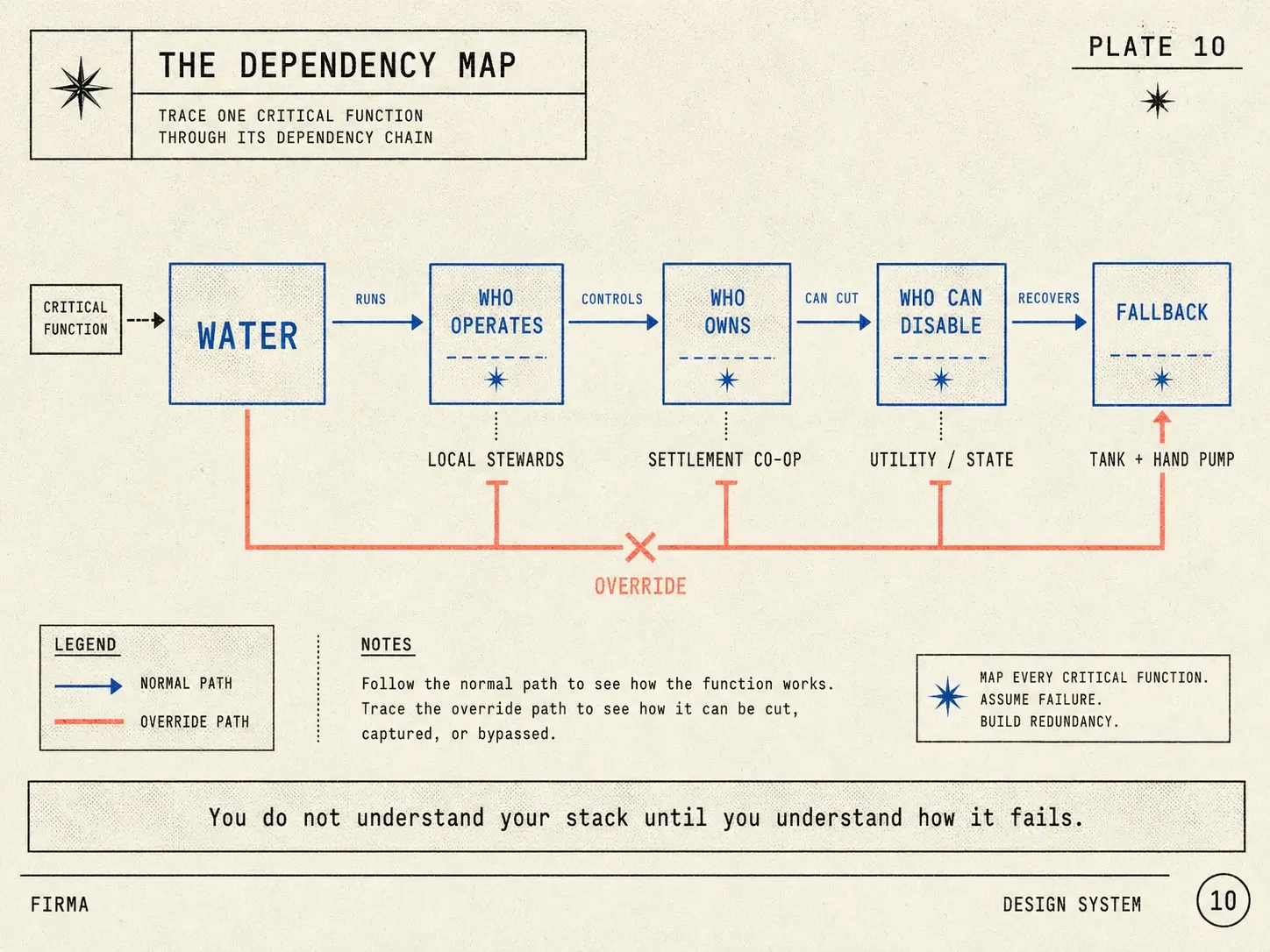
The dependency map
Every Settlemint should be able to map critical dependencies. For each essential function, ask:
- Who operates it?
- Who owns it?
- Who has authority over it?
- What does it depend on?
- Who can disable it?
- Can it be replaced?
- How long can the settlement survive its failure?
- What is the fallback?
You do not understand your stack until you understand how it fails.
The interface question
People should not have to understand twenty modules to participate in settlement life. Realm may become the primary personal interface; a settlement operating layer may provide shared visibility into work, decisions, resources, infrastructure, contribution, permissions, care needs, and community activity.
But interface simplicity must not conceal authority. People should be able to understand what system made a decision, who controls it, what data it uses, how it can be challenged, and what happens when it fails.
Simple experience. Legible authority.
The stack is not the sovereignty claim
A Settlemint may operate an impressive stack and still remain under the sovereignty and jurisdiction of an existing state. The stack can increase capacity, resilience, autonomy, bargaining power, and local governance capability. It does not automatically create independent jurisdiction, diplomatic recognition, territorial sovereignty, or statehood.
The stack builds capability. Political status must still be earned, granted, negotiated, recognized, or otherwise established.
The lines to remember
Do not start with the module names. Start with what human life in place must actually be able to do.
The settlement is the reality. The stack is the support. The substrate is the coordination layer.
✴ Last updated · Tue Jul 21 2026 00:00:00 GMT+0000 (Coordinated Universal Time)