✴ The Settlemint Handbook · ModulesHB_13
Public Goods and Contribution
Public goods are named inside the economic function a Settlemint must prove, and contribution to them must be remembered, governed, and evidenced — a commons is shared capability under stewardship, not simply something free.
A commons without stewardship becomes depletion. A commons without meaningful access becomes private infrastructure with better language.
Public goods are not an ornament added to a settlement economy after the productive work is done. They are named inside the economic function itself. The published proof set states:
There is actual coordination of labor, capital, exchange, contribution, production, treasury activity, or public goods. A token alone does not satisfy this requirement.
Work, Economy, and Treasury treats the economic function as a whole. This module treats one part of it in depth: what a commons actually is, how contribution to it should be remembered, and what a settlement must answer before it claims its public goods are real.
A required function, not a decoration
The published architecture places public goods wherever the settlement's real work is described. The economic layer of the Settlemint stack is defined as work, capital, exchange, treasury, contribution, ownership, and public goods. The published handbook plan names work, production, and public goods among the primary operating domains, and public goods and contribution as its own canonical module — this one.
The reason is embodiment. Settlemints exist so that certain capabilities can stop being purely individual:
They may allow energy systems, workshops, housing, food systems, worship, education, care, governance, logistics, and public goods to become shared rather than purely individual.
A settlement that provides no shared capability has not yet done the thing a settlement is for.
What a commons actually is
The published definition is deliberately precise:
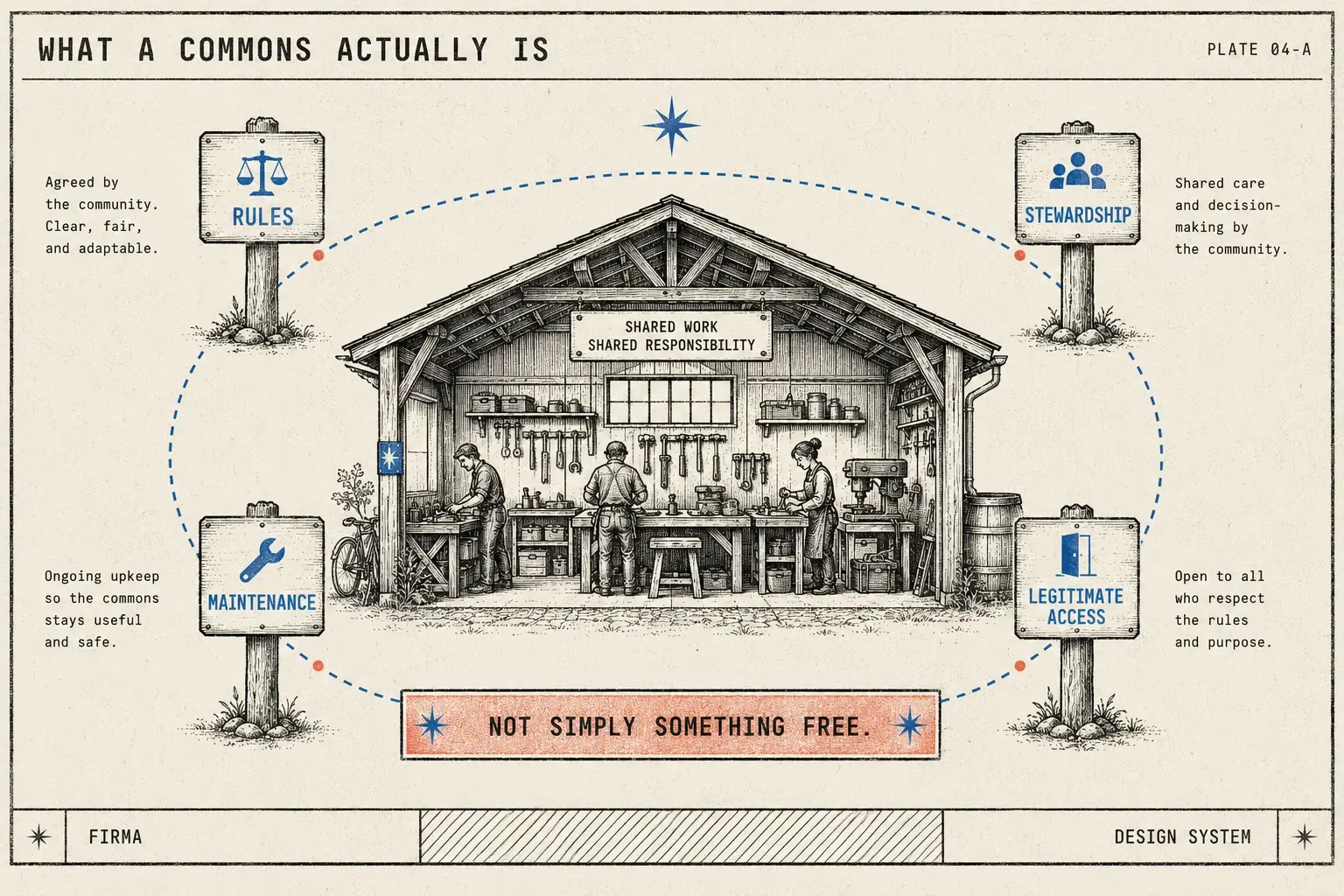
A commons is not simply something free. It is a shared capability governed through rules, stewardship, maintenance, and legitimate access.
The canon elaborates the same discipline as a founding principle: a commons requires boundaries, maintenance, governance, fair access, accountability, and protection from extraction or depletion. Both failure modes in the opening line are real. A commons abandoned to goodwill is depleted. A commons whose access is not meaningful is simply someone's private infrastructure wearing better language.
Governing the commons is therefore governance work, not economic residue — who may use it, who maintains it, who decides, and who corrects abuse are settlement decisions like any other; see Governance and Dispute Resolution.
Contribution is a first-class record
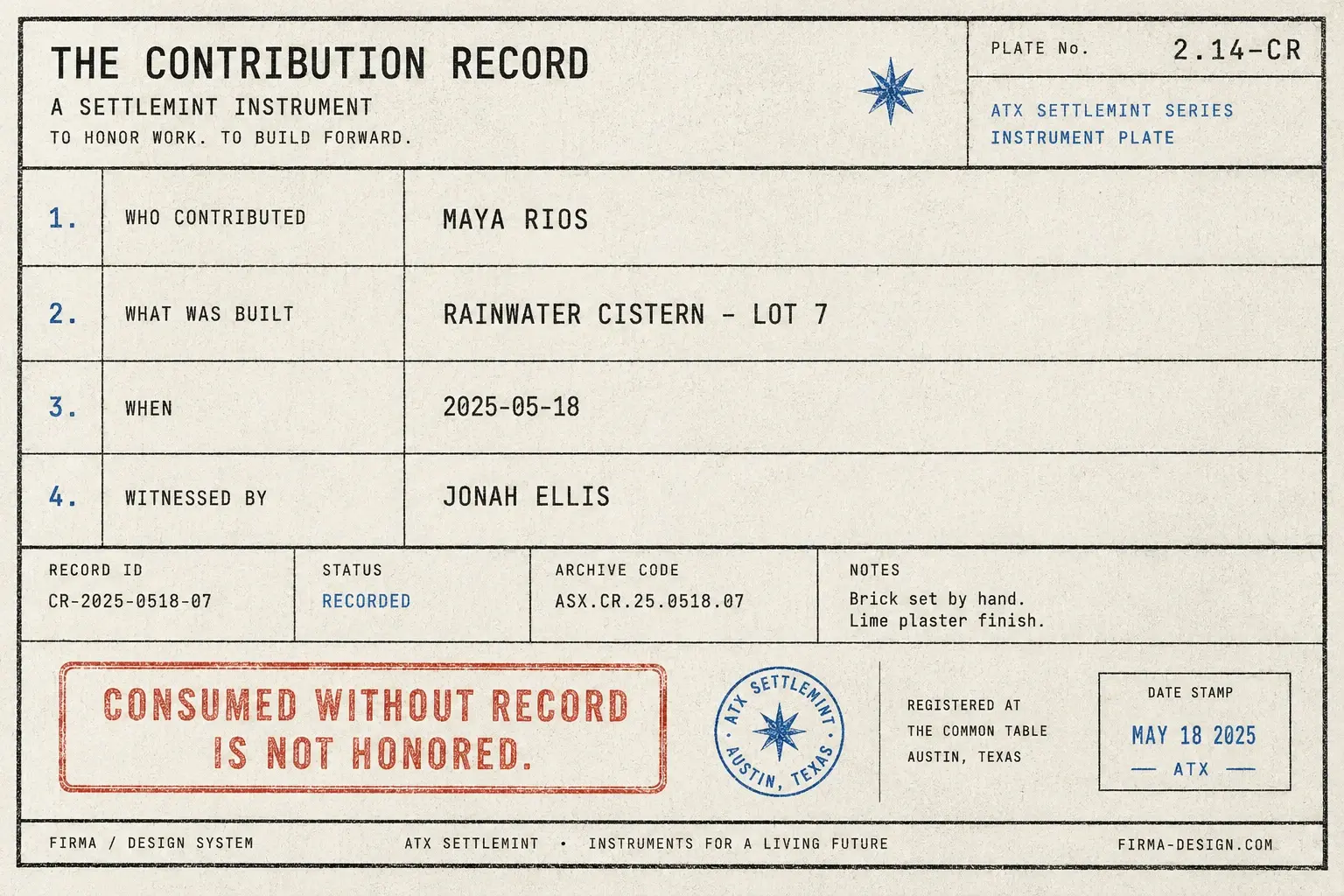
The settlement's memory function names contribution explicitly: the settlement must remember decisions, ownership, contribution, obligations, permissions, disputes, agreements, and institutional history. Among the things it must remember about its people are who contributed and what reputation was earned.
The published integration test makes the record load-bearing: contribution is remembered, and contribution may affect compensation or participation. And the standing principle:
Contribution should create durable memory, accountability, and fair participation.
A contribution that disappears into the commons without record has not been honored — it has been consumed. The canon also states what qualifies: contribution must be useful, consensual, legible, and sustainably rewarded or reciprocated where appropriate.
The questions a serious settlement must answer
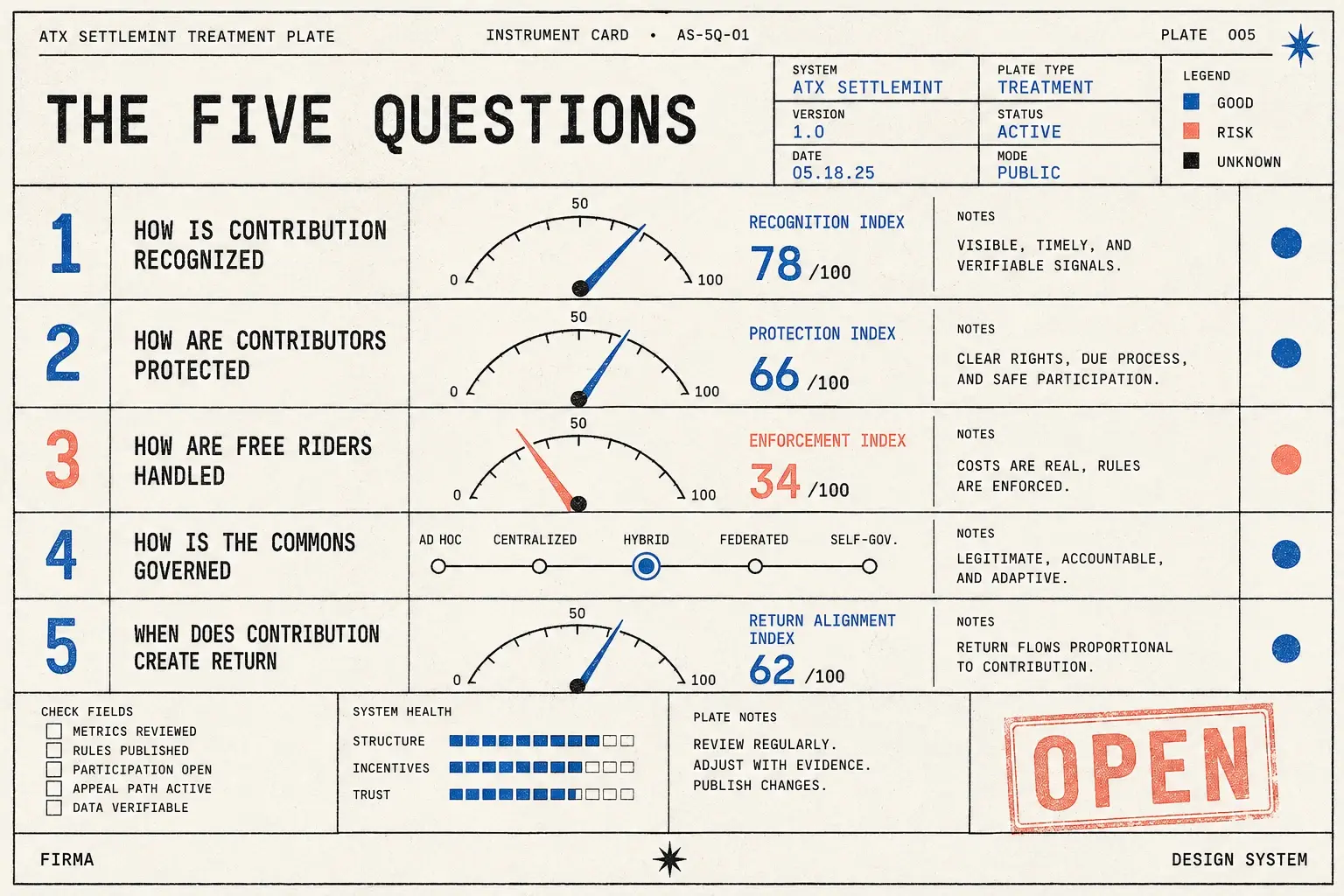
The published doctrine on generosity and the commons gives the working checklist. A serious system must answer:
- How is contribution recognized?
- How are contributors protected?
- How are free riders handled?
- How is the commons governed?
- When should contribution create compensation, ownership, reputation, reciprocity, or no return?
The canon is honest about the state of these answers: they remain open architectural questions. The principle should be preserved without pretending the mechanism is solved. A Settlemint should answer them locally, in writing, before its commons carries real weight — and record what it decided.
Generosity cannot be coerced
The thesis generosity is the consensus mechanism is treated carefully in Building for the Edges: it is a social and economic thesis, not a replacement for technical consensus protocols. Generosity may include sharing excess capacity, building public goods, contributing labor, teaching, hosting, protecting, or carrying another member through failure.
The boundary is equally published:
Generosity cannot be coerced without becoming extraction.
Nor should the commons become a mechanism for exploiting the most generous people. The operational discipline lives in the economy module: payment and freely given excess are separate records, because generosity is not a wage —
The system must not treat every act of generosity as unpaid labor that should have been compensated, nor every paid act as less meaningful because money was involved.
A settlement should let generosity become visible without becoming coercive.
When contribution creates return
Canon poses the question — compensation, ownership, reputation, reciprocity, or no return at all — and does not settle it. The only published pattern for earning through contribution, earning by giving excess, is explicitly an unproven thesis, with its proof obligations listed in Work, Economy, and Treasury: the resource must be real, the contribution useful, demand present, accounting credible, compensation sustainable, and the economics not primarily speculative. Until a mechanism proves those things, when contribution creates economic return remains open.
Remembering contributors without scoring them
The named implementation for contribution memory is Embodimint — the identity and reputation layer of the stack, which carries credentials, relationships, skills, reputation, roles, and contribution history. Its maturity is proposed: named with a function and an owner, established nowhere as deployed or proven.
Its boundary discipline governs any contribution record a settlement keeps, whatever the tooling:
Identity and reputation should not be reduced to a single universal score.
Reputation is contextual — trusted as a builder, unproven in governance — and context is exactly what a single score erases. The full history behind a reputation should not automatically be public; bounded, contextual attestations can be derived without exposing the complete record. A contribution ledger that produces one public, permanent, universal number has not solved the memory problem — it has built surveillance with better branding.
The function is canonical. The implementation is provisional.
Claimed public goods must be evidenced
Public goods claims face the same proof discipline as every other function — see Proof of Function. The published calibration is exact: a treasury funding real public goods is evidence; an operating treasury by itself is only a signal. So is members repeatedly completing shared work.
A settlement claiming public goods should hold an entry for the claim in its evidence ledger — claim, status, evidence, dependencies, failure modes, next proof — per Maturity Stages and Proof Tests. If the shared workshop is maintained by one founder, if the commons works only while subsidized, those are material facts and belong in the record.
Specific proof is stronger than grand language.
Related modules
- Work, Economy, and Treasury — public goods inside the economic function; payment versus freely given excess; the unproven earning thesis.
- Membership and Belonging — the recognized relationships and responsibilities from which contribution arises.
- Maturity Stages and Proof Tests — the evidence ledger and proof ladder that public goods claims must survive.
✴ Last updated · Fri Jul 31 2026 00:00:00 GMT+0000 (Coordinated Universal Time)