✴ The Settlemint Handbook · ModulesHB_12
Energy and Compute
Energy and compute are settlement infrastructure domains the edge must be able to operate locally — operational autonomy with honest dependency profiles, not legal sovereignty, with useful excess shared under a deliberate privacy boundary.
A community cannot meaningfully govern what it cannot operate.
Energy and compute sit among the systems every Settlemint must coordinate. The published stack doctrine names them directly:
A settlement needs ways to allocate capital, coordinate exchange, account for contribution, manage infrastructure, remember obligations, house people, generate energy, and provide compute.
In the stack's layering, energy belongs to the physical layer — alongside land, housing, water, food, transport, and production — while compute belongs to the intelligence and communications layer, alongside connectivity, AI, agents, data, sensing, and memory. See The Settlemint Stack. This module is the operational treatment: why the edge needs both locally, what kind of autonomy they create, and what discipline governs sharing them.
Why the edge needs them locally
The edges are where existing systems stop working well enough — the frontier, where people operate past where systems were designed to operate, and the reach, where people live past where systems were designed to reach. See Building for the Edges.
Frontier builders face a published paradox:
The more novel the thing they are building, the less likely existing infrastructure was designed for it.
They may need to assemble their own energy, compute, communications, housing, logistics, payments, coordination, governance, or institutional relationships. And the deeper diagnosis:
The frontier does not necessarily lack resources. It often lacks systems capable of composing those resources into reliable local capacity.
At the reach, the stronger question is what a place can already contribute — including energy potential — and what infrastructure would allow that contribution to compound locally and across a wider network.
Neither domain must arrive first. The published modularity rule governs sequencing:
Modularity allows capability to arrive in the order the edge actually requires it.
One place may need communications first, then energy and compute. Another may begin with people, covenant, land, housing, worship, and shared work.
Operational autonomy is not legal sovereignty
Energy autonomy and compute autonomy are named forms of operational autonomy — the practical ability to sustain or govern a function without total dependence on outside systems. That is why they matter to a Settlemint: a community cannot meaningfully govern what it cannot operate.
But the published boundary is explicit:
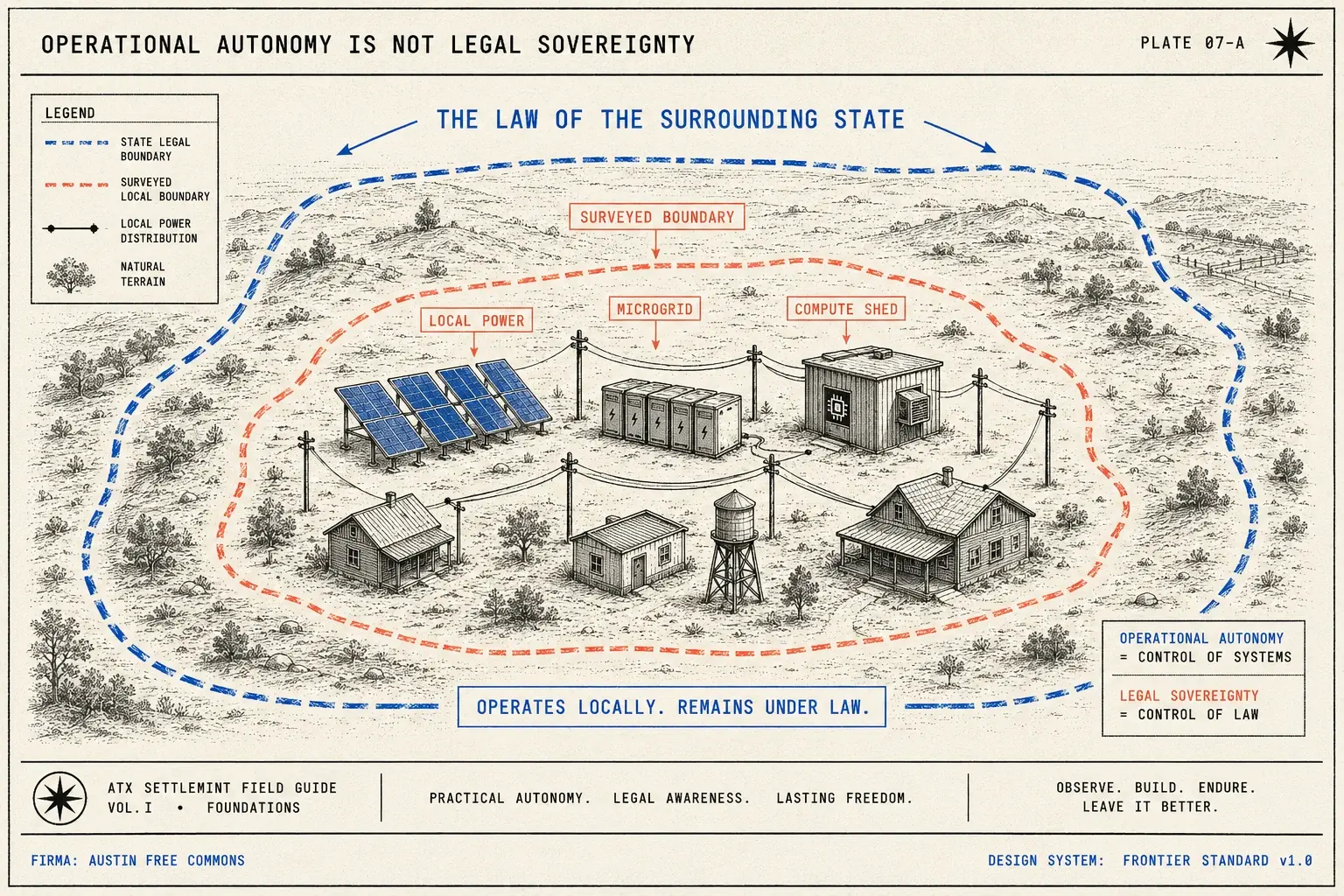
Operational autonomy is not legal sovereignty.
A community may produce all its own electricity and still remain fully subject to the law of the country in which it operates. A Settlemint may operate energy and compute systems while remaining under the laws of the surrounding country. The accurate claim sounds like this:
This Settlemint has meaningful operational autonomy in energy, compute, communications, and treasury, while remaining legally subordinate to the surrounding sovereign state.
Use the strongest accurate term, not the strongest-sounding term. See What Is Sovereignty?
Proof discipline applies here as everywhere. Solar panels do not prove energy reliability, and a settlement does not become a Settlemint because it purchased one item from each category. Capacity claimed is a signal; capacity operated and sustained is evidence.
Dependency profiles, not contradictions
Sovereign infrastructure does not mean infrastructure independent from every outside system. It increases the ability of people or communities to control, govern, replace, interoperate with, or survive the failure of systems critical to their lives — and the published list of such systems includes both energy and compute.
The canon's own examples:
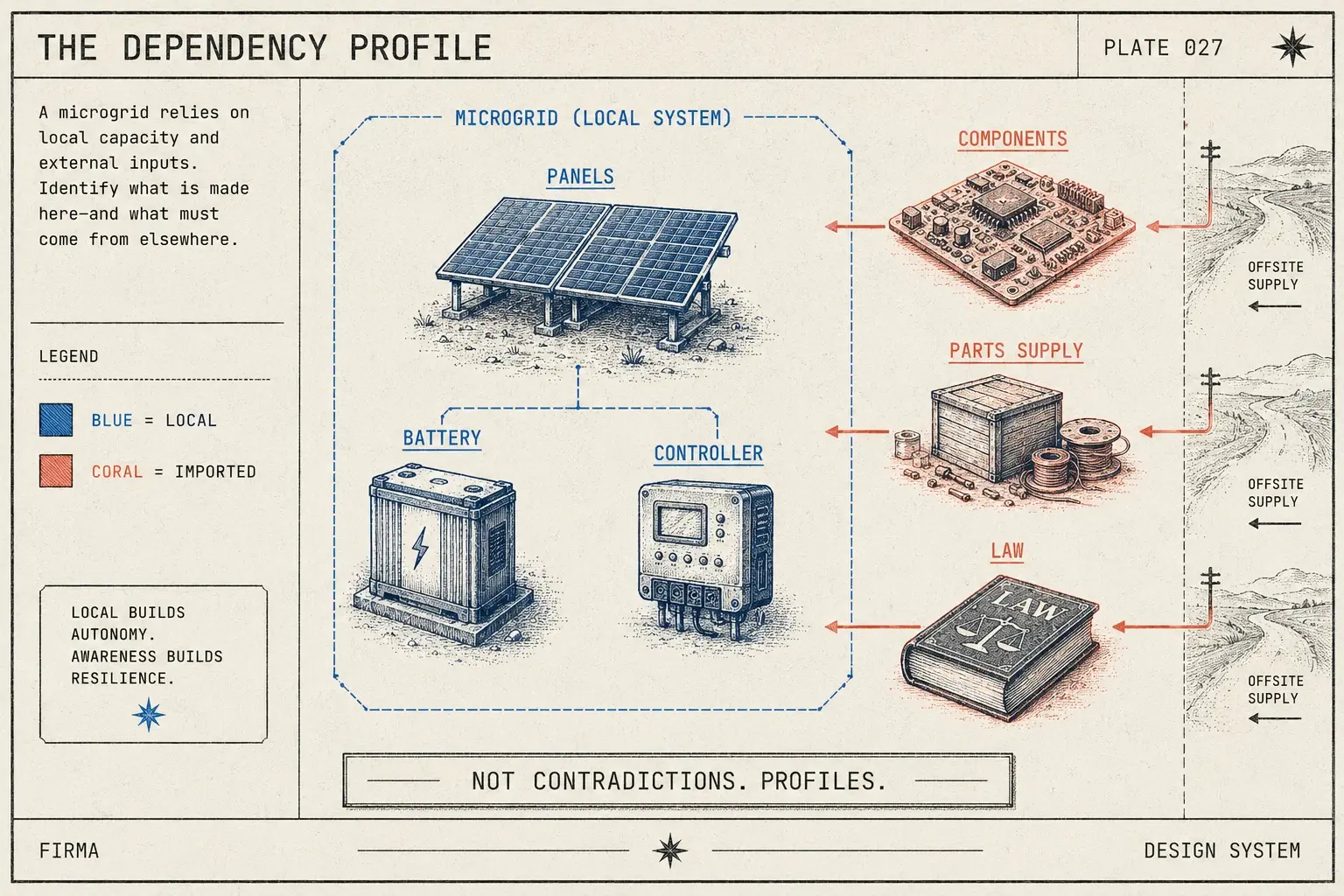
A microgrid may increase energy autonomy while relying on imported components and existing law. A locally hosted model may improve data control while depending on external hardware.
These are not contradictions. They are dependency profiles.
The goal is not autarky:
The goal is not to pretend dependency has disappeared. The goal is to make dependency visible, diversified, negotiable, and survivable.
An honest settlement record states its energy and compute dependencies plainly — who supplies the components, who can interrupt the service, what fails first — rather than hiding them behind the word sovereign.
Useful excess
Settlements and their members produce excess that is often wasted, stranded, or difficult to coordinate — unused compute and excess energy lead the published list.
What is excess to one node may be capacity to another.
The real challenge is to make contribution measurable, trustworthy, routable, reciprocal, and worth sustaining. The abundance test applies: does participation create new useful capacity, does contribution strengthen the contributor as well as the network, and does infrastructure compound locally?
The economic discipline governing this pattern lives in Work, Economy, and Treasury and governs here too. A Realm, household, or Settlemint may contribute compute, energy, connectivity, storage, or hosting to a wider network and may receive value in return — but the network should create value by making previously isolated capacity useful, not merely by financializing participation, and any future mechanism must prove the resource is real, the contribution is useful, demand exists, accounting is credible, compensation is sustainable, and the economics are not primarily speculative.
Until then, earning by giving excess remains a thesis rather than a proven model.
The privacy boundary
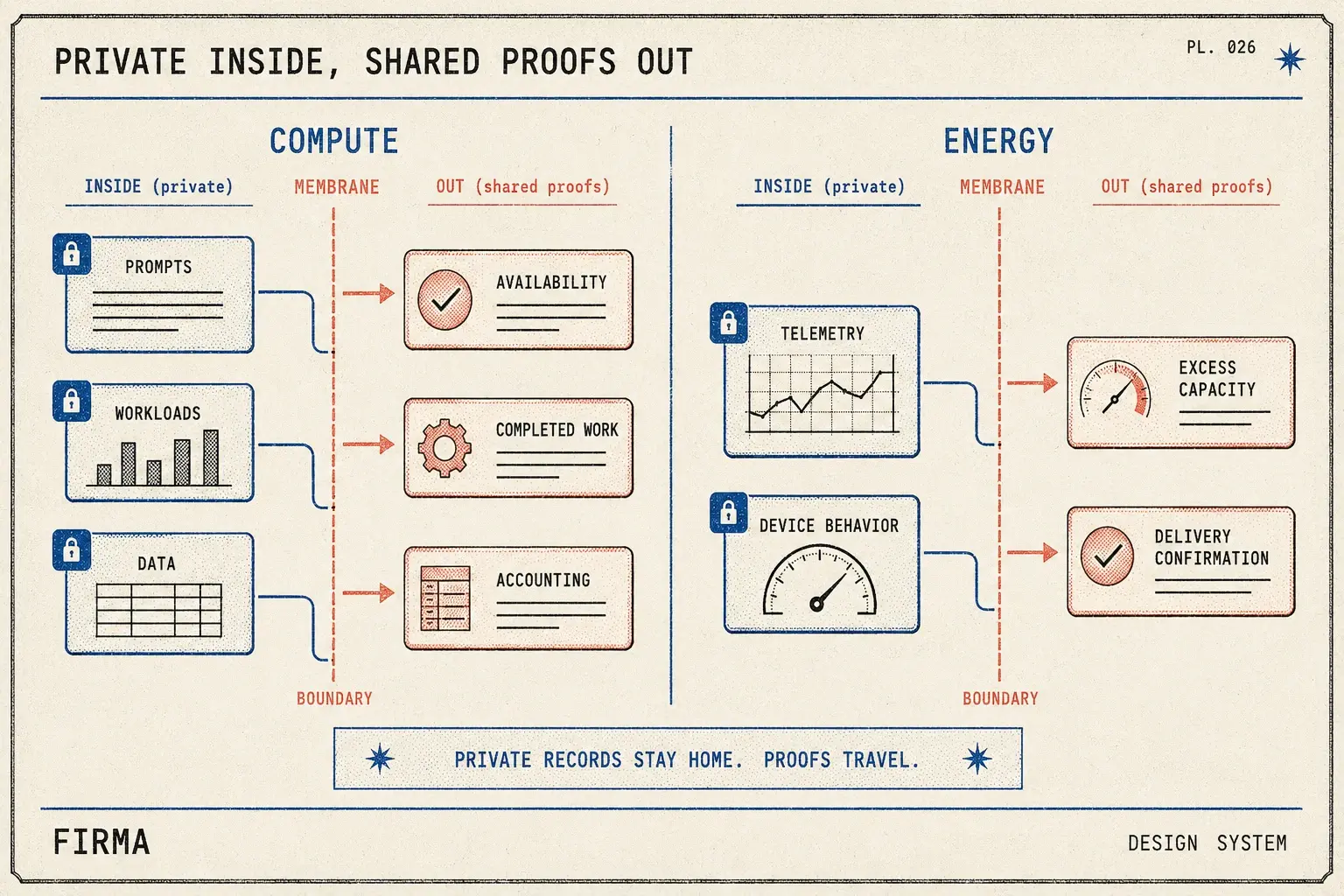
Sharing excess does not mean sharing everything. The published substrate boundary: Firmamint receives only what the network needs to verify or coordinate — including compute and energy availability, resource commitments, contribution proofs, and settlement records. The internal life of a person, household, organization, or settlement — conversations, deliberations, private context, telemetry — stays private to its own domain.
Applied to these two domains, the boundary in the canon's privacy model runs:
- Compute — prompts, workloads, proprietary data, and AI context remain private. What is shared is available compute, completed work, resource accounting, and settlement information.
- Energy — household telemetry, device behavior, and occupancy patterns remain private. What is shared is excess capacity, requested capacity, delivery confirmation, and settlement records.
Publication to the substrate should always be intentional, not automatic.
Proposed — the exact publication-boundary model remains open. See Firmamint.
Function before product
The functions are canonical: a settlement must be able to generate energy and provide compute. The implementations are provisional.
The canon names emerging physical systems that may eventually serve these functions. Photon — proposed — is an emerging energy system, or an economic representation of contributed energy. On the compute side, the canon names a function family rather than a product: edge compute, shared compute, hardware, and access to computational capacity. Exact boundaries and relationships remain unfinished, and the canon's own instruction applies:
Do not place them into a final diagram merely because names exist.
A Settlemint should use the simplest reliable tool that solves the present problem.
The Realm is the personal contribution point
Energy and compute do not enter the network only at settlement scale. A Realm — the living personal edge domain of a person or household — may contribute compute, bandwidth, storage, energy, sensing, and other productive resources. Proposed. See Realm.
The individual gives useful excess to the commons. The commons makes every Realm less fragile and more capable.
Contribution must have memory: it should create durable memory, accountability, and fair participation. The specific recording mechanisms remain provisional until separately defined. Where personal AI is involved, the Realm is designed to be the primary trust boundary for personal context — local or edge inference keeping intelligence close to the person, reaching beyond only when needed. Proposed — no privacy or security guarantees are claimed until architecture proves them.
How energy and compute contribution is rewarded, how grid interconnection and shared-compute routing actually work, and how availability is verified at scale — canon is silent; these remain open.
Related modules
- The Settlemint Stack — energy and compute among the domains every Settlemint must coordinate, and the layering that places them.
- Housing and Shared Infrastructure — the rest of the physical layer these systems power and serve.
- Work, Economy, and Treasury — useful excess, the commons, and the unproven thesis of earning by giving excess.
✴ Last updated · Fri Jul 31 2026 00:00:00 GMT+0000 (Coordinated Universal Time)