✴ The Settlemint Handbook · ModulesHB_09
People and Covenant
How a body of people becomes a people — the threshold of "we," the binding principle stronger than convenience, households as a real unit, and the formation of shared memory, culture, and duty before any administration begins.
A Settlemint can be populated without being inhabited by a people. A development can provide land, buildings, and utilities without producing a people, shared purpose, governance, memory, or belonging. This module consolidates what the publication says about the harder thing: how a body of people becomes a people, and why that must happen before administration. The mechanics of membership — relationship categories, rights, entry and exit — belong to the membership module. This module is about what membership administers.
The governing line:
Belonging is what allows individuals to understand themselves as a people.
Technology can coordinate people. Infrastructure can empower people. Economics can reward people. Governance can organize people. None of that, by itself, makes them a people — and it cannot be manufactured by branding alone.
Peoplehood before administration
The published principle is blunt: belonging comes before bureaucracy. Before designing credentials, votes, citizenship records, or permissions, define who belongs, in what relationship, with which responsibilities and rights.
The same order governs the settlement itself. Do not begin with databases, credentials, voting systems, or citizenship documents. Begin with belonging — the recognized relationship through which a person can truthfully say, "I am part of this, and this people or place has a claim on my responsibility."
Administration records and protects a peoplehood that already exists. It cannot create one. A membership database with no people behind it is the social equivalent of a governance platform with no legitimate authority behind it — the symbol without the function.
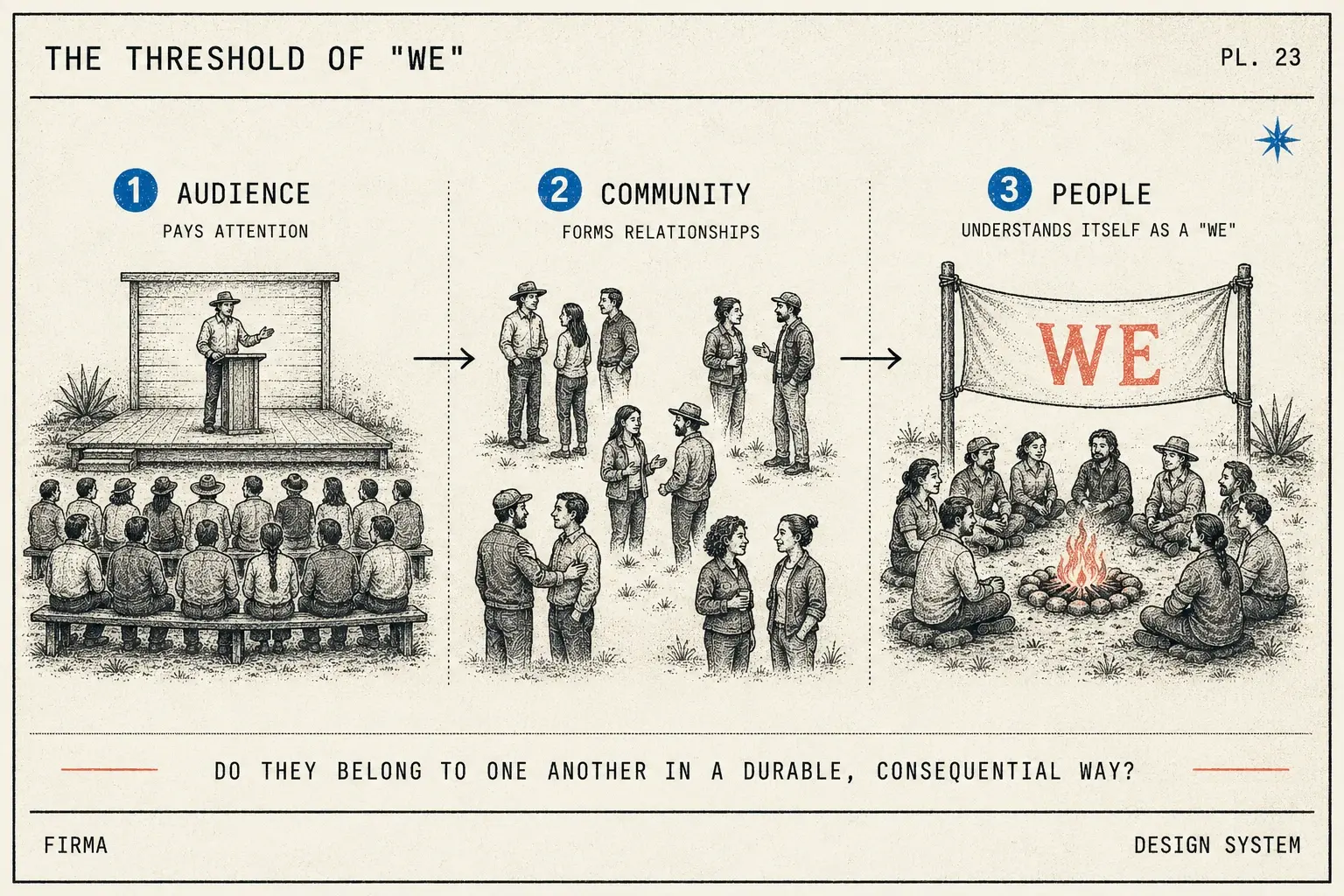
The threshold of "we"
The publication treats peoplehood as a threshold that most groups never cross, not a label any group may adopt:
An audience pays attention. A community forms recurring relationships. A people understands itself as a "we."
Members of a people develop shared memory, identity, duty, covenant, culture, history, and future orientation. The test is not size, activity, or enthusiasm:
Do members believe they belong to one another in a durable and consequential way?
Not every community becomes a people, and not every people seeks statehood. A million followers are not a people; a highly active online community may still not be a people. This is the same threshold behind the publication's definition of a nation — a people who understand themselves as a people — treated fully in the foundations chapter.
Peoplehood is also one of four distinct maturities the publication tracks, and it can regress. Social maturity — how deeply have individuals become a people? — is maintained through repeated function, not awarded forever by one milestone. The measurement discipline is in the maturity module and the progression chapter.
The binding principle
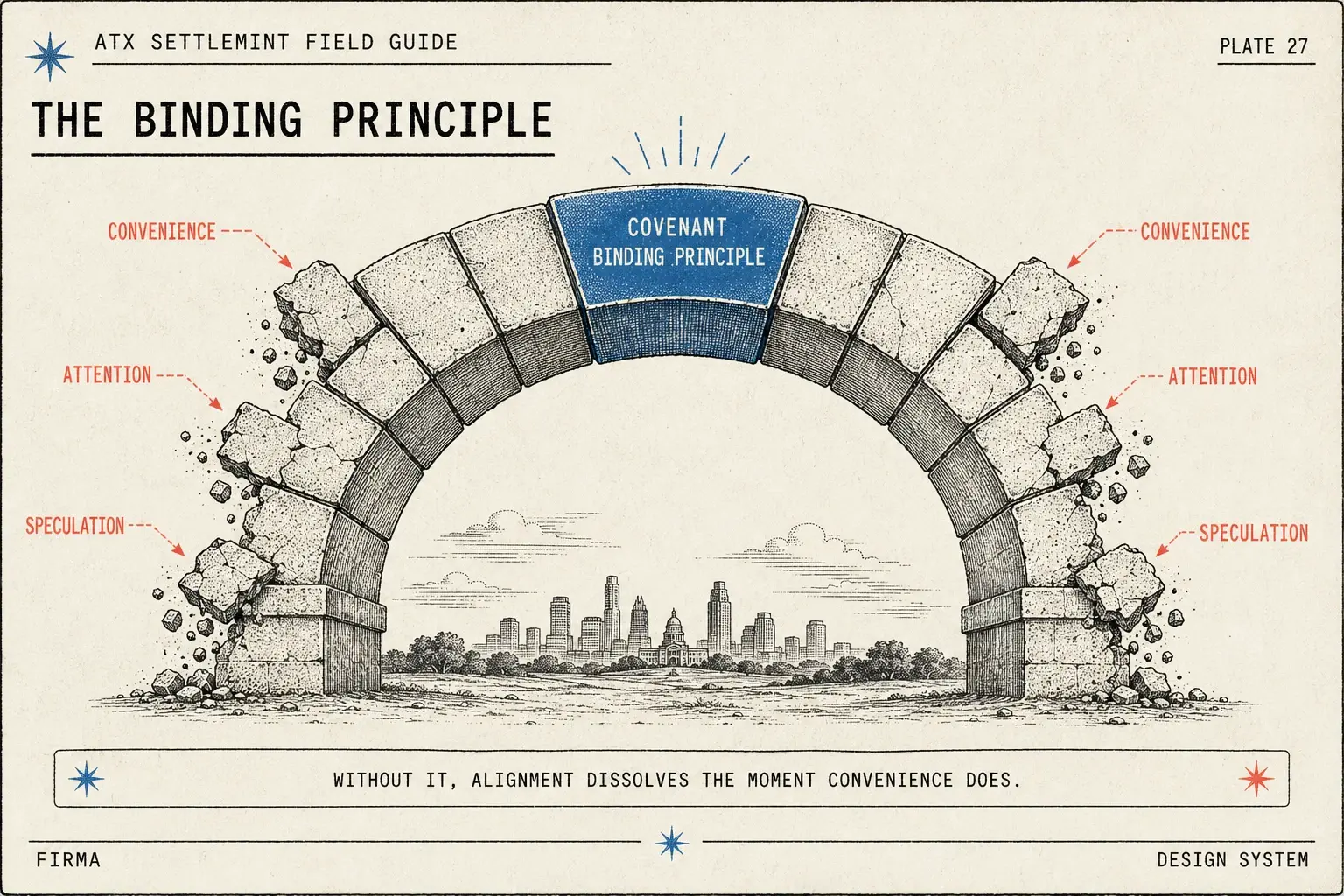
A people needs a reason to exist beyond convenience or financial upside:
A binding principle is something stronger than convenience or speculation.
The original network-state framework calls this a moral innovation. The publication deliberately keeps the category broader: a people may instead form around covenant, religion, civilizational identity, historical continuity, shared place, kinship, or a positive common good that is not well described as an innovation. The broader term — binding principle, founding proposition, or covenant — remains under test, but the function is required: without it, alignment dissolves the moment convenience does.
Covenant is not contract
The publication's working distinction, given fully in the membership module:
A contract asks what we have agreed to exchange or perform. A covenant asks who we are to one another, and what we are responsible to become and preserve together.
Covenant does not eliminate contracts, rules, or legal clarity; it explains the deeper relationship those instruments serve. The discipline is to use covenant where it is authentic — not as a decorative word for every commercial arrangement.
Households are a real unit
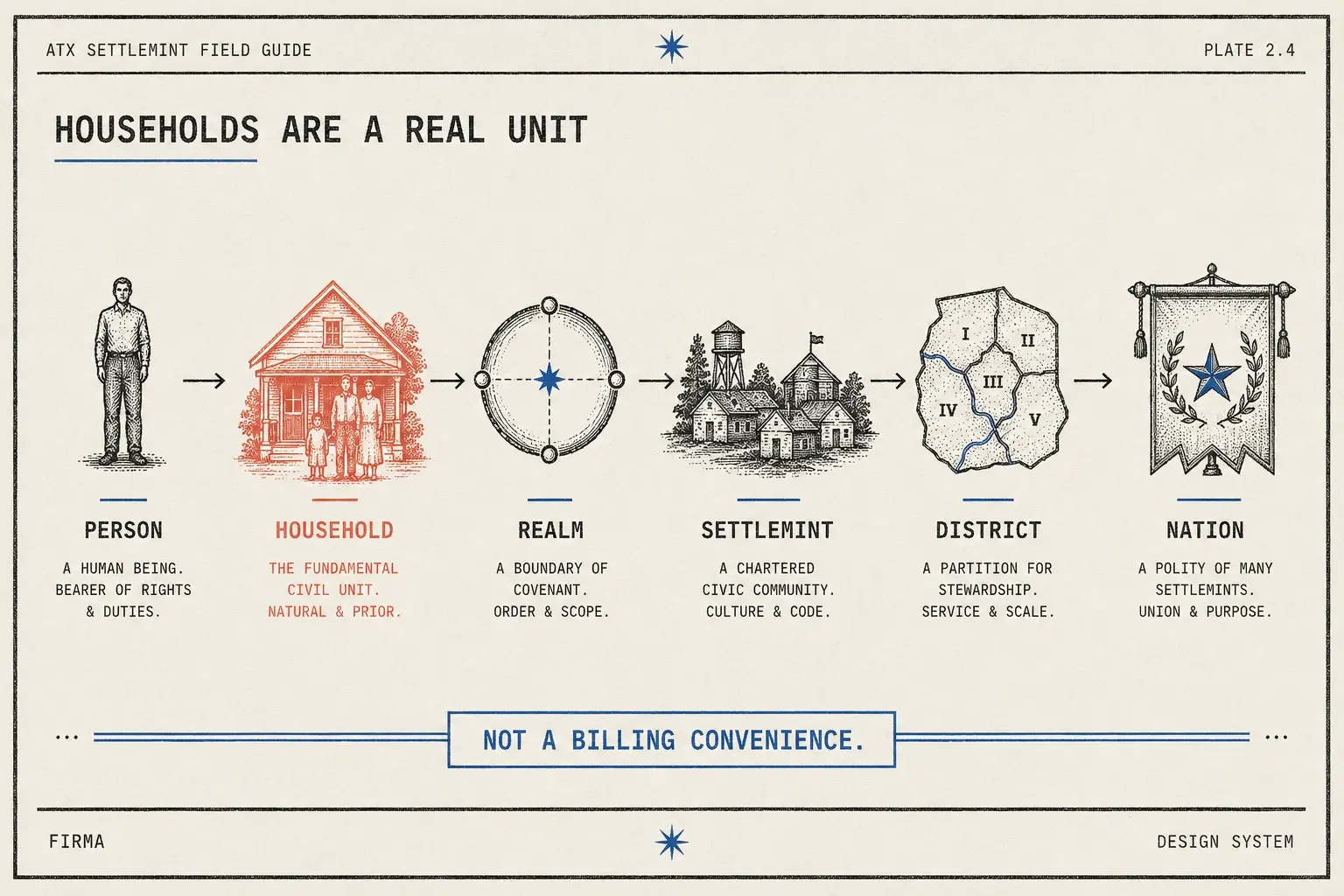
The publication's civil architecture does not run from individual straight to settlement:
Person → Household → Realm → Settlemint → District → Nation → Constellation
Infrastructure, protocols, capital, and institutions should serve human persons, households, communities, and places — and the household appears in that list as a real unit, not a billing convenience. The Realm belongs to the person or household, and household-level questions are named as real questions: whether a household can share one Realm, how children develop within it, how inheritance and succession work. Those questions remain open, and the membership module lists them among the unresolved membership systems each community must answer.
Formation, memory, and duty
A people is formed, not assembled. Among the early systems of a starting settlement, the starting module names formation — whatever practice carries the community's shared purpose, kept central rather than decorative — and institutional memory: remembering who contributed, what was decided, what was spent, what failed, and what obligations remain.
The doctrine behind both is the same:
Infrastructure can be purchased. Trust, shared purpose, and institutional memory must be cultivated.
For a covenantal people, memory has a longer horizon: the preservation and transmission of faith, witness, formation, memory, and responsibility across generations. Testamint is the emerging implementation of that covenant-memory function within the Nation of Heaven — an implementation, not a universal requirement for every Settlemint. As everywhere in this handbook, the human function is canonical and the implementation is provisional.
Covenant-first origin discipline
The original network-state pathway is cloud-first: online community, then collective action, then land, then recognition. The publication preserves a competing pathway:
Covenant first. People and place together. Network everything.
Its shape, as one of several origin paths: covenant → people → shared life → institutions → network expansion. This remains a testable origin pathway, not a proven model — the publication's own words are that it must not become a slogan that substitutes for execution.
The discipline it imposes is real either way. A covenant-first settlement may begin with people, purpose, and place already joined — and still lack governance, economy, memory, and continuity. Beginning with covenant changes what already exists and what must still be proved; it does not exempt anyone from proof. The full origin-path treatment is in the starting module.
The theological foundation
Firma's Christian foundation is not decorative language applied to a neutral technical system. It changes the underlying anthropology: the person is not merely a user, the household is not merely a consumer unit, the community is not merely a market, and the land is not merely an asset. The practical obligations include personhood, communion, stewardship, sacrifice, hospitality, responsibility, and care for the vulnerable — the fuller treatment is in Building for the Edges.
Two boundaries keep this honest:
A Settlemint does not have to be Christian or part of the Nation of Heaven.
The Nation of Heaven is the specifically Christian and covenantal expression; the universal concepts must remain intelligible and usable outside it. And the foundation is not to be erased or secularized to make the vision more palatable — but neither is theology poured into every paragraph. It belongs where it genuinely clarifies purpose, anthropology, authority, belonging, or economic design.
What remains open
The publication has not resolved — and this module does not invent:
- how a Settlemint's covenant is actually entered, witnessed, renewed, or released, and by whom;
- whether every Settlemint requires an explicit covenant, or whether a binding principle in another form suffices;
- household sharing, children's developing identities, inheritance, and succession;
- the relationship between faith, political membership, residence, and participation;
- how spiritual authority and civil authority relate without being confused.
These remain open. The membership module presents them as the questions a Settlemint must answer, and the governance module carries the questions of legitimacy that follow from them.
The standard
Whether a body of people has become a people is judged the way everything in this handbook is judged — by function, not declaration:
Do these people meaningfully understand themselves as a people?
And the line beneath the whole module:
Belonging is what allows individuals to understand themselves as a people. This is not automatic and cannot be manufactured by branding alone.
✴ Last updated · Fri Jul 31 2026 00:00:00 GMT+0000 (Coordinated Universal Time)