✴ The Settlemint Handbook · ModulesHB_08
ATX: The Implementation Case Study
ATX is a genesis Settlemint in formation — the reference implementation where the framework must prove itself through lived human function, tracked in a dated public evidence ledger that never states a claim beyond its proof.
ATX is a Settlemint in formation: a real place where the framework must prove itself through lived human function.
Every module in this handbook describes what a Settlemint must prove. This module shows the discipline applied to a real place — the same proof ladder, the same evidence ledger, the same refusal to state a claim beyond its evidence. ATX is a genesis Settlemint in formation in Austin, Texas: real land, existing buildings, infrastructure under restoration, real people, and real responsibility. The full published chapter is ATX: A Settlemint in Formation; this case study is the working extract, with the evidence ledger as its center.
The purpose is not to make ATX look complete. The purpose is to turn essential functions into reliable institutions, record what works, expose what fails, and produce knowledge that other communities can use.
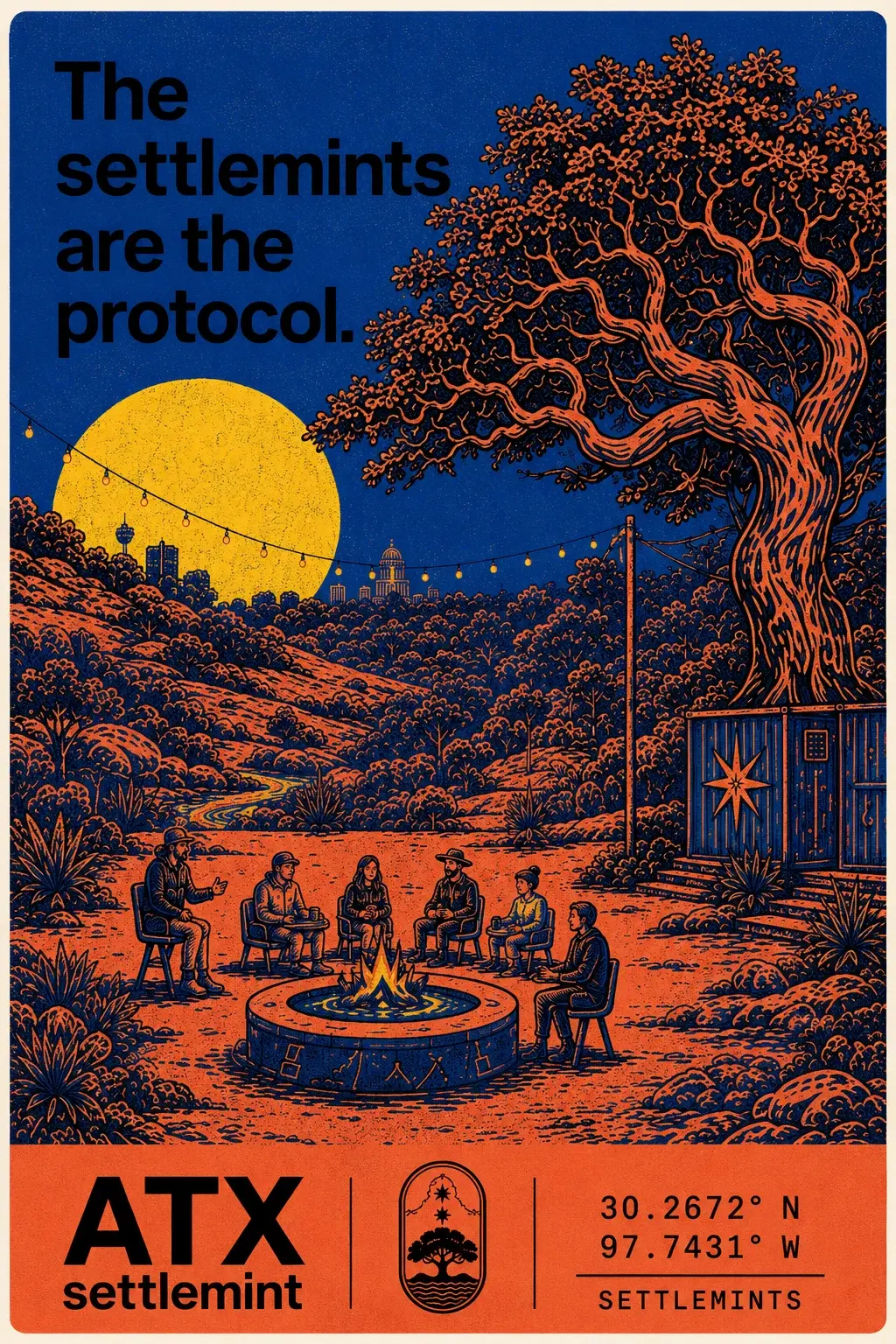
What ATX is testing
ATX is the first serious attempt to apply the framework to real land, real people, real constraints, and real responsibility. It is not a finished model, a sovereign city, a mature District, or a completed Settlemint stack.
It is also not the template every future Settlemint must copy. Its origin, theology, climate, land, relationships, funding, and institutional partnerships are specific. Alongside its own team, it works with ministry, mission, and cultural partners; training and deployment are intended to run through CIK Equip and related programs.
A reference implementation shows one credible way the framework can work. It does not eliminate other ways.
Its larger contribution should be a tested body of knowledge:
- what functions mattered first,
- what dependencies were hidden,
- which systems failed,
- which practices became reliable,
- how much maintenance was required,
- what governance proved legitimate,
- what economics became sustainable,
- and what could be repeated elsewhere.
Infrastructure can be purchased. Trust, shared purpose, and institutional memory must be cultivated.
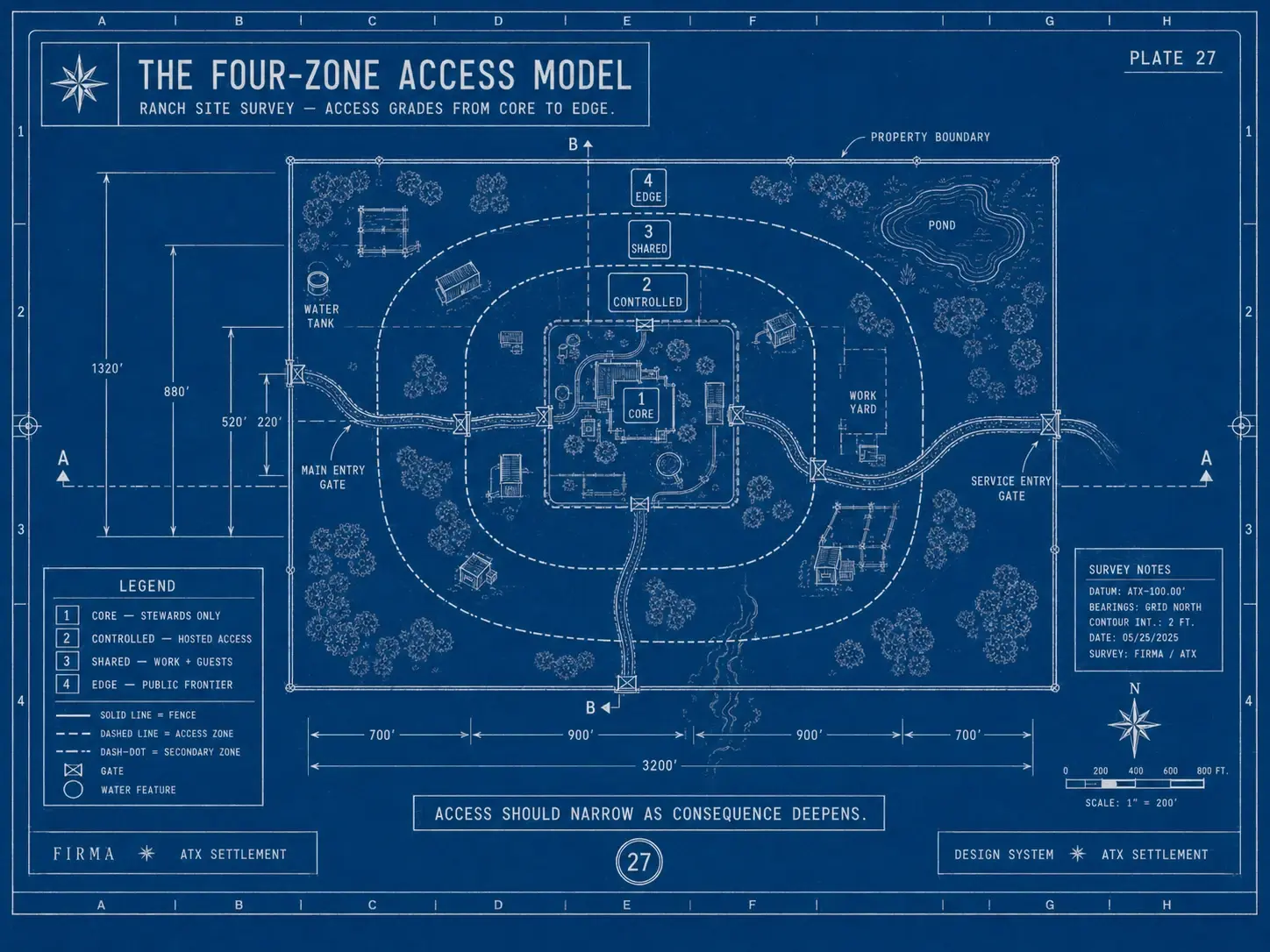
The four-zone access model
Security and hospitality are not opposites. The wrong extremes are a property nobody unknown can ever approach, and a private core opened indiscriminately because the mission is generous. ATX resolves this with graduated access — four rings, from core to edge:
- Zone 0 — Private Core. Residence, family life, sensitive operations. Invite-only. No guest, resident, volunteer, artist, partner, or event attendee receives automatic access.
- Zone 1 — Covenant & Operations. Trusted team activity, builders, retreats, trainings, approved collaborators. Credentialed, role-based access.
- Zone 2 — Commons. Gatherings, workshops, cultural events, programmed community-facing activity. Event-based or steward-approved access — and public programming does not imply unrestricted movement elsewhere.
- Zone 3 — Havens. Independent modular dwellings for artists, builders, missionaries, and stewarded guests. Case-specific, sponsor-backed, time-bounded where appropriate. A Haven stay never automatically implies access to Zone 0.
The governing principle:
Create more room at the edge without dissolving the boundary around the core.
This is structural doctrine, not a floor plan. Each zone assignment carries a sponsor, a steward, and explicit boundaries — the same explicitness the operating loop demands of work.
The operating loop in practice
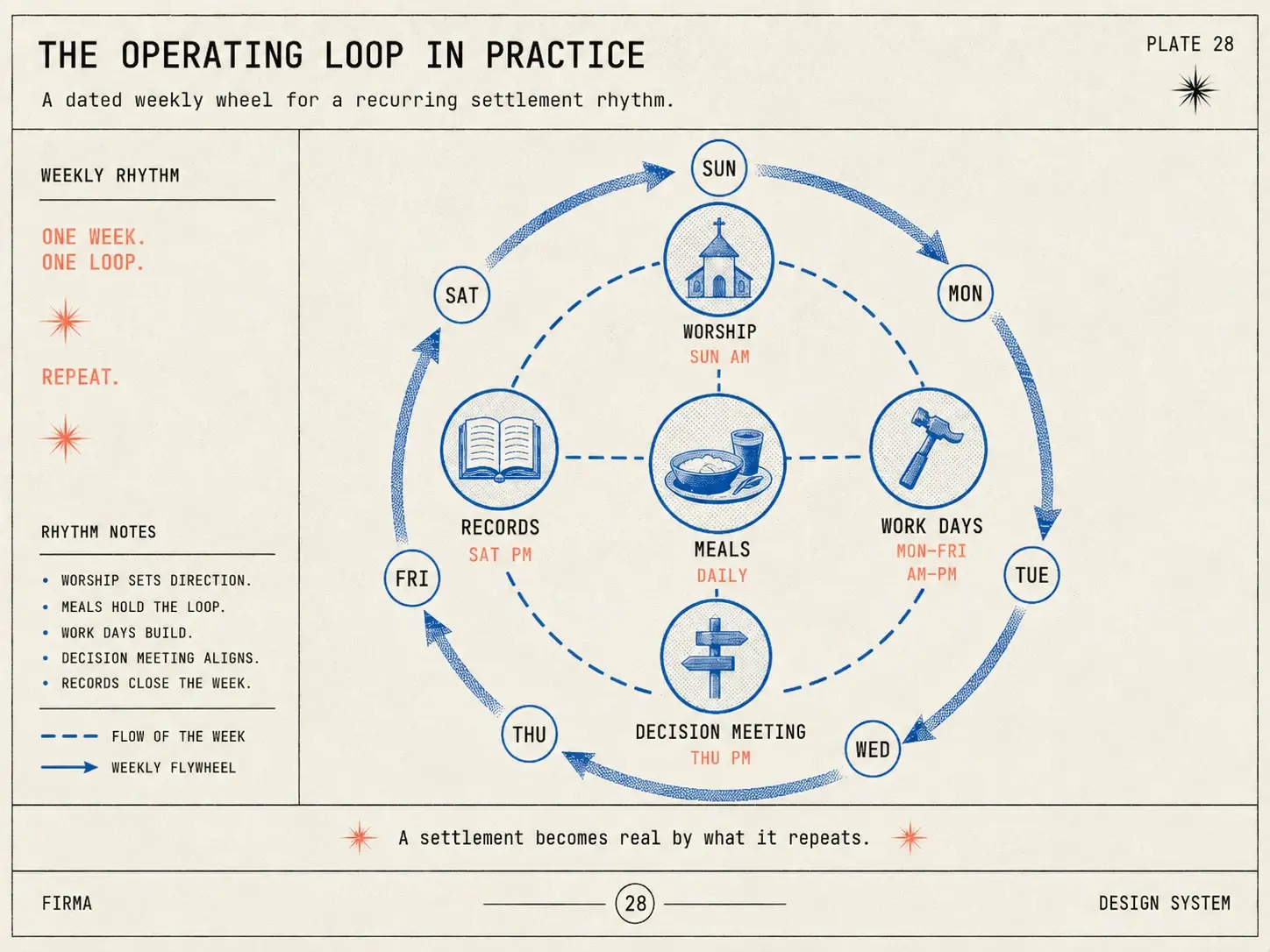
ATX runs the smallest useful settlement loop before pretending the full stack exists:
Need → Claim → Act → Verify → Earn / Give → Reputation → Lesson
A real need appears. Someone claims responsibility. Real work happens. A qualified person verifies the outcome. Payment is recorded when appropriate — and freely given excess is recorded separately, because generosity is not a wage. Evidence of capability and stewardship accumulates, and greater trust earns greater responsibility.
No global reputation score. No governance token. No fake onchain activity. Nothing sensitive written to an immutable public ledger.
The first operating target is deliberately small: complete the first ten real needs end-to-end. For each: create the need, assign a sponsor, record the claimant, record the contribution, attach evidence, verify the outcome, record payment or freely given excess, and capture the lesson. After ten, review the system before adding more complexity. The first ten needs should become a product-design dataset, not a marketing statistic.
The standard behind the whole loop:
The first Settlemint does not begin when a chain launches. It begins when a community can see a need, coordinate around it, act together, preserve evidence of what happened, and become stronger because of what it gave.
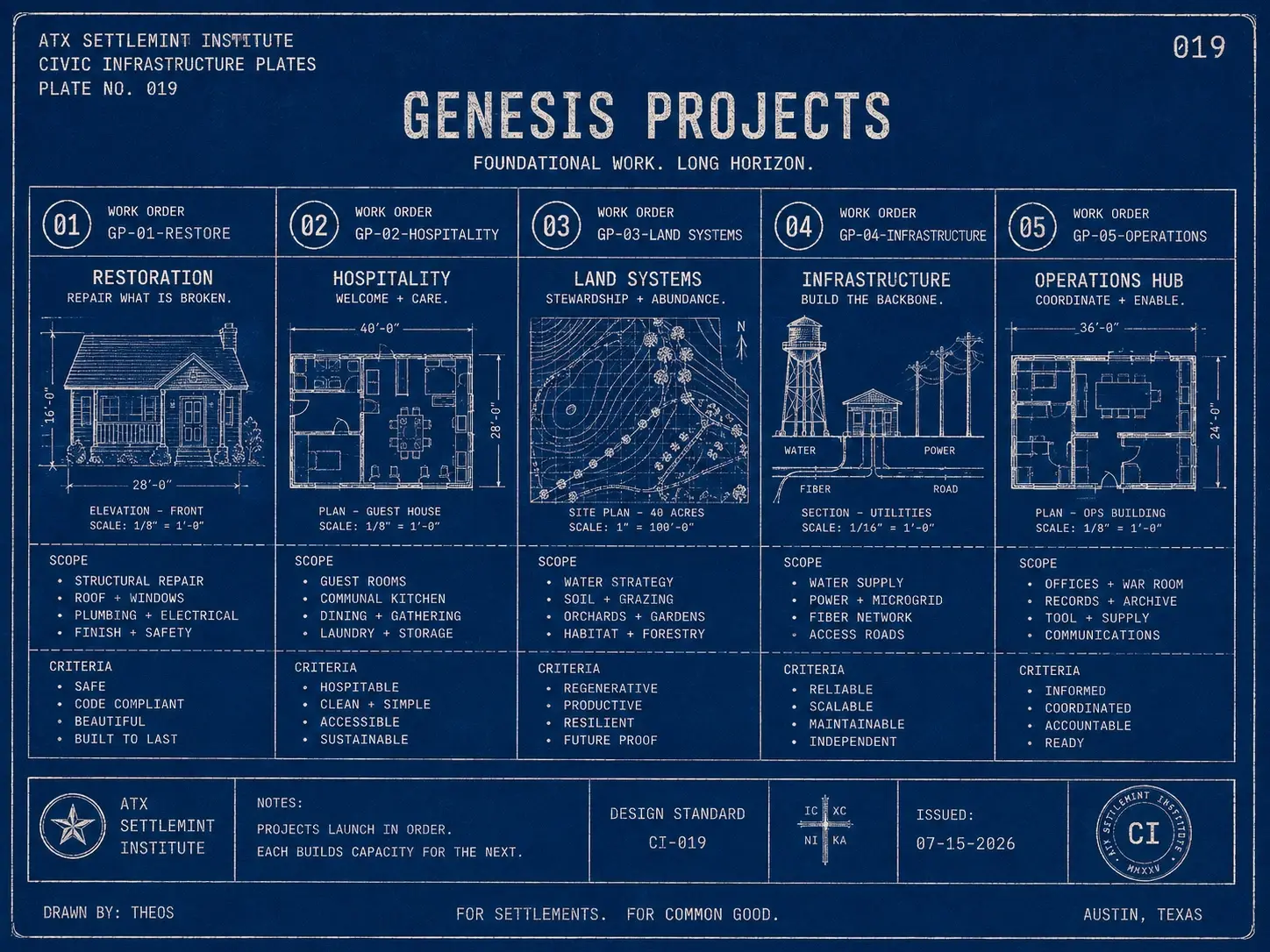
Genesis projects: early proofs, not marketing stunts
Genesis projects are not marketing stunts.
They are early proofs that create real capability, culture, memory, operational evidence, and public trust. A Genesis project should do at least four things:
- Solve a real need.
- Produce a visible outcome.
- Generate useful operational evidence.
- Teach us something about the future Settlemint stack.
If it does not create real value beyond attention, it should not be called a Genesis project. Three of the chartered projects, each stated at its actual maturity:
- First Need Ledger — active experiment; the first operating target. Ten real needs at the property, fully instrumented through the operating loop. The least glamorous project and the most important one.
- The First Cultural Act — proposed. An Austin artist creates the first cultural act of ATX, with a concrete local giveback built in. The specific giveback is an open decision.
- Haven 001 — proposed. The first modular dwelling at the edge: hospitality, access, and stewardship made real. The Haven direction is decided in principle; the first use case, siting, legal review, and stewardship model remain open.
The sequencing logic: start with reality already in front of us. Learn. Then increase complexity.
No project becomes sacred because it was first. The point of Genesis is to create truth, not mythology.
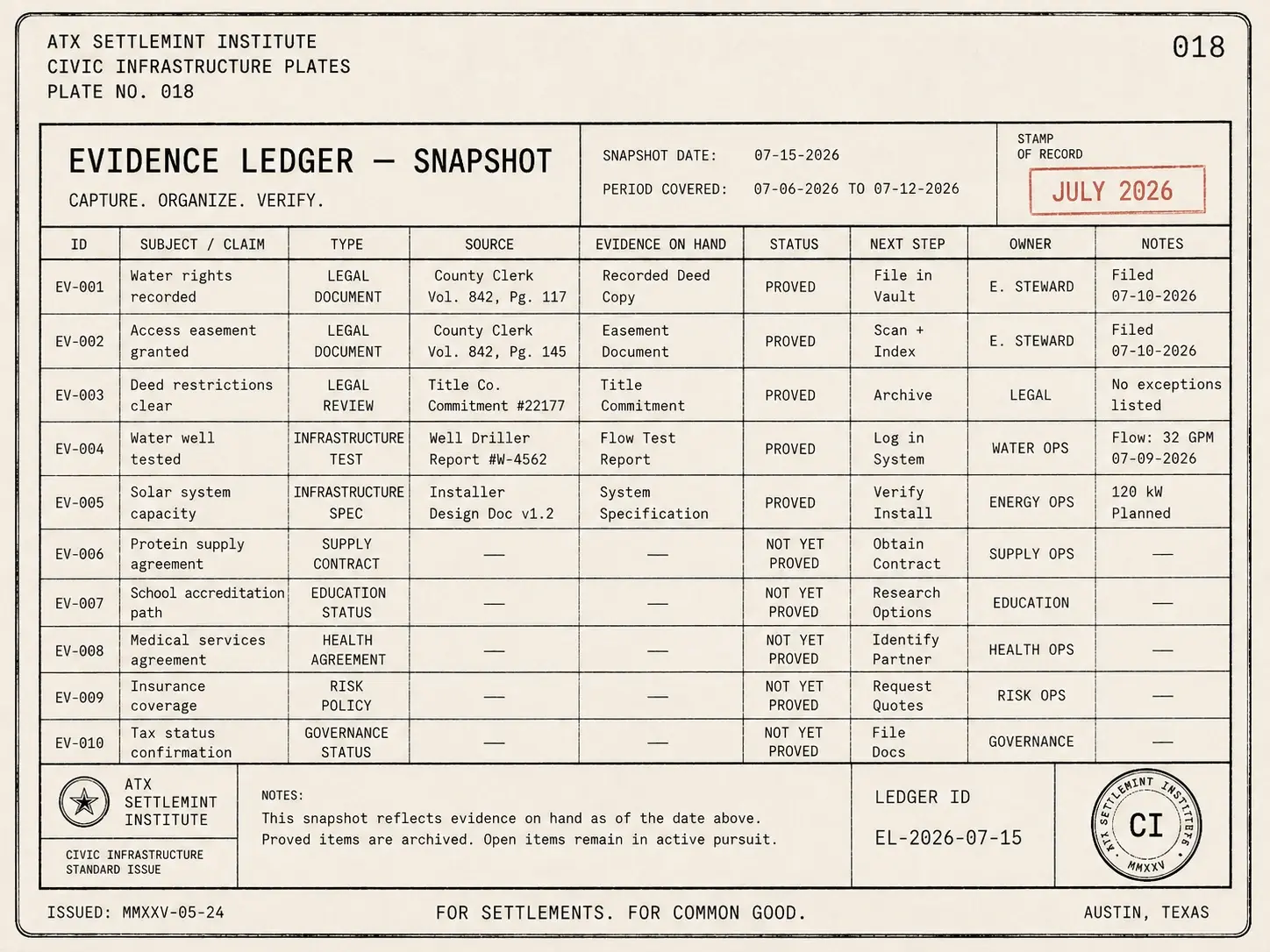
The evidence ledger — snapshot (July 2026)
This is the guide practicing its own discipline in public. Every major claim is tracked through the published ledger fields — claim, status, evidence, dependencies or not-yet-proved, and next proof — and every status uses the published maturity sequence:
Claim → Signal → Evidence → Repetition → Reliability → Institution
The ledger below is assembled from the published chapters: the worked example in Claim Is Not Proof, the maturity profile in From Community to Network State, and the proof table in ATX: A Settlemint in Formation.
| Claim | Status | Evidence | Not yet proved / dependencies | Next proof |
|---|---|---|---|---|
| ATX is becoming a Settlemint | Formation and pilot | Real land, real people, recurring activity, infrastructure restoration, capital, shared work, and institutional relationships | Durable governance, persistent economic loops, mature membership, reliable resource systems, integrated infrastructure, and long-term continuity | A recurring shared function that moves from ad hoc founder-led coordination into a reliable community institution |
| People | Meaningful existing evidence | Existing relationships, leaders, team members, and aligned partners | Durable membership, roles, residency patterns, and shared obligations | — |
| Place | Real evidence | Real land, buildings, and physical infrastructure | Reliable habitation, restoration, maintenance, and sustained use | — |
| Purpose | Meaningful evidence; membership boundaries still developing | Strong Christian mission and Settlemint vision | Translation of vision into recurring practice and clear priorities | — |
| Settlement function | Formation and early pilots | — | — | — |
| Governance | Mostly proposed or ad hoc | Leadership and informal decision-making | Legible authority, accountability, dispute resolution, and continuity | — |
| Economy | Early and incomplete | Capital, work, restoration activity, and possible revenue functions | Repeatable productive loops, transparent treasury practices, and operating sustainability | — |
| Infrastructure | Mixed; several systems under restoration or externally dependent | Existing property systems and active restoration work | Reliable water, energy, communications, housing, compute, logistics, and maintenance | — |
| Memory | — | Emerging records, plans, and coordination systems | Durable contribution, decision, asset, expense, and obligation records | — |
| Continuity | Not yet proved over enough time | Commitment and activity | Function through time, leadership changes, conflict, and financial constraint | — |
| District political capacity | Aspirational | — | — | — |
| Network-state standing | Aspirational | — | — | — |
Blank cells are deliberate. Where the published sources state no status, evidence, or next proof for a row, this ledger does not invent one — that is the discipline the ledger exists to practice.
On District political capacity, the published chapter is direct: ATX may become a mature Settlemint before it possesses meaningful city-level political capacity. It currently operates under the laws and jurisdiction of Texas and the United States. District language should therefore remain aspirational until actual political capacity and lawful authority emerge.
This ledger is a dated snapshot. It is maintained through the editorial workspace and republished as evidence changes. A ledger that is never updated is a claim, not a record.
Failure is evidence
A serious proof system records failure. If participation collapses, infrastructure requires constant founder intervention, an economy works only while heavily subsidized, or the community cannot survive disagreement, those are material facts.
Failure does not automatically invalidate the project. Concealing failure prevents learning.
A system that can see its failures can improve. A system that turns every failure into narrative cannot learn.
The internal classification discipline says the same thing from the other direction:
Say what is real. Say what is experimental. Say what is proposed. Say what is future. Never blur the lines to sound further along than we are.
What would advance the claims
For the headline claim, the published next proof is stated verbatim in the ledger above:
A recurring shared function that moves from ad hoc founder-led coordination into a reliable community institution.
Beneath it, ATX has set its first evidence targets — small on purpose:
- 10 real needs, 10 claims, 10 completed contributions,
- multiple verifiers,
- several payment types and several freely given excess contributions,
- at least 3 real governance decisions,
- one working guest-access protocol,
- one Haven concept brought through legal and design review,
- and one Genesis project with measurable Austin benefit.
That is enough to begin learning from reality. For how each domain graduates from claim toward institution, see Maturity Stages and Proof Tests; the evaluation requirement itself is codified in Proof of Function.
ATX is a genesis Settlemint in formation.
It has real land, people, resources, relationships, and responsibility. It does not yet have every mature system described in the Settlemint framework. That distinction is not weakness. It is disciplined truthfulness.
Claim is not proof. Deployment, endurance, and fruit provide the evidence.

See also
- ATX: A Settlemint in Formation — the full published chapter this case study extracts from.
- Claim Is Not Proof — the ledger fields, the proof ladder, and the worked ATX entry.
- Maturity Stages and Proof Tests — running the ledger and proof tests as ongoing practice.
- Proof of Function — the standard's requirement that every claim be evaluated by demonstrated function.
✴ Last updated · Wed Jul 22 2026 00:00:00 GMT+0000 (Coordinated Universal Time)