✴ The Settlemint Handbook · ModulesHB_14
Resilience and Continuity
Care and continuity are proven functions, not sentiments — how a Settlemint responds when people, systems, or relationships fail, and how every other function keeps working after attention, money, founders, or agreement fall away.
Continuity is repeated function under changing conditions.
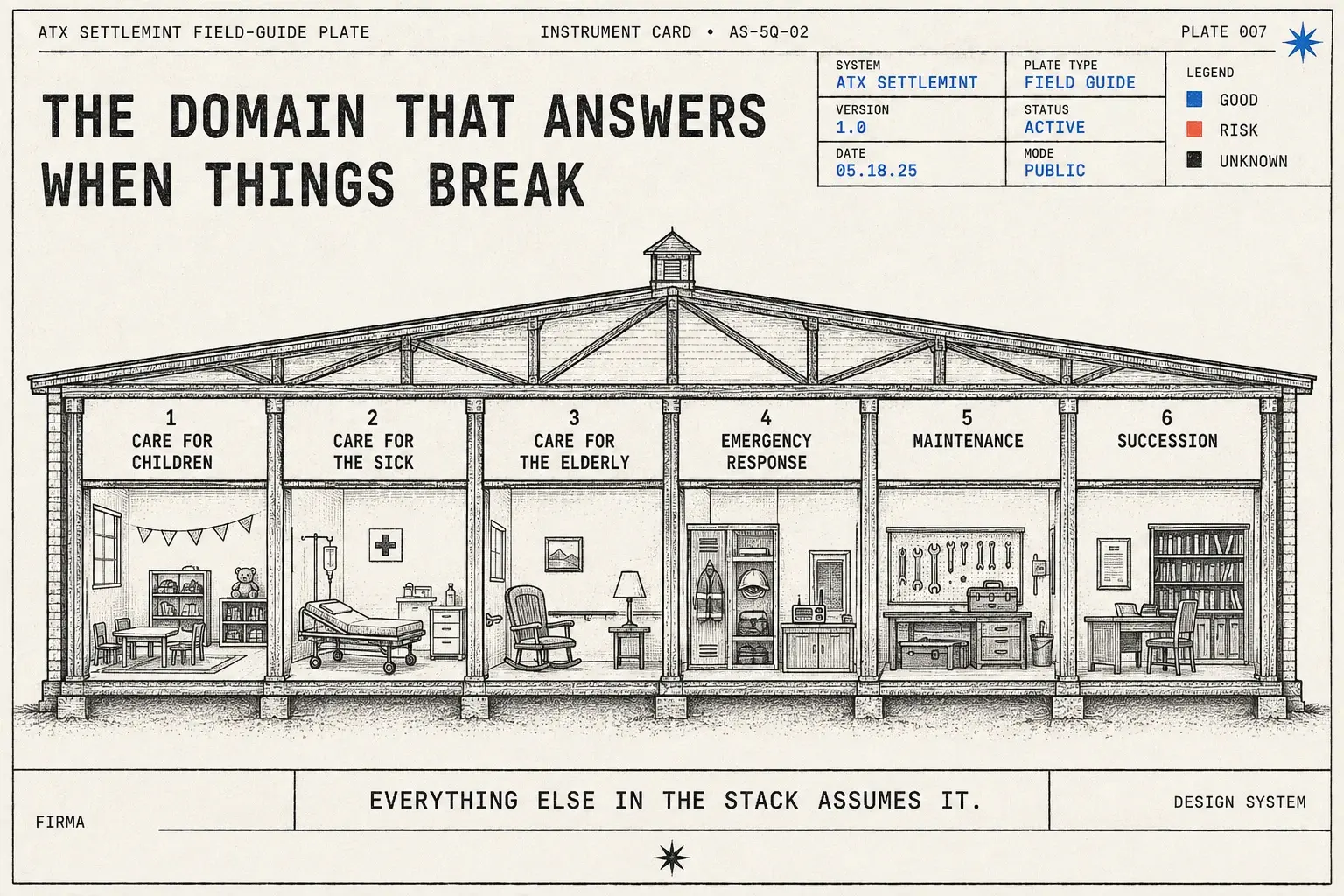
Care and continuity appear among the ten functions a credible Settlemint must increasingly demonstrate (see Claim Is Not Proof): care — the community can respond to human need and failure — and continuity — the place persists beyond an event, founder visit, or funding cycle. This module treats them as one operating domain, because canon treats them as one: the domain that answers when things break. Everything else in the stack assumes it.
Care and continuity as a stack domain
The stack definition is direct:
A settlement must respond when people, systems, or relationships fail.
Per The Settlemint Stack, this domain includes:
- care for children,
- care for the sick,
- care for the elderly,
- emergency response,
- maintenance,
- succession,
- restoration,
- and continuity beyond one founder or funding cycle.
Two disciplines follow from the definition. First, care is proof, not sentiment. The question is never whether the community feels responsible for its people but whether it can actually respond to human need and failure — a function to be demonstrated, placed on the proof ladder, and held like any other. Second, the domain is not a checklist of products. A stack does not become real because one item was purchased from each category; it becomes real when systems work together in practice, and this domain is where that integration is tested hardest — precisely when something else has stopped working.
Continuity itself is defined by what it outlasts. A settlement's continuity means the place persists beyond a weekend, event, founder, grant, speculative cycle, or media moment. Land, buildings, commitment, and activity do not prove it; only time under real conditions does.
Running the continuity test
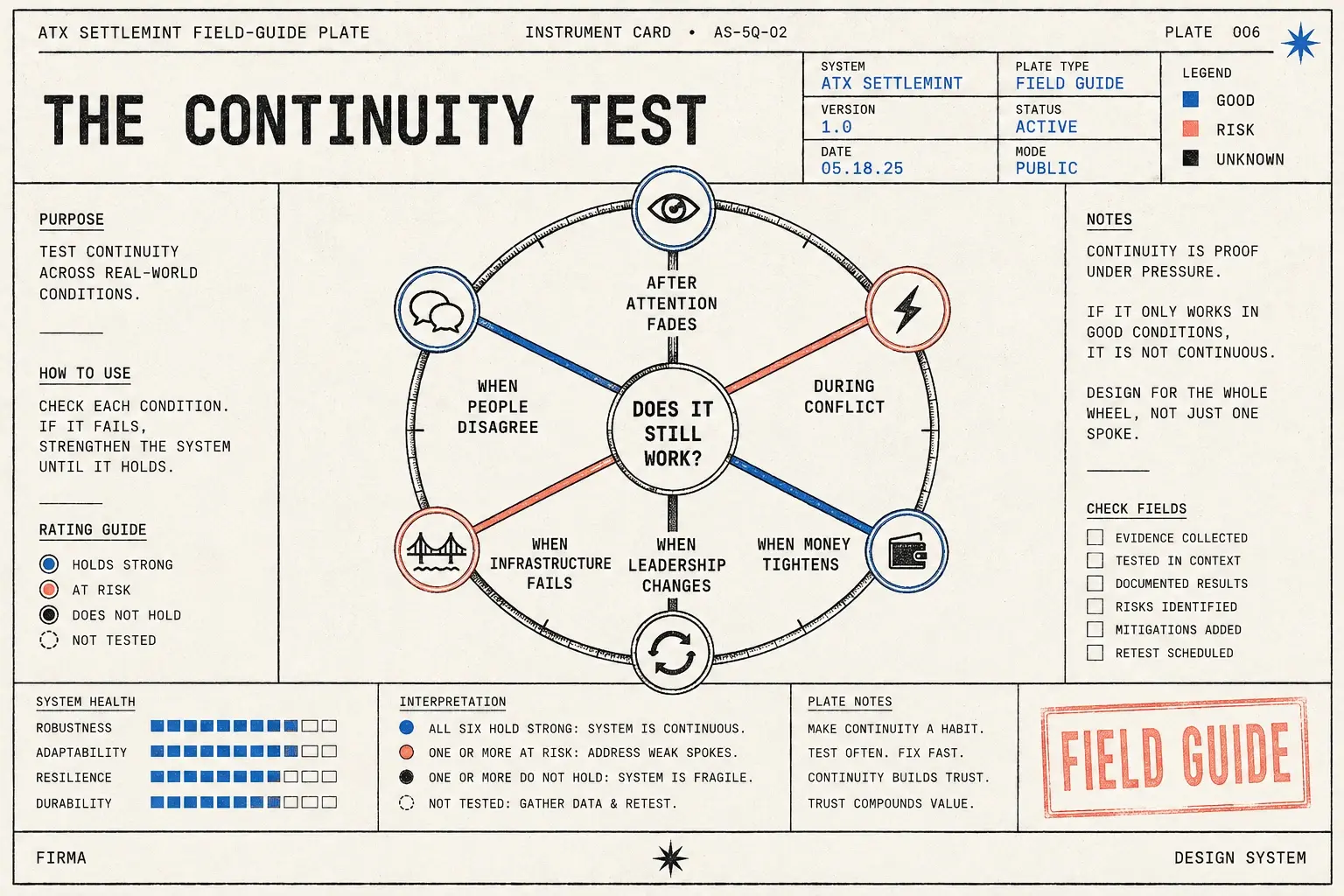
The two practical tests — the continuity test and the founder-dependence test — are given in full in Maturity Stages and Proof Tests. This module governs how the first is run as a standing discipline rather than a one-time exam.
Many systems work briefly. For each function the Settlemint claims, the test asks whether it still works after launch attention fades, during conflict, when money becomes tighter, when leadership changes, when infrastructure fails, and when people disagree.
A function that has only ever operated under favorable conditions may have demonstrated repetition rather than reliability.
The changing conditions are not obstacles to the assessment — they are the assessment. So the review is not scheduled around calm; the moments of strain a settlement actually passes through are its continuity evidence, and belong in the evidence ledger when they occur.
Maturity can regress
Rungs on the proof ladder are held, not owned:
Maturity is maintained through repeated function, not awarded forever by one milestone.
A reliable function can become intermittent. A profile that never moves backward is a profile that is not being measured. Resilience work is therefore not only advancing functions up the ladder but noticing — and recording — when one has slipped down it. A maintenance routine that lapses, a care arrangement that quietly stopped, an infrastructure system running only because one person keeps intervening: each is a real change in the settlement's profile, whatever its documents still claim.
Failure is evidence
A serious proof system records failure:
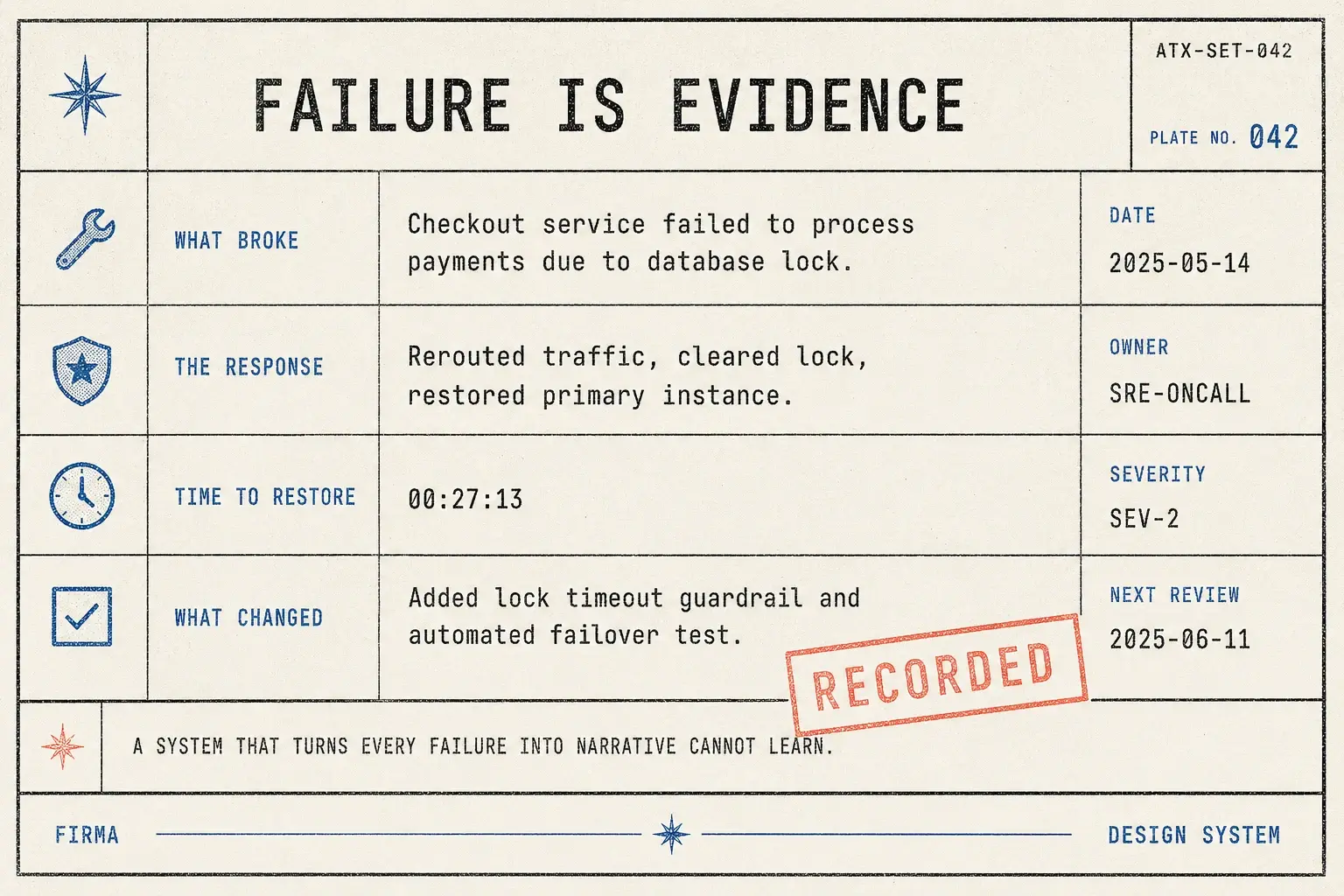
A system that can see its failures can improve. A system that turns every failure into narrative cannot learn.
If participation collapses, if infrastructure requires constant founder intervention, if an economic loop works only while subsidized, if the community cannot survive disagreement — those are material facts, and they belong in the evidence ledger's Evidence and Failure modes fields. Failure does not automatically invalidate the project; concealing it does. For this domain in particular, recorded failure is the raw material: what broke, what the response was, how long restoration took, and what changed afterward is precisely the evidence that care and continuity are functioning.
Founder dependence: the central continuity risk
What stops working when the founder leaves the room?
Early projects naturally depend on founders; that is not the problem. The problem is claiming that an institution exists when the capability still resides almost entirely in one person. A function becomes institutional as:
- knowledge is shared,
- roles become clear,
- authority becomes legible,
- processes repeat,
- resources remain available,
- and correction no longer requires constant founder intervention.
Succession sits inside this domain because it is founder dependence resolved in advance: Governance and Dispute Resolution names succession among governance's required contents, and its standard applies here — if every meaningful function stops when the founder leaves, the institution is not yet mature. The goal is not to erase founders. It is to build legitimate roles, shared knowledge, succession, and durable capacity beyond one person.
Redundancy and single points of failure
The published direction for infrastructure resilience, stated for ATX and applicable generally: communications, energy, water, compute, housing, safety, transportation, and logistics should become more reliable and less dependent on single points of failure. A mature stack may add redundancy, local production, stronger autonomy, durable institutions, and advanced care systems — but the governing rule is:
Maturity is increasing reliability, integration, legitimacy, and resilience — not merely adding more modules.
Dependence on outside systems is not itself a failure. The requirement is that dependence be visible rather than hidden: the proof matrix's Independence question — what systems, people, capital, permissions, or subsidies must remain available for this to continue — is this domain's map of what a shock can take away.
The current proof
No Settlemint has yet proved this domain. ATX, the genesis case, records continuity honestly in its own ledger: commitment and activity are evidence, but continuity is not yet proved over enough time — the target being function through time, leadership changes, conflict, and financial constraint (see ATX: A Settlemint in Formation). That entry is the pattern for every Settlemint: state the small precise thing the evidence supports, and let the years accumulate.
What canon does not yet prescribe remains open: procedures for succession, emergency-response protocols, standards for care provision, the security dimension of this domain, and quantitative thresholds for "durable capacity to continue." Each Settlemint answers these for itself and records its answers as provisional.
Related modules
- Maturity Stages and Proof Tests — the continuity test and founder-dependence test in full, and the evidence ledger that records failure.
- Governance and Dispute Resolution — succession, correction of leadership, and remaining through conflict.
- Starting a Settlemint — standing up functions so that they can later survive their founders.
✴ Last updated · Fri Jul 31 2026 00:00:00 GMT+0000 (Coordinated Universal Time)