✴ The Settlemint Handbook · ModulesHB_11
Housing and Shared Infrastructure
Habitation is a required settlement function — proved by durable presence, rightly ordered public, common, and private space, maintained systems, and infrastructure whose dependencies are visible, resilient, and survivable.
People need a real place capable of supporting life.
Habitation is one of the functions a Settlemint must prove. The Settlemint Stack places place and habitation among the eight domains every Settlemint must coordinate: land, housing, utilities, access, maintenance, land use, and the relationship between public, common, and private space.
The published proof set states the function plainly:
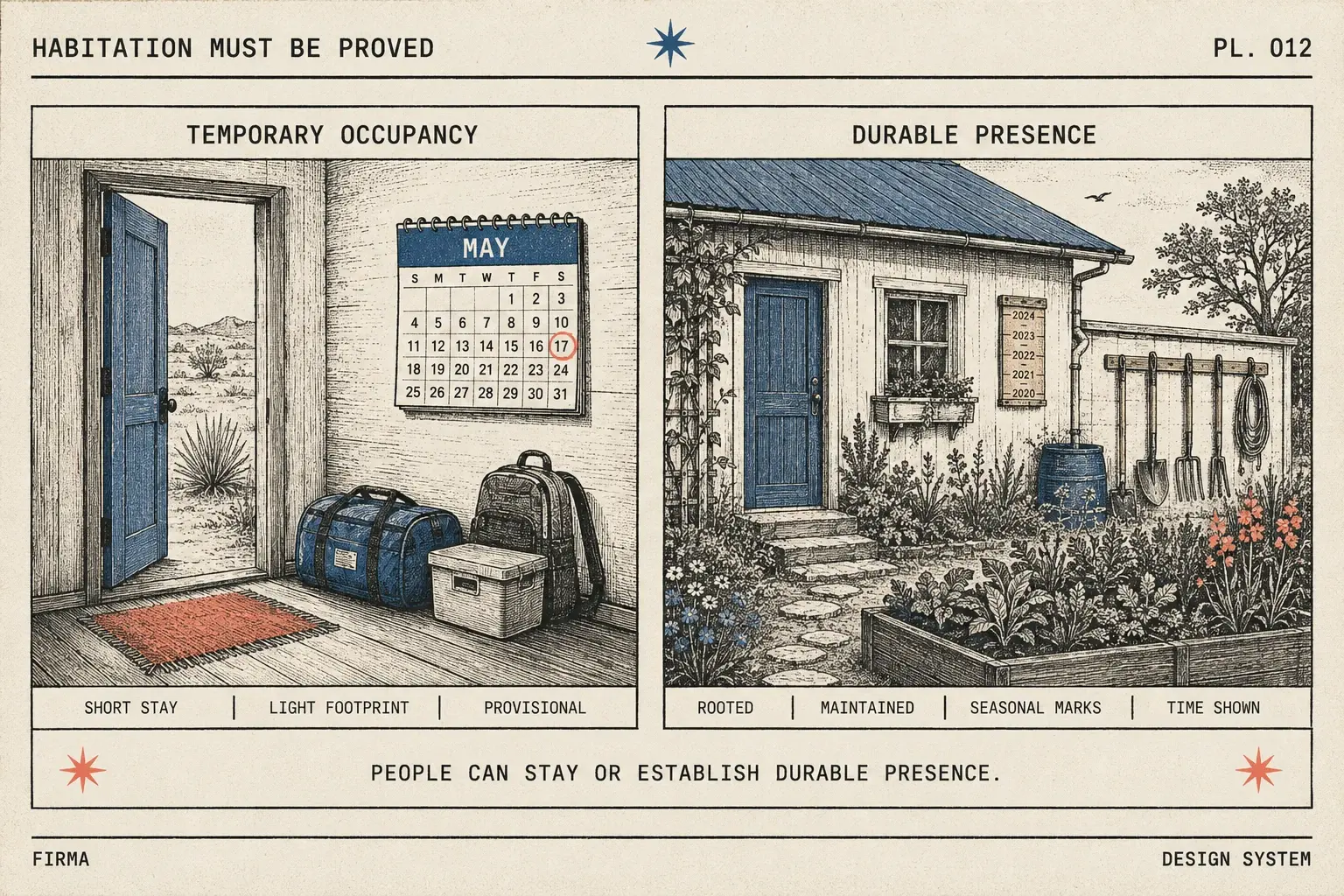
Habitation — people can stay or establish durable presence.
This module is the operational treatment: what habitation must prove, how shared and private infrastructure relate, and why maintenance — not installation — is the evidence that counts.
What habitation must prove
Housing claims are subject to the same proof discipline as every other function. The published standard is exact about what occupancy demonstrates:
One month of occupancy proves temporary habitation. It does not prove a durable settlement.
State the small precise thing the evidence supports. A settlement has proved habitation when people can stay, live, or establish durable presence — and when that presence persists beyond an event, a founder visit, or a funding cycle. The maturity discipline for placing this function on the proof ladder has its own module.
Housing is more than units
The canon is blunt about the gap between buildings and settlement:
Housing units do not prove community.
A real-estate development may provide land, buildings, and utilities without producing a people, shared purpose, governance, economy, memory, or belonging. The Settlemint begins with the human settlement itself — and its anthropology is not neutral:
The household is not merely a consumer unit.
Habitation is where households establish durable presence: where belonging, care, work, worship, and continuity take up residence in an actual place. Housing serves that function. It does not substitute for it.
Public, common, and private space
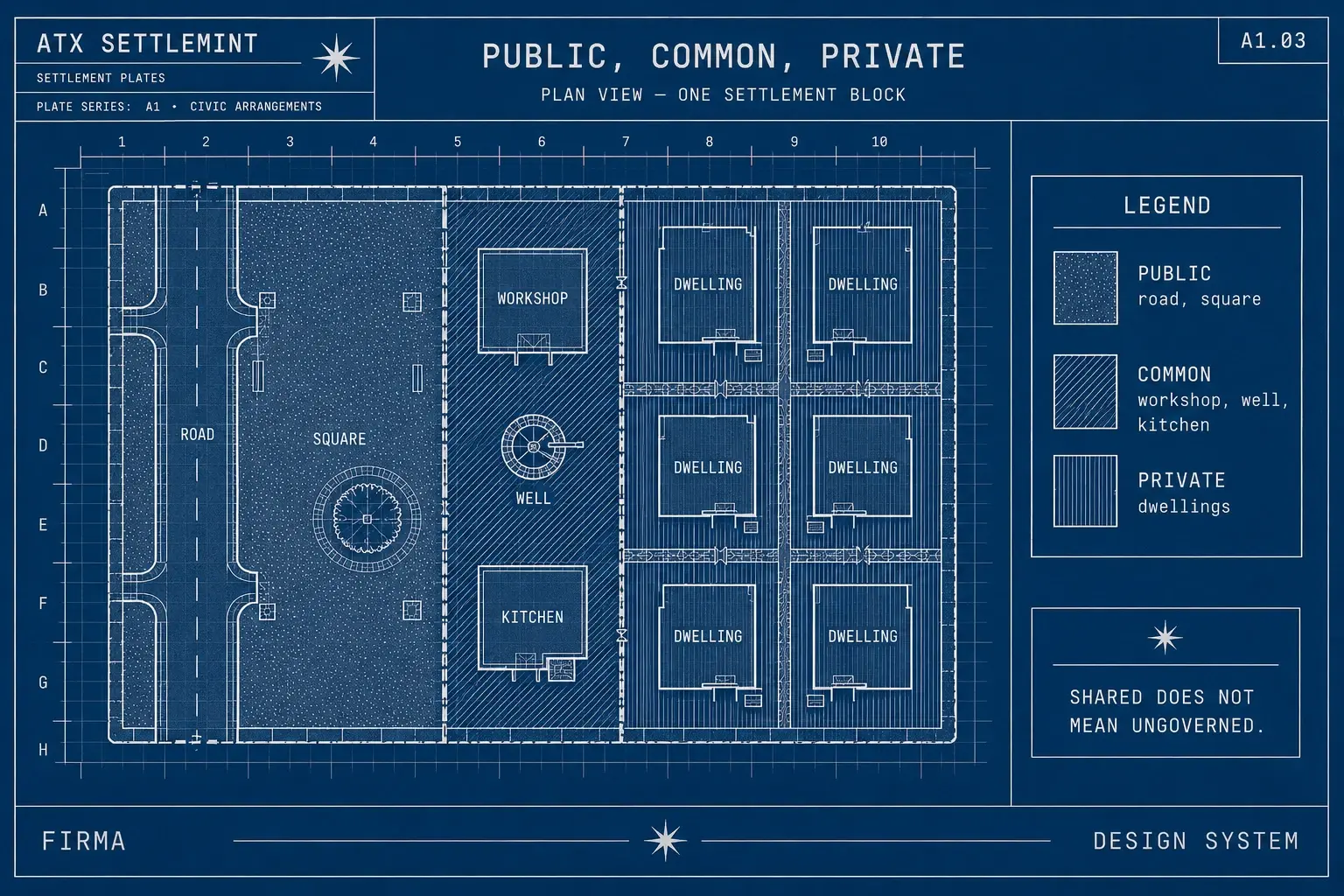
The habitation function includes the relationship between public, common, and private space. A Settlemint may allow energy systems, workshops, housing, food systems, worship, education, care, logistics, and public goods to become shared rather than purely individual.
But shared does not mean unowned or ungoverned. A commons is a shared capability governed through rules, stewardship, maintenance, and legitimate access:
A commons without stewardship becomes depletion. A commons without meaningful access becomes private infrastructure with better language.
Which infrastructure a given settlement holds in common, and on what terms, is contextual. The governance of contribution, access, and free riders belongs to Work, Economy, and Treasury. Where canon has not settled a boundary between shared and private provision, the boundary remains open — the discipline is that it must be visible and governed, not assumed.
Capability arrives in the order the edge requires it
The edges are not uniform, and the architecture should not require one monolithic city-in-a-box. The published doctrine — see Building for the Edges — states the principle:
Modularity allows capability to arrive in the order the edge actually requires it.
One place may need communications first, then energy and compute. Another may begin with people, covenant, land, housing, worship, and shared work. Housing is required in every case; when it arrives relative to other capability is a decision the real place makes, not the blueprint.
Maintenance is the unglamorous proof
A stack is not a checklist of products. Solar panels do not prove energy reliability, and purchased infrastructure does not prove function:
Infrastructure can be purchased. Trust, shared purpose, and institutional memory must be cultivated.
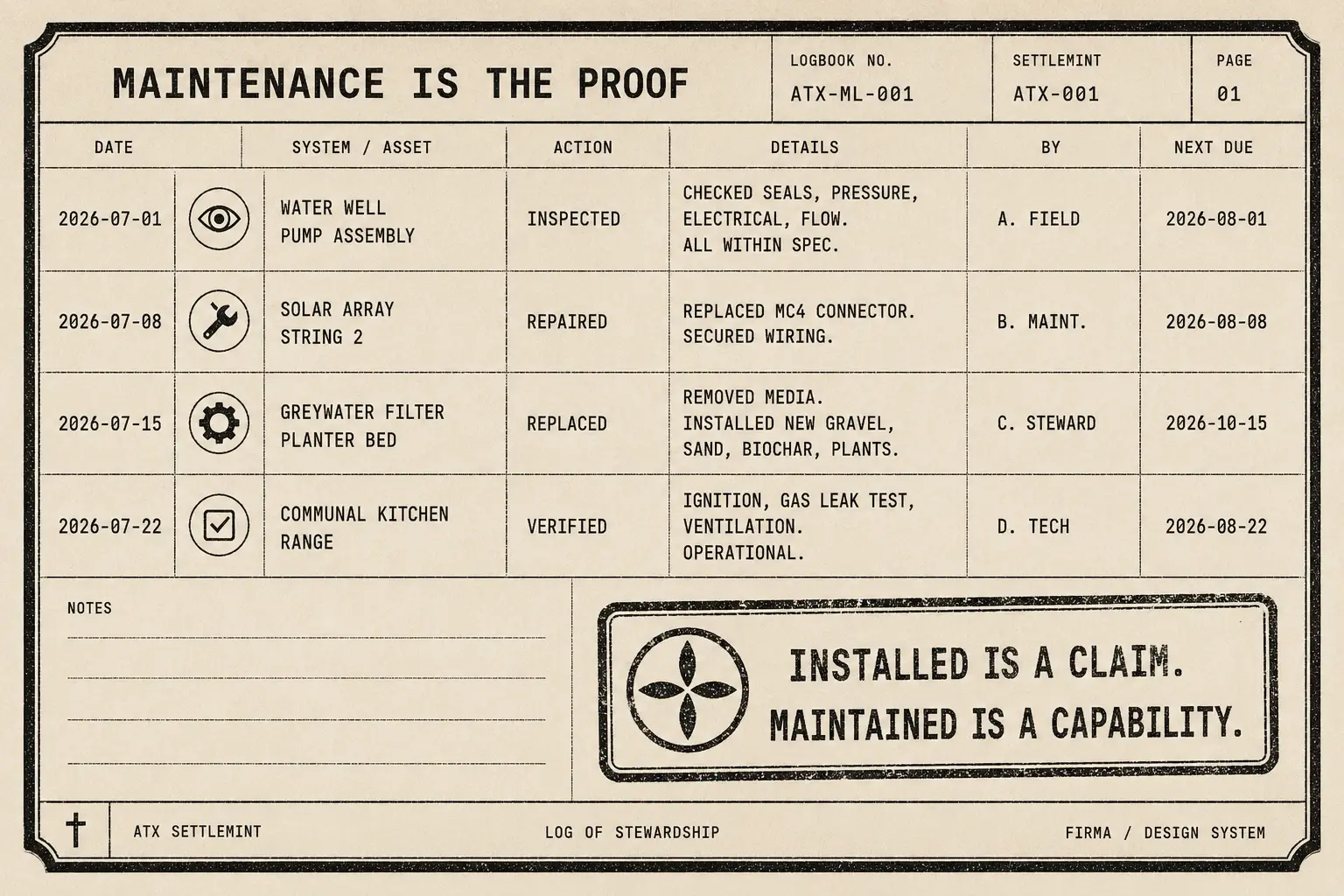
The published doctrine for the first Settlemint in formation names what real property stewardship requires: restoration, maintenance, prioritization, budgeting, ownership clarity, and accountable operating responsibility. Maintenance also belongs to the care and continuity domain — a settlement must respond when systems fail, not only celebrate when they are installed.
The evidence a reference implementation owes the wider framework includes exactly this record: which systems failed, which practices became reliable, and how much maintenance was required. A housing system that cannot be maintained by accountable stewards is a claim, not a capability.
The dependency map applied
Every Settlemint should be able to map critical dependencies, and housing and utilities are essential functions. For each — water, energy, housing, communications, waste, access — ask the stack's questions: Who operates it? Who owns it? Who has authority over it? What does it depend on? Who can disable it? Can it be replaced? How long can the settlement survive its failure? What is the fallback?
You do not understand your stack until you understand how it fails.
The published direction for infrastructure in formation follows: communications, energy, water, compute, housing, safety, transportation, and logistics should become more reliable and less dependent on single points of failure. Resilience is measured by the dependency map improving over time, not by equipment arriving.
Sovereign infrastructure, precisely
Sovereign infrastructure does not mean infrastructure independent from every outside system. The published working definition:
Sovereign infrastructure increases the ability of people or communities to control, govern, replace, interoperate with, or survive the failure of systems critical to their lives.
Housing is named among the domains this may include. A settlement's housing and utilities may improve resilience while remaining dependent on external providers, imported components, and existing law. These are not contradictions. They are dependency profiles — and the goal is not autarky but dependency made visible, diversified, negotiable, and survivable.
The function and its implementations
The handbook's standing discipline is function before product:
Housing is required. Haven is one possible implementation.
The implementation direction is proposed — decided in principle in one place, with first use case, siting, legal review, and stewardship model still open. What the exact role of any named housing implementation becomes remains open. The function does not wait on the answer:
The function is canonical. The implementation is provisional.
Related modules
- The Settlemint Stack — place and habitation as one of the eight domains, and the dependency map in full.
- Maturity Stages and Proof Tests — placing habitation on the proof ladder; occupancy versus durable presence.
- Work, Economy, and Treasury — commons governance, contribution, and stewardship of shared capability.
- ATX: A Settlemint in Formation — the worked application: property stewardship, infrastructure resilience, and what remains to be proved.
✴ Last updated · Fri Jul 31 2026 00:00:00 GMT+0000 (Coordinated Universal Time)