✴ The Settlemint Handbook · ModulesHB_10
Land and Place
Land proves only that you have land — this module consolidates what place must actually demonstrate, from habitation and stewardship of the site to regenerative land systems and the legal honesty that ownership creates rights within a jurisdiction, not sovereignty.
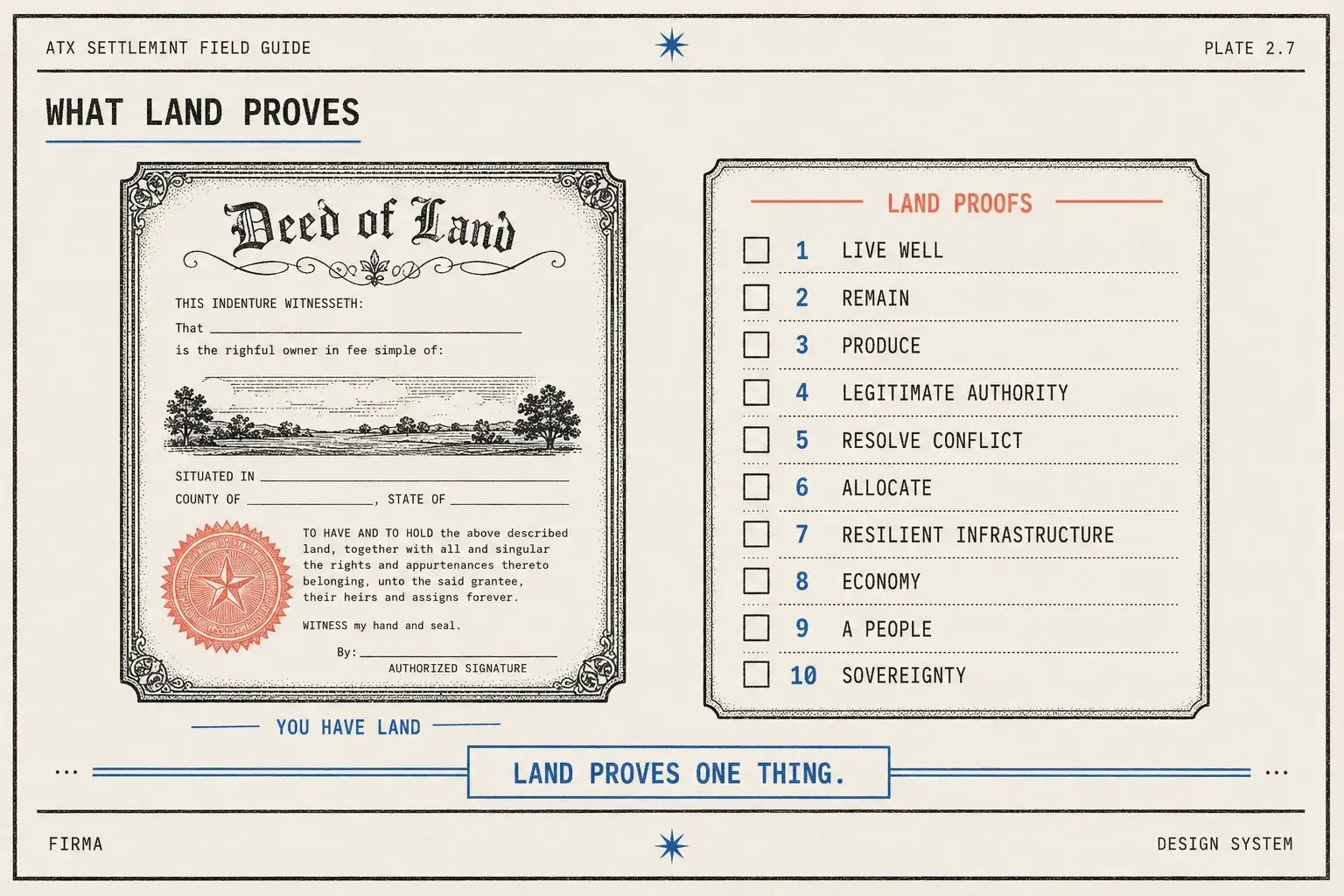
Land proves one thing: you have land.
The Settlemint question begins after a community has people and place: the network found its people, the people learned to act together, they acquired land — now what? Land does not automatically create a functioning settlement. A community may own property without having water, energy, housing, work, governance, care, production, memory, or durable institutions. This module consolidates what the publication says about land and place: what land proves, what a place must become, and what stewarding a real site actually requires. The defining treatment is in What Is a Settlemint?.
What land proves and does not prove
The published doctrine is blunt. Land does not prove:
- that people can live there well,
- that people can remain there,
- that the place can produce,
- that authority is legitimate,
- that conflict can be resolved,
- that resources can be allocated,
- that infrastructure is resilient,
- that an economy exists,
- that a people exists,
- or that sovereignty exists.
Land ownership does not prove a settlement.
Settlemints are operational human settlements, not merely parcels of land. In the proof discipline, land and physical place count as real evidence — a genuine input, stronger than a flag or a token — but an input is not the settlement. A real-estate development may provide land, buildings, and utilities without producing a people, shared purpose, governance, economy, memory, or belonging.
Site, occupied place, settlement
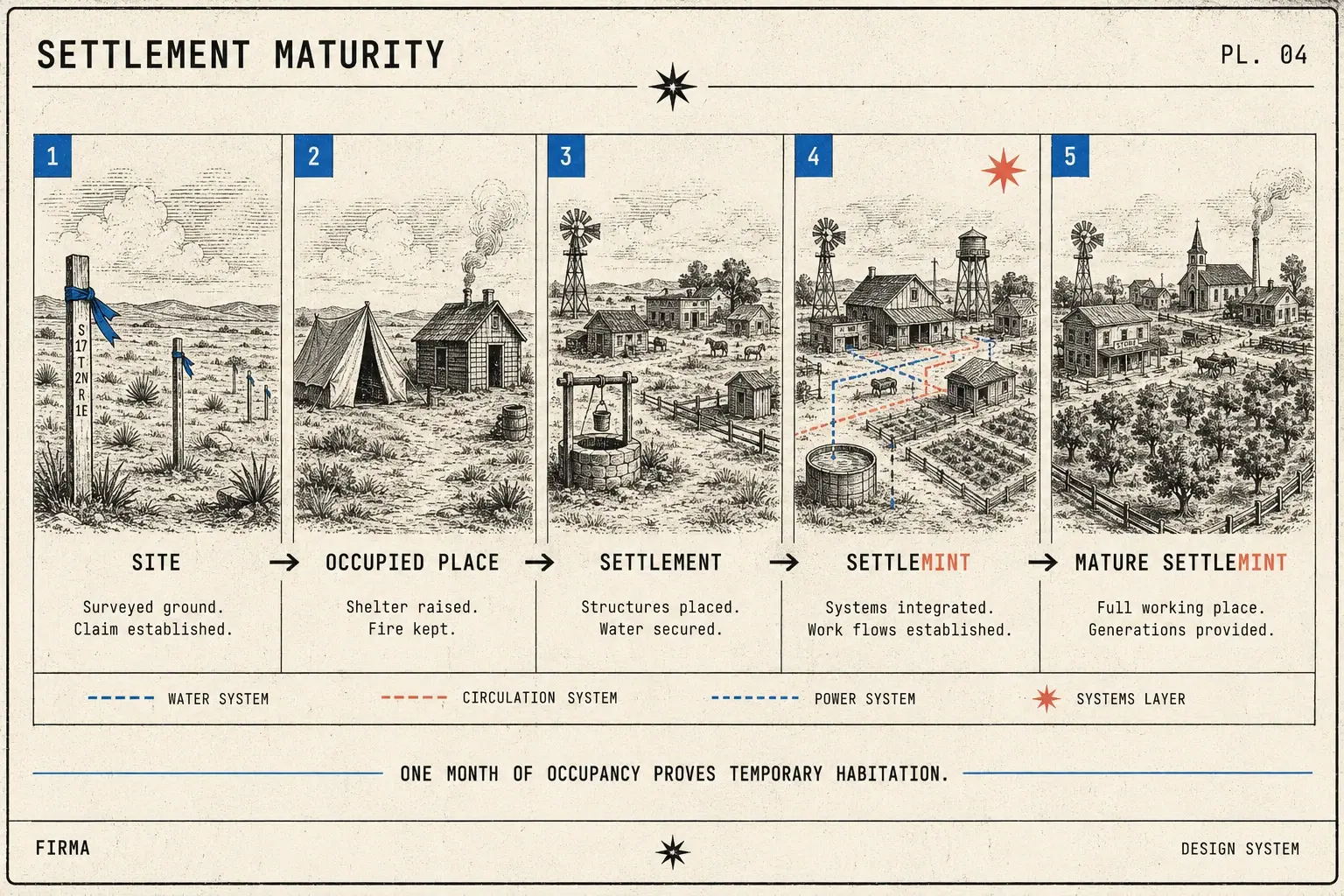
The publication separates settlement maturity from social and political maturity, and gives it its own axis:
How capable are its places of sustaining human life and shared function?
The published progression along that axis:
Site → Occupied Place → Settlement → Settlemint → Mature Settlemint
A site is not yet an occupied place, and occupation is not yet settlement — the proof discipline states the working distinction: one month of occupancy proves temporary habitation, not a durable settlement. The canon publishes the ladder and its governing question; granular criteria for each early stage remain open, to be earned as the maturity standard becomes testable. A District should not be treated automatically as the next settlement tier; it is primarily a political category that may emerge from one or more mature settlements. The full map is in From Community to Network State.
Place and habitation in the stack
Place and habitation is one of the eight domains every Settlemint must coordinate — see The Settlemint Stack. People need a real place capable of supporting life:
- land,
- housing,
- utilities,
- access,
- maintenance,
- land use,
- and the relationship between public, common, and private space.
Habitation is also one of the ten functions a credible Settlemint must increasingly demonstrate: people can stay or establish durable presence. Housing and shared infrastructure receive their own operational module; this one concerns the land and the place as such.
Stewardship of place is an operating responsibility
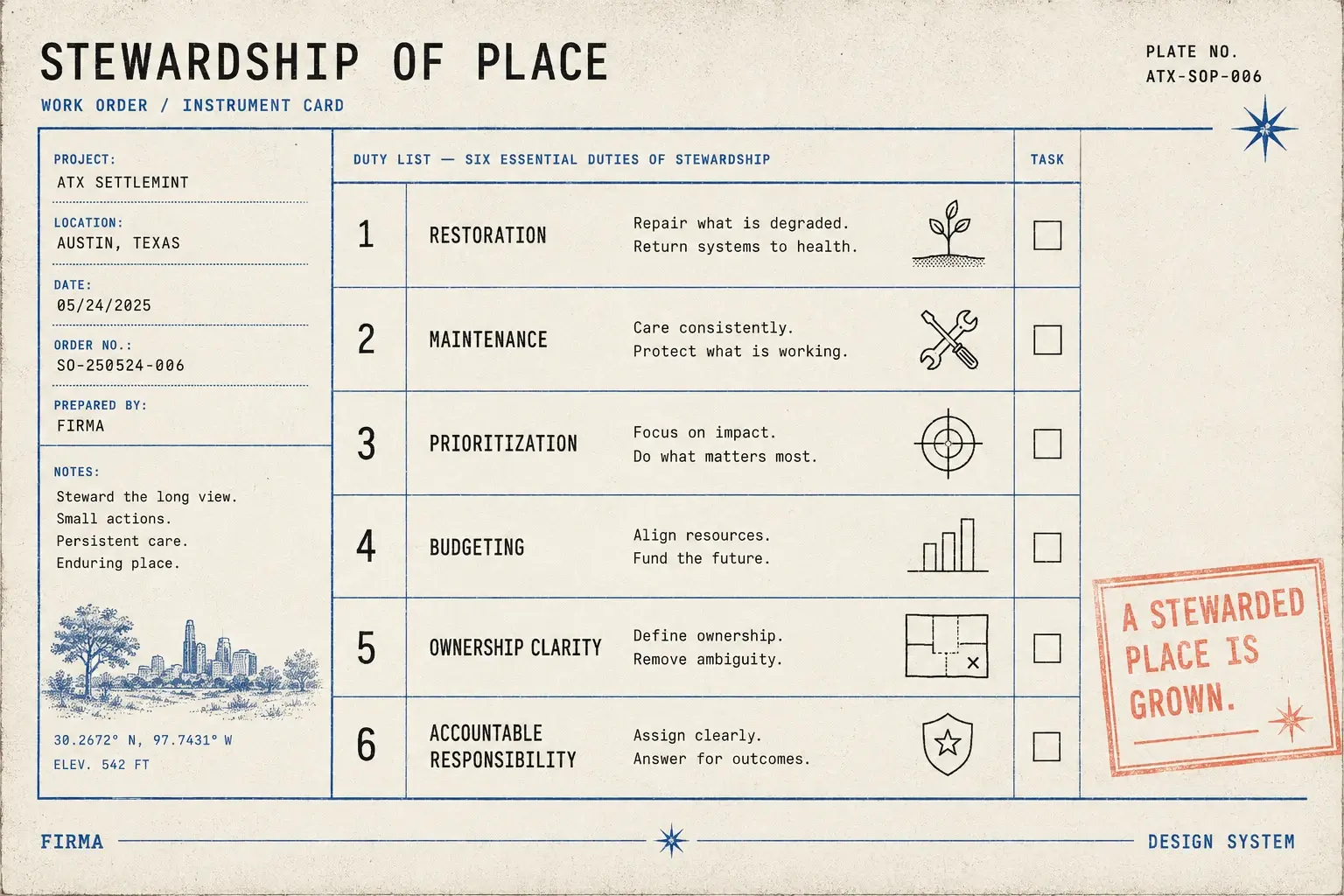
Land in a settlement is not a passive holding. The published first-systems doctrine names stewardship of place among the first systems any starting settlement must build, and states what the responsibility contains:
The land and buildings require restoration, maintenance, prioritization, budgeting, ownership clarity, and accountable operating responsibility.
Each element is load-bearing. Restoration and maintenance are continuous work, not events. Prioritization and budgeting force honest choices about what the site needs next. Ownership clarity and accountable operating responsibility mean someone answers for the land — memory of who owns what and what obligations exist is part of the settlement's memory function. And the standing distinction applies here first:
Infrastructure can be purchased. Trust, shared purpose, and institutional memory must be cultivated.
A property can be bought in a day. A stewarded place is grown. See Starting a Settlemint for stewardship of place among the first systems.
Public, common, and private space
The stack doctrine requires a settlement to work out the relationship between public, common, and private space as part of the place-and-habitation domain. The publication does not yet prescribe a typology; what it does publish is the commons discipline that governs any shared space:
A commons without stewardship becomes depletion. A commons without meaningful access becomes private infrastructure with better language.
A commons is not simply something free. It is a shared capability governed through rules, stewardship, maintenance, and legitimate access. The one worked implementation in the record is ATX's graduated access — four rings from core to edge — which resolves the tension between security and hospitality without choosing either wrong extreme: a property nobody unknown can ever approach, or a private core opened indiscriminately because the mission is generous. See the ATX case study. Beyond this, a general doctrine of spatial zoning for Settlemints remains open.
Regenerative land systems
The published first-systems doctrine includes land systems — food, water, soil, and ecological care appropriate to the actual site. The reference implementation states the constraint that generalizes:
Agriculture, soil restoration, water stewardship, landscaping, food production, and ecological care should develop according to the actual capabilities and climate of the site.
The discipline is in the qualifier. A land program copied from another climate, another soil, or another settlement's ambitions is branding, not stewardship. The published success signals for the first implementation include that the land is becoming more fruitful — fruitfulness of the actual site, not conformity to a template. Not every Settlemint requires every system at the same level; context matters.
Land within existing jurisdiction
The publication is unambiguous about what ownership legally creates:
Land ownership does not prove sovereignty.
Owning property creates legal rights within an existing jurisdiction. It does not ordinarily create independent political sovereignty over that land. Owning land may create real control — the practical ability to direct, operate, or exclude — but control does not automatically create jurisdiction or sovereignty. A community may have contractual authority over property use without possessing criminal jurisdiction over residents. A Settlemint may exist under the sovereignty of an existing country and cooperate deeply with local government; it does not need legal independence to be real.
The honest instrument here is the Authority and Autonomy Profile, whose domains include property, land use, and housing: for each, ask what the settlement has capacity, control, authority, and jurisdiction over, and who can override it. The full treatment is in What Is Sovereignty?.
What a mature land practice must prove
Land and place claims ride the same proof ladder as every other function:
Claim → Signal → Evidence → Repetition → Reliability → Institution
The published record of the first Settlemint in formation shows the discipline applied: for the place function, real land, buildings, and physical infrastructure stand as real evidence — while reliable habitation, restoration, maintenance, and sustained use remain to be proved. That is the shape of the claim for any settlement: the deed is evidence, the stewardship is the proof. A mature land practice is one where restoration and maintenance recur, habitation endures, land systems produce according to the site's capability, and responsibility for the place survives individual moments — the movement from claim toward institution described in the maturity module.
A Settlemint is proved by function in place.
Related modules
- The Settlemint Stack — place and habitation as one of the eight domains a settlement must integrate.
- Starting a Settlemint — stewardship of place and land systems among the first systems.
- The ATX Case Study — the place function on a real evidence ledger, and graduated access in practice.
✴ Last updated · Fri Jul 31 2026 00:00:00 GMT+0000 (Coordinated Universal Time)